You're probably doing what most newly engaged couples do. You've opened five venue tabs, saved a dozen Instagram posts, and started a notes app list full of words nobody explained properly. Corkage. Minimum spend. Exclusive use. Dry hire.
At first glance, it all sounds manageable. Then one venue says its price includes the room but not the bar. Another includes furniture but not staff. A third mentions “dry hire only” for part of the estate, and suddenly a romantic venue search starts to feel like reading a contract in a foreign language.
That confusion is normal. Couples often fall in love with a place long before they understand how it works on the day. Historic venues make that even more common, because beautiful old buildings often come with practical restrictions that modern hotels don't. A ruined terrace, a listed hall, or a countryside estate may offer atmosphere in abundance, but the hiring model matters just as much as the view.
If you're also weighing destination options, it can help to compare venue styles in different settings. Some couples browsing English heritage venues also explore Portugal venues with The Algarve Experience to understand how package structures vary between countries and venue types.

A useful next step is learning how to choose a wedding venue before you compare prices. The hire model changes the cost, the planning workload, and how much control you'll have.
Your Wedding Venue Search Begins
One couple I often think about started with a simple goal. They wanted somewhere historic, somewhere with character, somewhere that didn't feel like a generic function room. They found stone walls, sweeping grounds, candlelit interiors, and outdoor spaces that looked remarkable in photographs. Then the questions began.
“Does dry hire mean cheaper?”
“Does it include tables?”
“Can we bring our own caterer?”
“Who clears up afterwards?”
Those are exactly the right questions. The phrase dry hire meaning sounds technical, but it affects nearly every practical decision you'll make. It shapes your budget, your supplier list, your timeline, and how much support you'll need.
Why this term matters so early
A venue isn't just a backdrop. It's the framework for your whole wedding. If you misunderstand dry hire at the shortlist stage, you can easily compare two venues that look similar online but operate in completely different ways.
For example:
- One venue may include planning support. That can remove a large amount of decision-making.
- Another may offer the building only. You then arrange catering, bar service, staff, furniture, and setup separately.
- A heritage site may have access rules. Suppliers might need to load in during limited hours or avoid certain areas entirely.
Dry hire isn't a bad surprise. It's simply a different kind of wedding build.
That difference can be liberating for the right couple. It can also feel heavy if you were expecting an all-in-one service. Once you understand that distinction clearly, venue brochures become much easier to read.
What Exactly Is a Dry Hire Venue
The simplest definition of dry hire meaning is this: you are hiring the venue space itself, not a bundle of in-house wedding services.
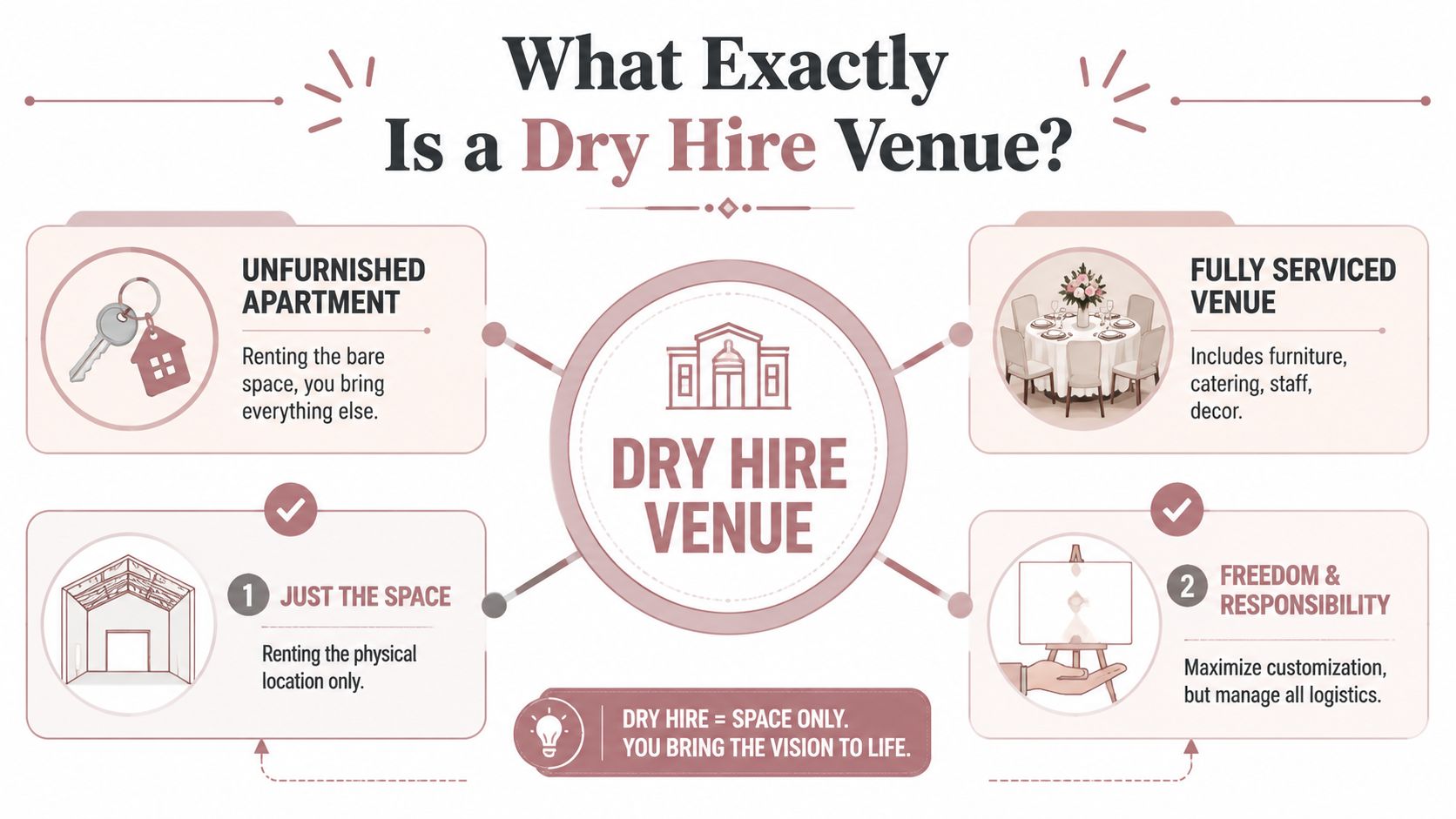
That sounds straightforward, but at a historic UK venue it has very practical consequences. If you book a medieval hall, abbey setting, or heritage estate, you may be securing exclusive use of a remarkable backdrop while arranging many of the working parts yourself. The building gives you character and atmosphere. Your suppliers make it function.
A helpful way to picture it is as hiring a beautiful shell for the day. The walls, grounds, and approved event spaces are there. The catering team, bar setup, furniture, power planning, waste collection, and timetable often come from elsewhere unless the contract says otherwise.
At heritage venues such as exclusive-use wedding venues at Battle Abbey, this distinction matters even more because the site may have conservation rules that shape what can be brought in, where suppliers can park, and how long setup can take.
What you're usually hiring
Dry hire often includes the fixed parts of the venue package:
- Use of the setting itself. This may cover the hall, terrace, gardens, or another approved area of the property.
- Agreed access times. You are usually given a setup window, event hours, and a breakdown period.
- Permission to hold the event in specific spaces. At historic sites, access is often limited to approved areas.
- The character of the venue. The architecture, grounds, and sense of place are a large part of the value.
What usually isn't included
Couples need to read closely, as dry hire often leaves out the operational pieces that make the day run comfortably:
- Catering and drinks service
- Bar staff and waiting staff
- Tables, chairs, linens, crockery, and glassware
- Sound, lighting, and AV support
- Cleaning, waste removal, and post-event clearing
- On-the-day coordination beyond opening and closing the site
- Decor setup and takedown
- Supplier scheduling and oversight
Practical rule: If it can be carried in, consumed, staffed, switched on, or cleared away, check whether you need to book it separately.
That is why dry hire can feel wonderfully flexible and unexpectedly detailed at the same time. You are not only choosing a venue. You are also choosing how much of the wedding infrastructure you will build around it.
This short video breaks down the core differences visually, which can be useful if you are comparing options with family or trying to decode venue wording in a brochure:
Historic venues often use this model for practical reasons. Listed buildings and protected sites cannot always add permanent kitchens, storage rooms, bars, or heavy production equipment in the way a modern hotel can. That restriction is not a flaw. It is part of what preserves the setting.
For couples, the question is not “is it dry hire?” It is “what must we arrange ourselves, and what rules come with this building?” At an abbey, manor, or other heritage site, ask about power supply, supplier access, noise limits, candle policies, floor protection, waste removal, and next-day collection times. Those details shape the budget just as much as the hire fee does.
Dry Hire vs Wet Hire A Direct Comparison
You visit a medieval abbey for a viewing and fall in love with the stone walls, the ruins, and the sense of history. Then you visit a country house hotel and are handed a package with catering, staff, bar service, and furniture already built in. Both are wedding venues. They ask different things of you.
That is the heart of dry hire versus wet hire.
Dry hire usually means you are hiring the setting and then building the wedding around it with your own suppliers. Wet hire usually means the venue provides the setting plus some combination of catering, staffing, drinks, furniture, and coordination. In practical terms, dry hire works more like booking an empty but beautiful stage. Wet hire works more like booking the stage with part of the cast and crew already in place.
At a heritage venue, that distinction matters even more. A listed site may offer extraordinary character but have tighter rules around kitchens, open flame, heavy equipment, access times, and supplier setup. A modern full-service venue is often designed to handle those needs in-house from the start.
Dry Hire vs Wet Hire At a Glance
| Feature | Dry Hire | Wet Hire (Full-Service) |
|---|---|---|
| What you book | The venue space itself | The venue plus selected services |
| Starting quote | Usually simpler, with fewer elements included | Usually higher, because more is bundled in |
| Creative control | Broad freedom over suppliers, menu, styling, and flow | More structured, with venue-led options |
| Planning responsibility | Mostly with you and your planner | More shared with the venue team |
| Supplier choice | Usually wider | Often limited to approved or in-house teams |
| Cost visibility | Spread across separate contracts and invoices | Often easier to read in one package |
| Best suited to | Couples who want to shape each layer of the day | Couples who want more support built in |
The easiest way to separate the two is to ask one question: who is solving the wedding-day logistics?
With wet hire, the answer is often the venue for a large part of the day. With dry hire, the answer is usually a mix of you, your planner, and your chosen suppliers. That does not make dry hire harder in every case. It makes it more custom-built.
For weddings at places such as abbeys, manor houses, and other protected properties, the comparison should go beyond the brochure. Ask for a side-by-side list of what is included, what is permitted, and what must be brought in. A dry hire fee can look modest until you add generators, catering tents, extra staff, loo trailers, glassware, waste removal, and overnight security if the site requires it. A wet hire package can look higher at first, but some of those costs may already be covered.
The emotional difference matters too. Dry hire often suits couples who want the wedding to feel authored from the ground up. Wet hire often suits couples who want decisions narrowed into a framework that already works well in that building.
Neither route is automatically better value. The right fit depends on how much freedom you want, how much coordination you are comfortable handling, and how the venue itself operates.
If you are comparing private estate settings and heritage properties, it helps to read about exclusive use wedding venues at the same time. Exclusive use tells you whether the place is yours. Dry or wet hire tells you how much of the wedding infrastructure comes with it.
The Pros and Cons of Choosing Dry Hire
A couple books a dramatic historic venue, perhaps a site with ancient stone walls, open grounds, and very little built-in event infrastructure. The hire fee looks reasonable. A month later, they realise they also need a catering setup, extra lighting, power planning, waste collection, furniture, and a clear schedule for every van arriving through a restricted access point.
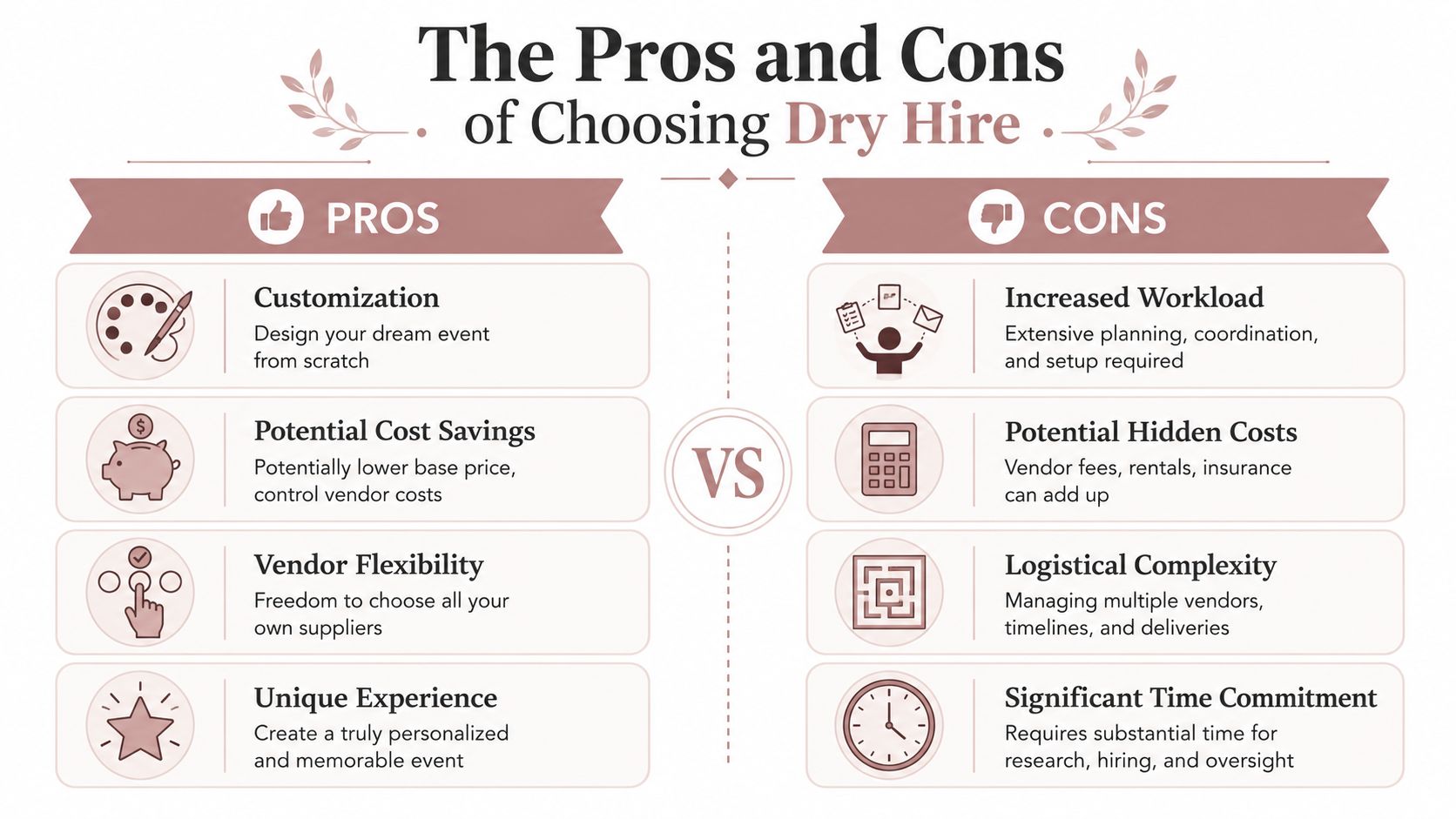
That is the primary trade-off with dry hire. It gives you room to create a wedding that feels wholly your own, but it also asks you to build more of the machinery behind the day.
Why couples love it
Dry hire appeals to couples who want the wedding to reflect their priorities rather than a preset format. It works especially well when the venue itself is the star, as it often is with abbeys, manor houses, and other heritage properties where character matters more than package convenience.
You may find dry hire attractive if you want:
- A menu with personality, such as a hog roast, barbecue, sharing feast, or culturally specific catering
- Your own choice of suppliers, rather than a tightly controlled in-house team
- Greater design freedom across furniture, lighting, bar style, and flow of the day
- A wedding with a distinct atmosphere that does not feel like a repeat of the last event held there
There is also an emotional benefit. Some couples want to feel they commissioned the day piece by piece, the way you might furnish a period home carefully rather than move into a fully serviced apartment. Dry hire suits that mindset beautifully.
Where the pressure shows up
The extra work rarely sits in the obvious places. It tends to appear in logistics, timing, and responsibility.
At a historic venue in the UK, those questions can become quite specific. Which gate may suppliers use? Are there limits on vehicle weight across old grounds? Can candles be used indoors? Is there enough power on site for catering and band equipment, or does a generator need to be brought in? Who stays at the end of the night to supervise collection, rubbish, and site sign-off?
Those details matter because heritage venues often operate with tighter rules than modern event spaces. Battle Abbey, for example, is memorable precisely because it is historic. That same history can affect access, preservation rules, noise limits, and what may be attached, lit, or installed on site.
Costs that are easy to miss
A lower venue hire fee does not tell you the full cost of the wedding.
Extra spending often appears through:
- Supplier transport and longer travel times, especially for rural or restricted-access sites
- Temporary infrastructure, such as mobile kitchens, generators, heating, or loo trailers
- Bar and staffing arrangements, including corkage, licence questions, and late-night service
- Setup and clear-down labour, particularly when multiple suppliers work in sequence
- Venue protection measures, such as matting, security, or stricter waste removal procedures
Dry hire can leave couples feeling caught out. The venue itself may be excellent value, but the event you build inside it has many moving parts. At a heritage property, dry hire works a little like hiring an empty historic house for a dinner party. The setting is extraordinary, but you still need to bring in the tables, the kitchen plan, the staff, and the method for leaving everything exactly as you found it.
The more freedom you choose, the more coordination you need to fund, schedule, or hand to a planner.
A practical way to assess dry hire is to review the headline fee beside the exclusions list and supplier requirements. If you are comparing East Sussex options, it helps to look at wedding venue prices and what they include rather than judging value by the hire figure alone.
Making the Right Choice Your Dry Hire Decision Guide
A dry hire venue can feel wonderful at first glance. Then a critical question appears. Do you want the freedom to build the day piece by piece, or would you rather arrive at a venue where more of the structure is already in place?
That choice matters even more at a historic property in the UK. A venue such as Battle Abbey Weddings may offer extraordinary character, but heritage sites often come with stricter rules on access, sound, candles, deliveries, and how the grounds are protected. The setting is memorable because it has been carefully preserved. Your plans need to fit that framework.
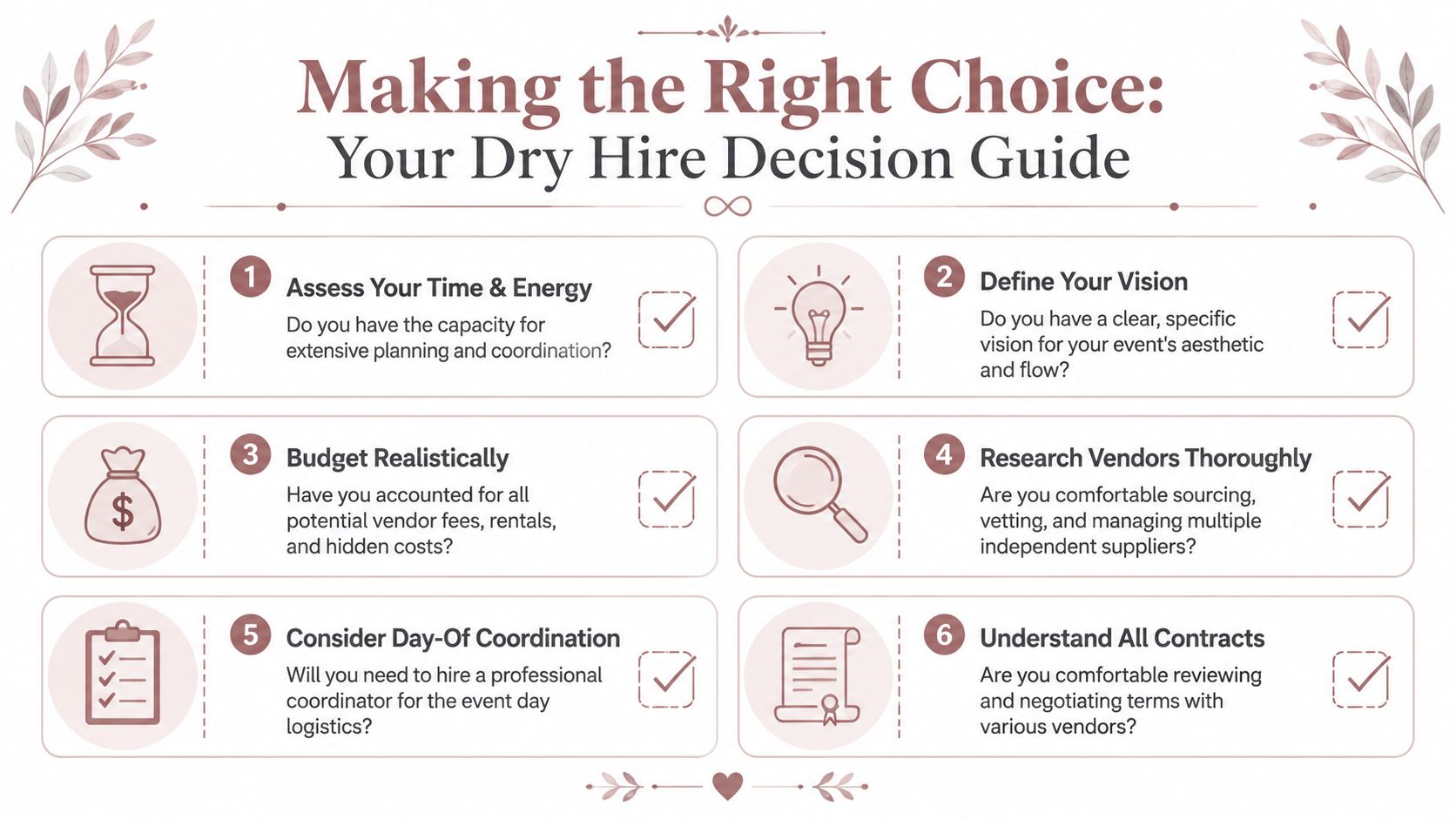
Who tends to do well with dry hire
Dry hire usually suits couples who enjoy shaping details and making decisions with purpose.
You may be well matched to it if you are:
- Comfortable with planning admin. Supplier quotes, schedules, and approval steps do not put you off.
- Clear on the atmosphere you want. You have a strong view on food, layout, styling, or cultural traditions.
- Working around specific requirements. A dry hire format can be easier when you need specialist caterers, custom timing, or a non-standard flow to the day.
- Ready to bring in support. A planner or on-the-day coordinator can hold the practical side together.
A first dance is a good comparison. Some couples are happy to practise and shape every step themselves, while others prefer guided structure. If that part of wedding planning feels familiar, this kind of guidance for a perfect wedding first dance mirrors the same principle. Freedom feels far better when it comes with expert help.
Who may prefer a fuller package
Some couples want choice, but not dozens of operational decisions.
If your work is already demanding, if you dislike chasing suppliers, or if you want one team to carry more of the logistics, a venue with a fuller package may be the calmer option. That is not a lesser choice. It is often the wiser one.
Checklist for a historic dry hire venue
At a heritage venue, ask for the working picture in writing. Beautiful photographs rarely show the practical limits that shape the day.
What is included in the hire fee
Ask for a plain list of rooms, furniture, staffing, cleaning, setup time, and clear-down time.Which parts of the site are protected or restricted
Historic interiors, ruins, terraces, and formal lawns may have rules about flames, fixings, confetti, sound levels, and guest numbers.How does supplier access work
Check unloading routes, parking distance, vehicle limits, gate hours, and whether suppliers need to carry items across uneven ground.What infrastructure already exists
Confirm power supply, water access, catering prep areas, refrigeration options, and toilet provision before you book outside suppliers.Who is responsible for waste, security, and end-of-night clear-down
At many dry hire venues, those jobs sit with the hirer or hired team unless the contract says otherwise.What approvals are needed before the wedding day
Some heritage venues want method statements, risk documents, or supplier sign-off in advance, especially for marquees, production, or large installations.What happens if the weather changes the plan
This matters at estates with outdoor ceremony spaces, uneven paths, or limited indoor backup options.
One simple test helps. If you can explain to a friend exactly how the day will be built, from supplier arrival to final collection, you probably understand the venue well enough to make a good decision. If that picture still feels hazy, ask more questions before signing.
Dry hire works like hosting in a grand historic house rather than booking a private dining room. The setting gives you atmosphere and flexibility. You still need a clear plan for how every part of the celebration arrives, operates, and leaves the site with care.
Crafting Your Perfect Day With Confidence
You are standing in a beautiful historic venue, looking at ancient stone, open lawns, and rooms full of character. Then the practical question arrives. Who is bringing the power distribution, the catering setup, the extra lighting, the staff to clear at the end, and the plan if the weather turns? That is the moment dry hire stops being an abstract term and becomes a planning choice.
By this stage, the goal is not merely to fall in love with a setting. It is to understand how the day will operate there, especially at heritage venues where charm and constraint often sit side by side. A place like Battle Abbey can offer atmosphere that is hard to match, but historic sites also tend to come with tighter rules, stricter protection of the grounds, and less built-in infrastructure than a modern hotel.
Dry hire works like hosting a celebration in a treasured family estate. You are given the setting, and then you assemble the day around it with care. That freedom can produce a wedding that feels personal. It also means the contract needs to be read closely, because responsibilities are often shared across the venue, your suppliers, and you as the hirer.
A sensible way to approach this is to treat the agreement as an operating map, not just a booking form. Check who is responsible for insurance, deliveries, equipment removal, damage, supplier compliance, and what happens if part of the setup cannot go ahead. At a historic venue, ask one more layer of questions. Are there limits on candles, amplified music, vehicle access, ground protection, or installation methods that could change your design or budget?
That is where confidence comes from. Not from having fewer decisions, but from knowing which decisions matter.
If you are close to choosing dry hire, use this short final sense-check:
- Can we picture the full day from first supplier arrival to final clear-down
- Do we know which heritage restrictions could affect style, timings, or cost
- Have we allowed for the hidden practical spend, such as power, toilets, waste removal, security, flooring protection, and staffing
- Do we have a planner, coordinator, or trusted supplier team to handle the detail well
If those answers feel clear, dry hire can be a wonderful fit. If they still feel foggy, that usually means you need more detail before signing, not that the venue is wrong.
And once the venue plan feels settled, many couples enjoy turning back to the guest-facing moments that bring warmth to the day. If your list still includes the first dance, this guidance for a perfect wedding first dance is a helpful next read.
A wedding should feel graceful on the day because the practical parts were handled early. That is especially true at historic venues, where the magic is real, but so are the logistics. As noted earlier, Battle Abbey Weddings is a useful example of why understanding the hire model matters just as much as loving the backdrop.