More than just a schedule, your wedding order of service is your guests' guide to the ceremony. Think of it as the script that welcomes everyone, explains special traditions, and introduces the key people standing with you as you say “I do”. For many, it will also become a cherished memento of your day.
The Heartbeat of Your Ceremony
The order of service is far more than a simple list of events; it's the narrative soul of your ceremony. It transforms a series of moments into a cohesive story, guiding your guests emotionally and logistically from the opening procession to that final, joyful walk back down the aisle.
This little booklet is often your guests' first real glimpse into the personality of your day. It sets the tone, whether you're aiming for something formal and traditional or relaxed and contemporary. It's also an incredibly practical tool, letting guests know when to stand, sing, or simply soak in a beautiful reading. It ensures everyone feels included, present, and connected to the promises you are making.
Why It Matters More Than You Think
A well-crafted order of service makes a huge difference to your guests' experience. It quietly answers their questions, preventing any confusion and allowing them to fully relax and engage with the proceedings.
It really comes down to a few key things:
- Participation and Inclusion: It’s your way of inviting guests to join in with hymns, responses, or any unique rituals you've planned.
- Introducing Key People: It gives context to your wedding party, readers, and musicians, properly honouring the role they’re playing in your day.
- Explaining Traditions: If you're blending cultures or including symbolic acts that might be unfamiliar, the order of service can offer a brief, welcoming explanation.
- Creating a Lasting Memento: You’ll find that many guests, especially close family, will keep your order of service as a treasured keepsake.
A thoughtfully designed order of service is one of the most effective ways to make your guests feel truly welcome. It’s a tangible piece of your wedding that says, "We're so glad you're here to witness this, and we want you to be a part of every moment."
Ultimately, this document is a reflection of your care and attention to detail. At a historic venue like Battle Abbey, where the setting itself tells such a powerful story, your order of service becomes a complementary chapter. It bridges the gap between the grand history of the space and the personal history you are just beginning to create. It’s a small detail that makes a huge impact.
What to Include in Your Wedding Order of Service
Think of your order of service as more than just a schedule. It’s the story of your ceremony, written down for your guests. It guides them through the most important moments of the day, so they can feel truly part of it. While every wedding is different, there are a few key pieces of information that make all the difference.
Let's start with the first impression: the cover. It sets the tone before anyone even takes their seat, so it should be beautiful, clear, and reflect the style of your day.
Getting the Basics Right: The Cover and Welcome
The very first page inside your booklet should feel like a warm hug. A simple welcome note is a lovely way to thank your guests for being there and to make them feel immediately included. It’s a small touch that goes a long way.
You’ll want to repeat the essential details from the cover, just to confirm everyone is in the right place at the right time.
- The Cover Essentials: Keep it simple and elegant. At a minimum, include your full names, the date of your wedding, and the venue. For example: "The Wedding of Amelia and Thomas, 21st September 2025, Battle Abbey".
- A Welcome Note: Just inside, a short, heartfelt message makes all the difference. Something like: "Welcome to our wedding! We are so overjoyed to share this special day with you, our most cherished family and friends. Thank you for travelling to be with us as we start our life together."
- The Wedding Party: This is your chance to introduce the key people standing beside you. Listing the parents of the couple, bridesmaids, groomsmen, ushers, and anyone with a special role helps guests put names to faces and is a lovely way to honour them.
Mapping Out the Ceremony
This is the heart of your order of service. It’s a simple, chronological guide to the ceremony itself, showing guests what to expect and when. This isn't about giving a word-for-word script, but about providing a clear roadmap from the moment the music begins to the final cheer as you walk back down the aisle.
Having this structure helps everyone relax and feel fully present for each part of the proceedings.
A well-structured order of service does more than just inform; it builds anticipation. By outlining the key moments like readings, vows, and musical pieces, you invite guests to invest emotionally in each part of the ceremony, making the experience richer for everyone involved.
For many couples, writing their own vows is the most personal part of the day. If you're looking for a little help getting started, you can find brilliant advice on how to write wedding vows to get your feelings down on paper.
Music, Readings, and Personal Touches
Your choice of music and readings is what really injects your personality into the ceremony. Listing them in your order of service is not only practical, but it also gives credit to musicians and readers, and highlights the meaning behind your choices.
You might want to add a small note explaining why a particular song or poem is special to you as a couple. It’s a beautiful, personal touch that your guests will love. If you're still piecing together your ceremony soundtrack, our guide to creating the perfect wedding music playlist is packed with inspiration.
To make things really clear for your guests, here's a simple breakdown of the essential elements to include.
Essential Elements for Your Order of Service
| Component | Purpose and What to Include | Pro Tip |
|---|---|---|
| Processional Music | The music that accompanies the entrance of the wedding party. Name the song and artist/composer. | Note if it's a live performance, e.g., "Canon in D by Pachelbel, performed by The Sussex String Quartet." |
| Readings | Include the title of the reading and the name of the author, followed by the reader's name. | You can add a short sentence about why you chose this reading if it has a special meaning to you. |
| Exchange of Vows | Simply state "The Exchange of Vows and Rings". You don't need to print your entire vows. | This creates a moment of intimacy and encourages guests to listen intently rather than read along. |
| Recessional Music | The upbeat song played as you exit as a married couple. List the song and artist. | This song sets a celebratory tone for the rest of the day, so choose something that makes you both smile! |
Finally, don't forget a simple "Thank You" on the back. It’s the perfect way to close the booklet. You can thank everyone for their presence and support, and maybe add a little note about what’s happening next, like where the drinks reception is. It’s a final touch that leaves everyone feeling warm and appreciated.
Adapting Your Order of Service for Civil, Religious, or Humanist Ceremonies
Your order of service isn't a one-size-fits-all document. Far from it. It’s a reflection of the unique ceremony you've chosen, and the structure, tone, and content will shift dramatically depending on whether you're having a civil, religious, or humanist celebration. Getting this right is what turns the booklet from a simple schedule into a genuine guide for your guests, helping them connect with every single moment.
The landscape of UK weddings has changed so much, and this directly influences how you’ll likely structure your order of service. In 2023, civil ceremonies accounted for a dominant 85.7% of all marriages in England and Wales. That's a huge slice of the pie, up from 83% just the year before. In contrast, religious ceremonies fell to just 14.3%, with church weddings at an all-time low. This trend shows a real move towards more flexible, personalised ceremonies, which your order of service can beautifully reflect. You can see the full breakdown in the full 2023 report.
This diagram shows the typical flow of a wedding order of service, guiding guests from the cover, through the ceremony, and on to the party.
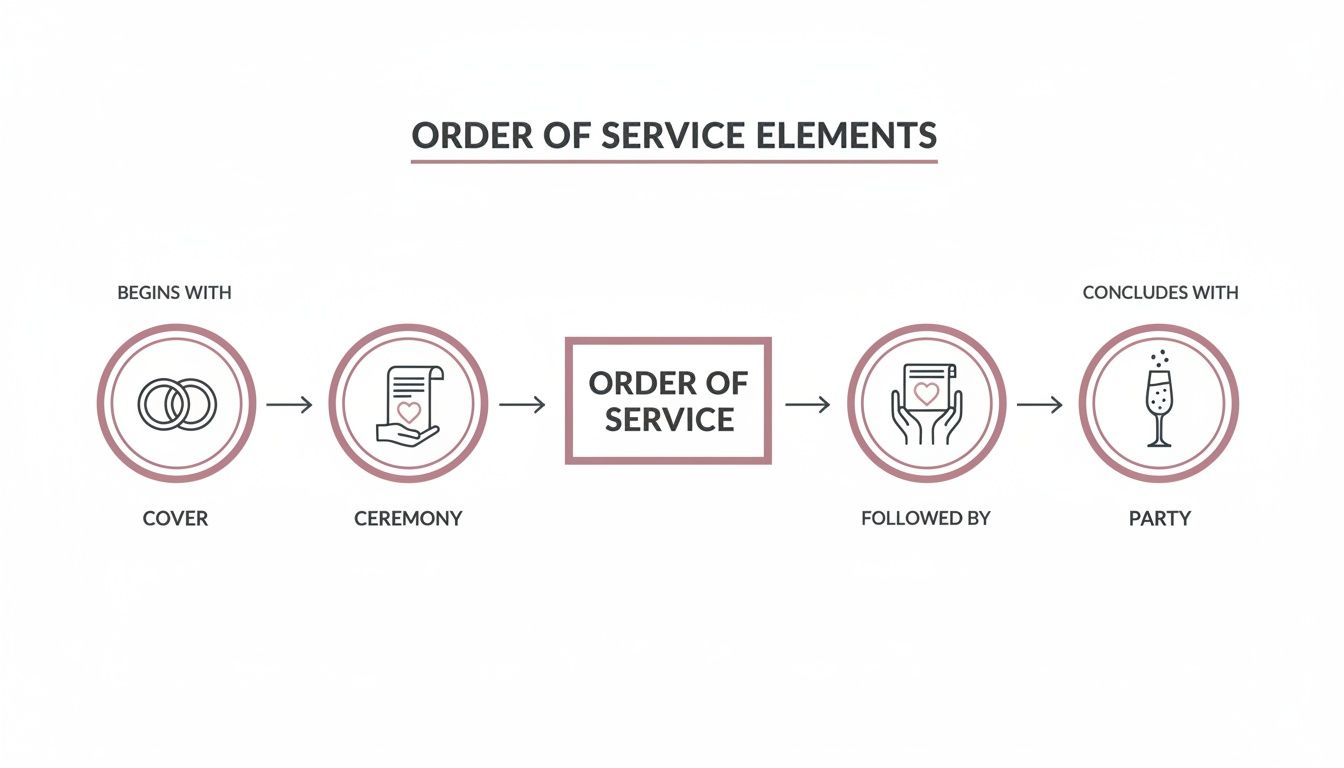
You can see how the booklet acts as a roadmap, taking everyone on a journey from the formal beginning of the day to the more relaxed celebration that follows.
Crafting a Guide for a Civil Ceremony
A civil ceremony, whether it's in a registry office or a licensed venue like Battle Abbey, follows a specific legal framework. Your order of service needs to outline this structure clearly, but it’s also the perfect place to highlight the personal elements you’ve woven in. While the focus is on the legal declarations, there's plenty of room for your personality to shine through.
The parts you can’t change are the declaratory and contracting words. These are the legally binding phrases you must say. In your booklet, you can simply list these as "The Declarations" and "The Vows" without printing the full text. This keeps the focus on the moment you actually speak them.
Here’s where you get to make it your own:
- Music: You have complete freedom here, as long as there's no religious content. Make sure to list the songs for the entrance (processional), the signing of the register, and your grand exit (recessional).
- Readings: This is a chance to choose poems, passages from books, or even song lyrics that mean something special to you. Your order of service should include the title of the reading and, of course, the name of the person delivering it.
- Personal Vows: Many couples add their own personal promises after the legal declarations are done. Your booklet can simply note this as "Exchange of Personal Vows."
A typical civil ceremony order might flow something like this:
- Entrance of the Bride/Groom/Couple
- Welcome and Introduction by the Registrar
- First Reading
- The Declarations (Legal Vows)
- Exchange of Rings
- Second Reading
- Signing of the Schedule
- Pronouncement of Marriage
- Exit of the Couple
Top Tip: Use your order of service to explain why you chose a particular reading or song. A short, one-sentence note—like, "We chose this poem as it was the first one we read together"—adds a beautiful layer of intimacy that guests really appreciate. For more on this style, check out our guide to planning a registry office wedding.
Structuring a Traditional Religious Service
For a religious ceremony, like one in the Church of England, the order of service becomes an essential tool for everyone to participate. The structure is more formal and includes liturgical elements, hymns, and prayers that might be unfamiliar to some of your guests. A well-designed booklet helps everyone follow along and feel properly included.
Your vicar or priest will guide the content, but you’ll have choices for hymns, readings, and music. A key job for the booklet here is to print the full lyrics for any hymns so the whole congregation can join in with confidence.
Key components often include:
- The Entrance Hymn: The first big moment for congregational singing.
- Prayers and Blessings: These will be led by the officiant at various points.
- Bible Readings: You'll typically choose at least one meaningful reading from the Bible.
- The Sermon or Address: A short, personal talk from your officiant.
- The Blessing of the Marriage: The final prayer over you as a couple.
Clearly labelling each part of the service is crucial. For instance, instead of just writing "Hymn," specify "Congregational Hymn: All Things Bright and Beautiful." This kind of clarity makes the service feel accessible and welcoming to all your guests, no matter their faith background.
Personalising a Humanist Ceremony
Humanist ceremonies are all about personalisation. There’s no set script, which means your wedding order of service is a blank canvas to tell your story. The booklet becomes more than a guide; it’s a narrative of your relationship and shared values. This is where you can get really creative.
A humanist order of service often includes elements that share the story of the couple. You might want to include a section titled "Our Story" with a short paragraph about how you met. It’s also the perfect place to explain any symbolic acts you've chosen to include.
Consider adding unique elements like these:
- The couple’s story: Often shared by the celebrant, this is a central, heartfelt part of the ceremony.
- Symbolic rituals: Explain the meaning behind a handfasting, a sand ceremony, or the lighting of a unity candle.
- Contributions from friends and family: Acknowledge anyone who is sharing a story, a memory, or a special wish.
- Promises to each other: These are entirely your own words, reflecting your hopes and dreams for the future you'll build together.
The sheer freedom of a humanist ceremony means your order of service can be as detailed or as simple as you like. It is your opportunity to guide guests through a ceremony built entirely around you as a couple, making every single moment feel intentional and deeply meaningful.
Design Inspiration for a Memorable Keepsake
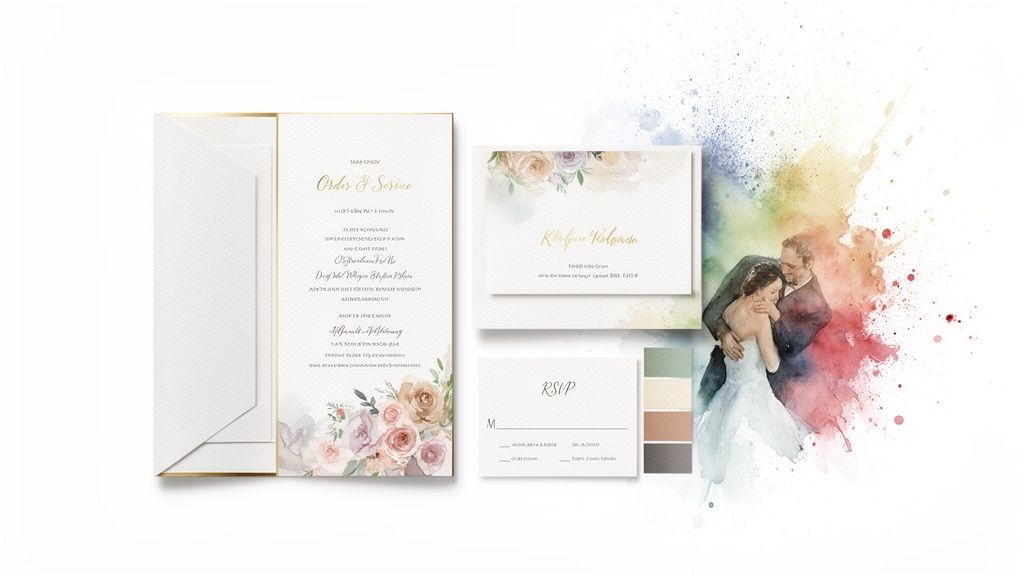
Your order of service is so much more than a schedule of events; it's a tangible piece of your day that guests will hold in their hands. The design is a wonderful chance to express your personality and create a beautiful memento that people will want to keep long after the confetti has settled.
The key is to create a cohesive look that feels connected to your wider wedding theme. This doesn’t mean everything has to match perfectly, but there should be a common thread tying your stationery together, from the invitations to the menus. It’s about creating a unified visual story.
Reflecting Your Venue and Theme
The best place to start finding your design direction is to look at your surroundings. A venue with a strong character, like the historic ruins and grand halls of Battle Abbey, provides a rich source of inspiration. Think about incorporating elements that echo the architecture, the textures, or even the history of the location.
This can be brought to life through a few thoughtful choices:
- Typography: A classic serif font or an elegant calligraphy script can evoke a sense of timeless romance, perfectly suited to a historic setting.
- Illustrations: A simple, tasteful line drawing of the Abbey on the cover is a beautiful personal touch. It instantly connects the booklet to the day.
- Colour Palette: Draw colours from your floral arrangements, bridesmaid dresses, or even the natural tones of the venue’s ancient stone and gardens.
Thinking of the booklet as a small gift for your guests can elevate your approach. If you're looking for other ways to add a personal touch, exploring unique handmade wedding gift ideas can spark some fresh inspiration for design elements.
A great design tells a story without saying a word. When a guest picks up your order of service, the feel of the paper and the style of the font should immediately immerse them in the atmosphere you’ve so carefully created for your wedding day.
Ultimately, you want something that feels authentic to you. If your style is more modern and minimalist, clean sans-serif fonts and a simple layout will feel right, even in a traditional venue. It’s all about finding that perfect balance.
Choosing Paper and Print Finishes
The tactile experience of your order of service is just as important as how it looks. The weight and texture of the paper you choose can make a significant impact, instantly conveying a sense of quality and care.
Think about the feeling you want to evoke. A thick, textured card with a deckled edge lends itself to a rustic, romantic theme. In contrast, a smooth, heavy card stock with a matte finish feels more contemporary and polished. Don't be afraid to ask your stationer for samples so you can feel the different options for yourself.
Once you’ve settled on the paper, a special print finish can take the design to the next level. These little touches can transform a simple design into something truly memorable.
Popular finishing options include:
- Foil Stamping: Adds a touch of metallic shine, perfect for names or a simple motif. Gold, silver, and rose gold are classic choices.
- Letterpress: This technique presses the design into the paper, creating a beautiful, subtle texture that feels incredibly luxurious to the touch.
- Embossing: The opposite of letterpress, this raises the design from the paper for a tactile, three-dimensional effect.
These special finishes do come at an extra cost, so it’s important to factor them into your budget. But even a small detail, like your initials in foil on the cover, can make your wedding order of service feel exceptionally special and thoughtfully designed.
Getting Your Timeline, Printing, and Distribution Right

Once you’ve settled on the creative side of things, it’s time to tackle the practicalities. This is where a little forward planning makes all the difference, helping you avoid any last-minute stress. A clear timeline is your best friend, ensuring your beautifully designed booklets are finalised, printed, and ready for your guests well before the big day.
The easiest way to approach this is to work backwards from your wedding date. It breaks the whole process down into manageable chunks and makes it all feel far less daunting.
Nailing Down Your Production Timeline
The absolute key to a smooth process is getting your ceremony details finalised as early as possible. You simply can’t send anything to print until every reading, piece of music, and name has been confirmed with your celebrant or officiant. Once you have that locked in, you can start on the logistics.
Here’s a practical timeline that I’ve seen work for countless couples:
- 10-12 Weeks Out: Confirm every last detail of the ceremony. This means the final wording for readings, the names of everyone involved, and the exact sequence of events.
- 8 Weeks Out: Book your professional printer. Good stationers get incredibly busy, especially during peak wedding season, so get your slot secured early.
- 6 Weeks Out: Send your final text and design files over to the printer. This gives them plenty of time to work their magic without rushing.
- 4 Weeks Out: Receive and approve the final proof. This is a non-negotiable step. It’s your last chance to catch any mistakes.
The final proofread is probably the most critical checkpoint. I always advise couples to ask a trusted friend or family member—someone not involved in the nitty-gritty of planning—to read it through. A fresh pair of eyes is invaluable for spotting typos or grammatical errors you’ve read a dozen times and missed.
Having the finished booklets in your hands about a month before the wedding is a great feeling. It’s one more important detail ticked off the list. To see how this fits into the bigger picture, you can explore our complete wedding day timeline template.
Professional Printing vs. DIY
The choice between hiring a professional printer and doing it yourself usually comes down to three things: budget, time, and the quality you’re aiming for. Both routes have their pros and cons, and the right choice is entirely personal to you as a couple.
Professional Printing
- Pros: You’re guaranteed a high-quality, polished finish. Professionals have access to beautiful papers, special inks, and stunning techniques like foil stamping or letterpress. Crucially, it saves you a huge amount of time and effort.
- Cons: It’s definitely the more expensive option, and you are tied to the printer's production schedule.
The DIY Approach
- Pros: This gives you total creative control and can be very friendly on the wallet. It’s a wonderful option if you love crafting and want to add a genuinely personal, handmade touch to your wedding.
- Cons: Be warned, it can be incredibly time-consuming and requires a fair bit of patience and a good home printer. It can also be tricky to get that truly professional look without the right tools.
Your Day-Of Distribution Strategy
The final piece of the puzzle is actually getting the order of service into your guests' hands. A simple, smooth distribution plan means everyone has their copy before the ceremony begins, contributing to a seamless experience for all.
This is especially helpful in the UK, where between 62-77% of couples now host their ceremony and reception at the same venue. That all-in-one day makes a clear schedule even more valuable for guests as they move from the vows to the celebratory drinks.
You have two main options here:
- Have Ushers Hand Them Out: Ask your ushers or other helpers to give a booklet to each guest as they arrive and take their seats. It’s a lovely personal touch and ensures no one is missed.
- Place Them on Seats: Alternatively, simply place one on each chair before guests enter the ceremony space. This is very efficient and guarantees everyone has one waiting for them.
So, how many should you order? A good rule of thumb is one per couple or household, plus an extra 10-15%. This covers single guests and gives you spares for the wedding party, your photographer, and of course, a few precious keepsakes for you to treasure afterwards.
Your Wedding Order of Service Questions Answered
Even the most perfect wedding plan has a few last-minute questions that pop up. When it comes to your order of service, those final little details can make all the difference.
Think of this as your go-to guide for sorting out those practical bits and pieces. Here are the straightforward answers to the questions we hear most often.
How Many Orders of Service Should We Order?
Trying to land on the right number can feel like a bit of a guessing game, but there’s a simple rule of thumb that always works a treat. Plan for one booklet per couple or household, and then add an extra 10-15% on top.
This little buffer is brilliant. It ensures any single guests get their own copy, and it leaves you with spares for the key people like your officiant, photographer, and the wedding party. Crucially, it also means you’ll have a few pristine copies left over as keepsakes for yourselves. It’s always, always better to have a small stack left than to realise you’re one short.
What’s the Difference Between an Order of Service and an Order of the Day?
This is a really common point of confusion, but the distinction is actually quite simple.
- An Order of Service is all about the ceremony itself. It’s the nitty-gritty of the formal proceedings – detailing the procession, readings, vows, music, and the final walk back down the aisle.
- An Order of the Day, on the other hand, is the bigger picture. It gives a timeline for the entire celebration, from the ceremony and drinks reception right through to the wedding breakfast, speeches, cake cutting, and the party.
A lot of couples, especially when the whole celebration is happening in one place like Battle Abbey, decide to merge the two. A popular approach is a multi-page booklet with the ceremony details up front, followed by a timeline for the rest of the day’s events on the back page.
Think of it this way: the Order of Service is the script for the main act, while the Order of the Day is the programme for the whole show. Putting them together creates a single, indispensable guide for your guests.
When Should We Hand Out the Order of Service?
Timing is everything here. You really want your guests to have their copy in hand before the first notes of the processional music begin.
The most popular and effective way is to have ushers or a couple of designated helpers hand them out as guests arrive and are shown to their seats. It’s a lovely, personal touch and a warm welcome. Alternatively, you can simply place a booklet on each seat before anyone enters the ceremony space. This is super efficient and guarantees no one gets missed.
Do We Need an Order of Service for a Small, Intimate Wedding?
For a smaller gathering, it's not what you'd call strictly essential. It's much easier to guide guests and communicate what's happening when there are fewer people. That said, an order of service is still a truly wonderful touch.
For an intimate wedding, it really elevates the sense of occasion, making the ceremony feel even more special and thoughtfully planned. It also becomes a beautiful memento for your closest family and friends, honouring their presence at such a significant moment. Regardless of your wedding’s size, it’s a lovely way to make sure everyone feels completely included in the ceremony you've so carefully created.
At Battle Abbey Weddings, we believe every detail of your day should be as unique as your love story. Our historic venue provides a breathtaking backdrop for your ceremony, and our dedicated team is here to help you plan every moment to perfection. Discover how we can bring your dream wedding to life by exploring our remarkable venue.