A Church of England wedding in 2026 has a fixed legal fee of £605 in your home parish or £723 if you're marrying outside it. That means the ceremony itself is often far more affordable than couples expect, but the total church wedding cost usually rises once you add music, flowers, logistics, and a separate reception.
If you've just got engaged, there's a good chance you're holding two ideas at once. One is the emotional picture: walking into a beautiful church, hearing the first notes of the music, seeing family in the pews. The other is the practical question that lands almost immediately after: what is this going to cost us?
That confusion is completely normal. Many couples assume a church wedding will either be the cheapest option by miles or unexpectedly expensive once “all the extras” start appearing. The truth sits somewhere in the middle. The ceremony fee is often clear and modest by wedding standards, but the full budget depends on how your day is built around it.
Your Dream Church Wedding and Its Real Cost
A church wedding appeals to couples for good reason. It carries a sense of occasion that's hard to imitate elsewhere. The building already has atmosphere, the service has structure, and for many families it feels rooted in tradition rather than trend.
From a budgeting point of view, church ceremonies in the UK can also be one of the more affordable routes. At the same time, the church part is only one slice of the whole spend. As The Knot's wedding cost overview notes, church weddings in the United Kingdom can be among the most affordable ceremony options, but reception choices, flowers, and entertainment often have a much bigger effect on the final bill.
What couples usually think they're paying for
When people first search church wedding cost, they often mean one of two different things:
- The legal ceremony fee: what the church itself charges to marry you
- The full wedding day cost: ceremony, travel, drinks, meal, décor, music, and everything after
Those are not the same number.
A simple church ceremony can be financially accessible. A full traditional wedding with a church ceremony and separate reception can become much more layered, because you're combining multiple suppliers, locations, and decisions.
A church ceremony may be straightforward to price. The wedding day wrapped around it often isn't.
Where the budget usually expands
The most common pressure points are easy to miss at the beginning:
- Music choices: live organ, choir, or bell ringers can all change the feel of the ceremony, but they also add to the total.
- Separate venue logistics: if guests leave church and travel elsewhere for the reception, you may end up paying for another hire fee, catering, transport coordination, and extra styling.
- Personal touches: flowers, orders of service, and photography time across two locations all add complexity.
That doesn't mean a church wedding is poor value. Often it's excellent value. It just means the church fee is the anchor, not the whole answer.
A practical way to think about it
Start with the compulsory church charge. Then build outward in layers:
- Legal essentials
- Ceremony extras you care about
- Reception and guest experience
- Logistics between the two
That's the difference between a wedding that feels affordable on paper and one that stays manageable in real life.
Understanding the Official Church Wedding Fees
The cleanest place to begin is with the fixed Church of England fee. This is the part that gives couples the most reassurance, because it isn't vague and it isn't designed like a commercial venue package.
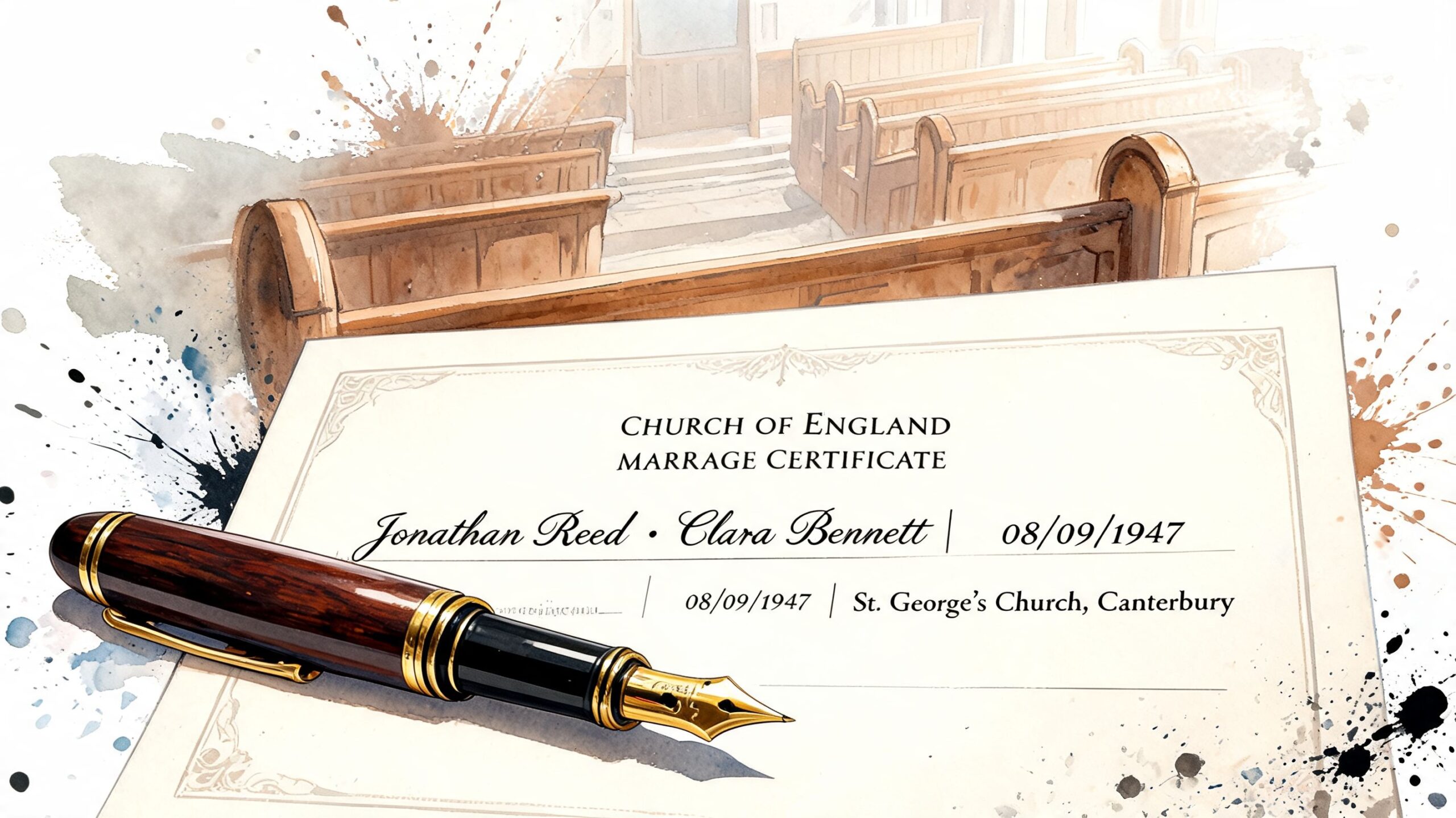
According to Bridebook's guide to church wedding costs, for 2026, the Church of England mandatory fee is £605 if you marry in your home parish. If you marry outside your home parish, the cost is £723, including the banns reading in your home parish.
Official baseline: £605 for a home parish wedding, or £723 for a church outside your home parish.
What that fee actually covers
Couples often underestimate the value of the legal fee. It isn't just room hire in a beautiful building.
It covers the essentials needed to hold the wedding properly through the church, including:
- The vicar's services
- Use of the church
- Lighting
- The legal necessities connected to the marriage
- Banns arrangements where applicable
That matters because many secular venues separate these costs into different line items. With a church wedding, the foundation is usually much more transparent.
Home parish or another church
The difference between the two fees often confuses couples at the enquiry stage.
If you're marrying in your home parish, the lower fee applies. If you want a church outside your parish, the cost is higher because the process also includes the banns being read in your home parish. That doesn't mean you can't choose another church. It means there's an added legal and administrative step.
If you're still working out what qualifies you to marry in a particular church, a practical starting point is this guide on how to get married in the UK, which helps clarify the process before you start comparing venues.
Why this part feels simpler than the rest
The compulsory fee is one of the few wedding costs that tends to feel calm once you know it. It's nationally set, easy to understand, and not built around upselling.
What changes after that is your experience of the day. Some couples want a short, elegant service with no extras. Others want full music, flowers throughout the church, bell ringing, and a traditional procession. The legal fee stays put. The atmosphere budget is where choices begin.
Decoding the Extras That Add to Your Bill
You book the church, note the official fee, and feel relieved for about a day. Then the practical questions start. Do you want live music? Are the bells included? Will you decorate a large stone building that can swallow flowers if you under-order them? That is usually the point where couples realise the church wedding cost is not just one figure. It is a base cost plus a series of choices.
The easiest way to understand these extras is to separate them into two groups. First, there are church-provided additions, such as music or bell ringing. Second, there are costs created by the setting itself, even if they do not appear on the church invoice.
Common extras couples ask about
As noted earlier from the same Bridebook guide, two optional additions commonly mentioned are an organist at £150 and bell ringing at £180.
| Service / Item | Average Cost (£) |
|---|---|
| Organist | 150 |
| Bell ringing | 180 |
Those are the only optional figures clearly verified in the source material, so they are the safest numbers to budget from at this stage. If your church later mentions items such as vergers, heating, printed orders of service, or extra rehearsal support, ask for the amount in writing before adding it to your running total.
That matters because extras often feel small in isolation. Together, they can behave like the add-ons when you buy a car. Floor mats, metallic paint, and parking sensors do not sound dramatic on their own, but the final invoice ends up higher than the headline price you first noticed.
Which extras usually earn their place
Some additions change how the ceremony feels. Others are lovely, but easier to leave out if you are watching the budget.
- Organist: Usually worth serious thought if you want a traditional church atmosphere. Live music affects the entrance, hymns, signing, and exit, so guests notice it throughout.
- Bell ringing: Best viewed as a celebratory extra for the moments outside the church. It does not change the service itself, but it does add that classic just-married feeling as you walk out.
A simple test helps here. If the extra shapes a memory you have pictured since getting engaged, price it properly. If it is only on your list because it sounds like something a church wedding "should" have, pause and ask whether you would miss it.
Costs linked to the church setting, not the church invoice
This catches couples out more than organists or bells.
A church ceremony often leads to extra spending because of the building itself. Older churches can have long aisles, side chapels, wide entranceways, and multiple places you may want to decorate. A small registry room usually needs far less styling. The same applies if you are marrying in a church and then paying separately for transport, drinks, and venue styling at a reception elsewhere.
Flowers are the clearest example. If you are trying to budget realistically for pedestals, pew ends, or arrangements that suit a larger ceremony space, this guide to how much wedding flowers cost for church and venue styling is a useful starting point.
The most useful question to ask the church
Ask for an itemised list of possible extras, with notes on who supplies each one and when payment is due.
That one question clears up a lot of confusion. It shows you which costs are fixed with the parish, which are optional upgrades, and which sit outside the church altogether. Once you split the budget that way, it becomes much easier to compare a traditional church wedding plus separate reception against an all-inclusive historic licensed venue in Southeast England, where many of these elements are bundled into one clearer price.
What Makes Church Wedding Costs Vary
Two couples can both say they're having a church wedding in England and end up with very different quotes around the ceremony. The legal fee may be set, but the surrounding costs shift based on location and how each church handles facilities and support.

The clearest example is geography. As discussed in a WeddingWire forum discussion on church costs, facility rental and professional coordination in a major city such as London can be 50 to 150 percent higher than in more rural towns. The same source also notes that an East Sussex church might itemise facilities, technology, and cleaning in ways that add 40 to 60 percent on top of the base ceremony cost.
Location changes more than the church fee
Couples often hear “church weddings are inexpensive” and assume that applies evenly everywhere. It doesn't.
A church in a major city may involve:
- Higher facility charges
- More formal coordination requirements
- Extra staffing or security expectations
- Less flexibility on timing because of a busier events calendar
A parish in a smaller town may feel more straightforward. There may be fewer add-on costs and fewer administrative layers involved.
Why East Sussex and the South East can feel tricky
The South East often sits in an awkward middle ground. It isn't always priced like central London, but it can still carry location pressure because demand is strong, suppliers are busy, and couples often choose churches with historic character.
That can show up in ways people don't expect. A parish may list a simple ceremony fee, then separately charge for facilities support, sound coordination, or cleaning. None of those costs are necessarily unreasonable. The issue is that they can make the final total feel bigger than the headline price suggested.
A low starting fee doesn't always mean a low final ceremony bill. Ask what sits outside the headline number.
The church's own policies matter too
Not every parish handles administration in exactly the same way. One church may bundle practical support into a single figure. Another may split it across separate payments.
This is why two quotes can feel hard to compare unless you look at the detail. Ask:
- What is compulsory?
- What is optional?
- Who receives each payment?
- Are any staffing or facilities charges billed separately?
Timing and complexity can affect your quote
Even without a published surcharge, more complex plans usually create more cost. A winter wedding may require more heating and lighting. A longer booking window may involve more staff time. A ceremony that relies on extra technology or access coordination can generate additional charges too.
That doesn't mean you need to avoid a church wedding in a sought-after location. It means you should compare quotes based on the full list of services, not the first number in the email.
Sample Budgets for Your Church Wedding
Sample budgets are useful when you treat them as planning shapes, not promises. They help you understand how choices stack up, especially when you're balancing church fees with the separate costs of celebrating elsewhere afterward.
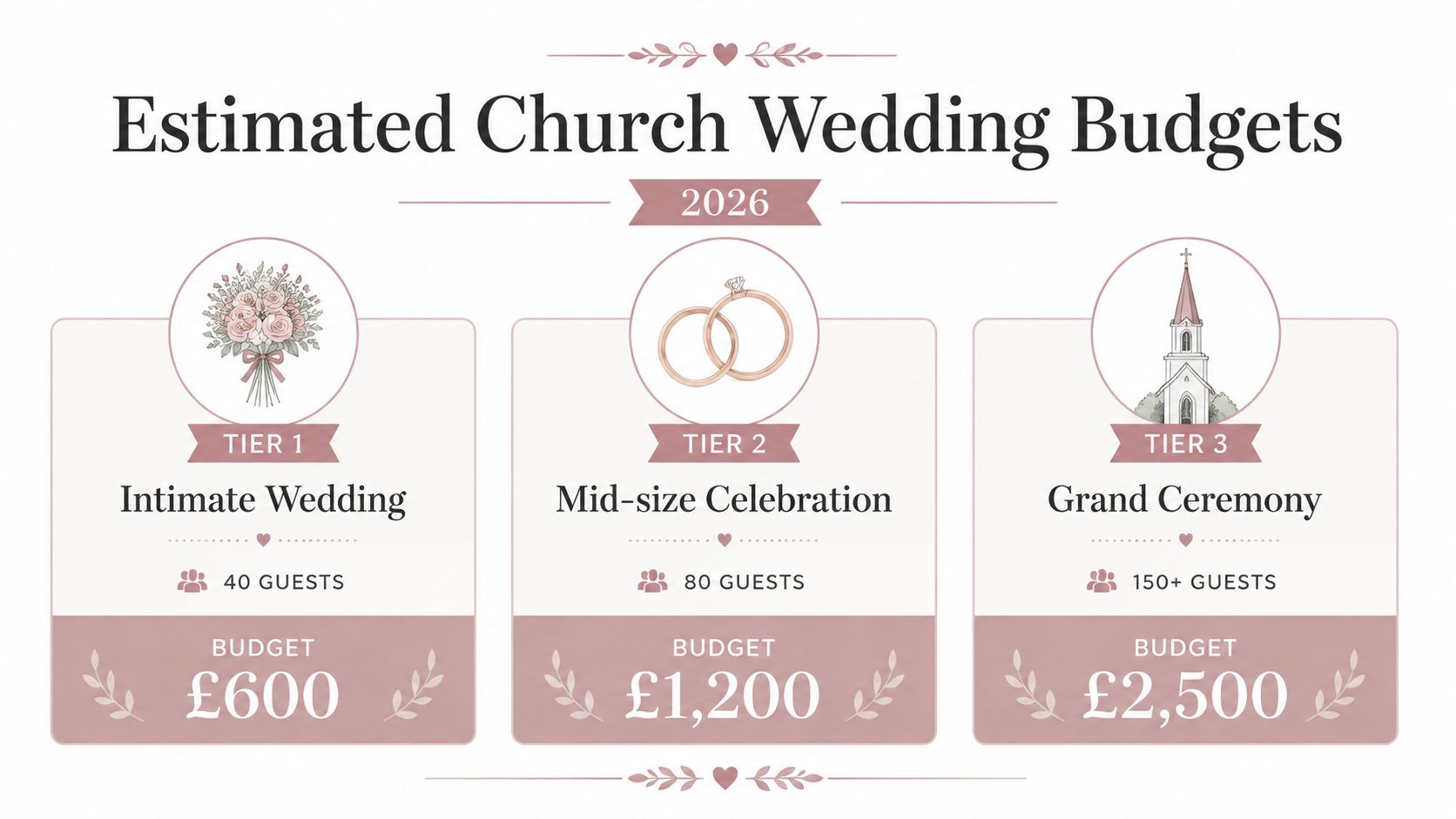
The infographic above gives a simple visual starting point for ceremony-related tiers. What it can't show is the story behind each budget, and that's usually what helps couples most.
Intimate wedding
A couple plans a small service with close family and a few friends. They marry in their home parish and keep the church arrangements simple. They choose one meaningful extra, perhaps live organ music, and then host a modest meal afterward rather than a large reception.
This kind of wedding often works well for couples who care most about the ceremony itself. The church wedding cost stays easier to manage because there are fewer moving parts, fewer guests to transport, and less pressure to turn the day into a full-scale production.
Useful questions for this style of wedding:
- Do we need every tradition, or only the ones that matter to us?
- Would a restaurant reception feel easier than private venue hire?
- Do we want live music in church enough to prioritise it over décor?
Mid-size celebration
A mid-size celebration usually starts to reveal the practical gap between “ceremony cost” and “full wedding cost”.
The couple may still use the church for the ceremony, but now there are more guests to direct, more travel between locations, and a stronger need for smooth timing. They may choose a fuller ceremony with bells or music and then book a separate reception venue with catering. At this point, church fees are no longer the main budget driver. Guest experience becomes the bigger cost category.
This is often where couples realise the split-site model creates hidden friction:
- guests need clear transport information
- suppliers may be loading in at two separate places
- photography coverage spans more movement across the day
Grand traditional wedding
A large wedding can be beautiful in a church setting, especially if you want a formal service and a classic arrival. But scale changes everything.
With a bigger guest list, every decision multiplies. More guests usually mean more reception complexity, more seating planning, more logistics after the ceremony, and more pressure to keep the day flowing. The church itself may still represent a relatively restrained part of the total spend, while the reception becomes the dominant financial commitment.
For larger weddings, the real budgeting challenge usually isn't the church fee. It's what happens once everyone leaves the church.
How to use sample budgets well
Don't copy someone else's budget line by line. Use scenarios to test your own priorities.
Ask yourselves:
- Are we paying for sentiment, convenience, or guest experience?
- Would we rather spend on the ceremony atmosphere or on the meal afterward?
- Do we mind running the day across two locations?
When couples answer those questions accurately, the right version of a church wedding becomes much easier to price.
Church vs Historic Venue in Southeast England
This is the comparison many UK couples need, especially in the South East. It isn't just “church or not church”. It's whether you want to build the day in separate parts or choose a venue where ceremony and reception happen in one place.
Many online articles are shaped by US assumptions, which can make UK planning harder than it needs to be. As noted in the verified research based on this article discussing church wedding pricing context, many online resources focus on US costs, while UK couples need local context. That same verified material also highlights that historic licensed venues offer a different value proposition because pricing often includes exclusive site hire for 75 to 250 guests, rather than the standard venue-sharing model.
The traditional split model
A church ceremony plus separate reception venue gives you the classic flow many people grew up imagining.
Its strengths are clear:
- Spiritual or family connection: the church may hold personal meaning
- Traditional atmosphere: especially for couples who want hymns, a church aisle, and that formal sense of occasion
- Flexibility afterward: you can choose a reception style that feels completely different from the ceremony
But it has trade-offs:
- Multiple suppliers and invoices
- Travel between locations
- More room for timing problems
- Costs that appear in fragments rather than one clear total
The historic licensed venue model
A licensed historic venue offers something structurally different. You're not separating ceremony and celebration in the same way. You're usually paying for exclusive use, a coherent guest journey, and a simpler planning setup.
That can be especially useful for larger parties. If you're comparing options for a big guest list, it helps to look at venues designed specifically for celebrations on that scale, such as wedding venues for 150 guests, because they're built around guest flow rather than retrofitting a reception after the ceremony.
Cost clarity versus emotional tradition
Couples need to be honest about what they value most.
A church wedding can feel less expensive at the start because the ceremony fee is so clear. A historic licensed venue can feel more expensive at first glance because the quote is larger. But the larger quote may also include more of the day in one package, which can make budgeting easier.
For some couples, especially those still exploring outdoor or flexible reception formats, it's also worth understanding alternatives such as wedding marquee pricing in London, because marquee celebrations raise similar questions about site hire, catering coordination, and what is or isn't included.
Which option suits which couple
Choose the church plus separate reception route if:
- The ceremony location matters significantly
- You want a religious service in a parish setting
- You don't mind managing a day that moves between places
Choose a licensed historic venue if:
- You want pricing that reflects more of the whole event
- You prefer fewer handoffs and fewer logistics
- You want guests to stay in one setting from ceremony to evening celebration
Neither route is universally better. One is rooted in tradition and can be excellent value at the ceremony stage. The other often offers more operational ease and a clearer sense of the total investment.
If you're weighing up a traditional church wedding against a licensed historic venue in East Sussex, Battle Abbey Weddings is worth exploring. It offers ceremony and reception options within one historic setting, with transparent pricing, flexible guest formats, and experienced planning support, which can make it much easier to compare the total cost of your day rather than just the starting fee.