You're probably doing what almost every newly engaged couple does in the first serious week of planning. You open a few venue pages, price a meal package, add drinks in your head, remember there's photography, outfits, flowers and a registrar somewhere in the mix, then wonder whether “cheap wedding deals” really means settling for something underwhelming.
It doesn't.
The mistake is treating wedding savings like supermarket savings. A wedding budget rarely improves because you clipped one clever discount. It improves because you made a sequence of good decisions in the right order. That's how couples afford the day they actually want, including venues that look far beyond their budget at first glance.
Beyond Clipping Coupons A Strategic Approach to Your Wedding Budget
The first budget shock usually comes from comparing your own comfort level with the national average. That gap can feel discouraging for about ten minutes, until you realise how many couples are already solving the same problem.
According to Hitched's UK Wedding Survey 2024 summary, the average wedding cost in the UK was about £20,700, but nearly a third of couples reported spending under £10,000. That matters because it turns “cheap wedding deals” from a desperate search into a normal planning strategy.

A lot of couples assume affordable means sparse. In practice, affordable often means edited. Fewer guests. A better time slot. A package with fewer costly moving parts. A menu style that still feels generous without paying for formality you don't care about. If you need a starting point, these budget wedding ideas for practical cost control are the sort of decisions that change the whole picture early.
Cheap is the wrong word. Clever is the right one
I'd separate budget weddings into two categories. The first is cheap on paper and expensive in reality. The second is well-built. The second one is what you want.
A well-built wedding budget does three things:
- It uses timing well. Date choice changes pricing faster than almost any décor idea ever will.
- It evaluates value, not headlines. A lower venue fee can become a higher overall bill once extras start stacking up.
- It asks better questions. Good negotiation isn't pushing for unrealistic discounts. It's removing waste, swapping unnecessary elements, and clarifying costs before they harden into contracts.
Practical rule: Don't ask, “How do we make this wedding cheap?” Ask, “Which decisions lower cost without lowering meaning?”
What couples get wrong at the start
Most overspending starts with the wrong first decision. They book emotionally, then budget reactively. They choose a date before checking the cost effect of that date. They fall in love with a guest list before checking what each guest triggers in catering, drinks, staffing and rentals. They compare packages by headline price instead of by what is included.
That's fixable.
The couples who stay calm and in control usually follow a simple framework. Timing. Evaluation. Negotiation. Not because it sounds tidy, but because it matches how wedding costs behave. If you use that framework, “cheap wedding deals” stops meaning compromise and starts meaning strategy.
The Timing Game When to Book for Maximum Savings
The biggest savings rarely come from asking a supplier to shave a little off a quote. They come from choosing a date the market values differently.
That's why timing should be your first budget decision, not your fifth. If you're flexible on when you marry, you give yourself room to afford a better venue, a cleaner package, or a more polished food and drinks experience without stretching every other category.
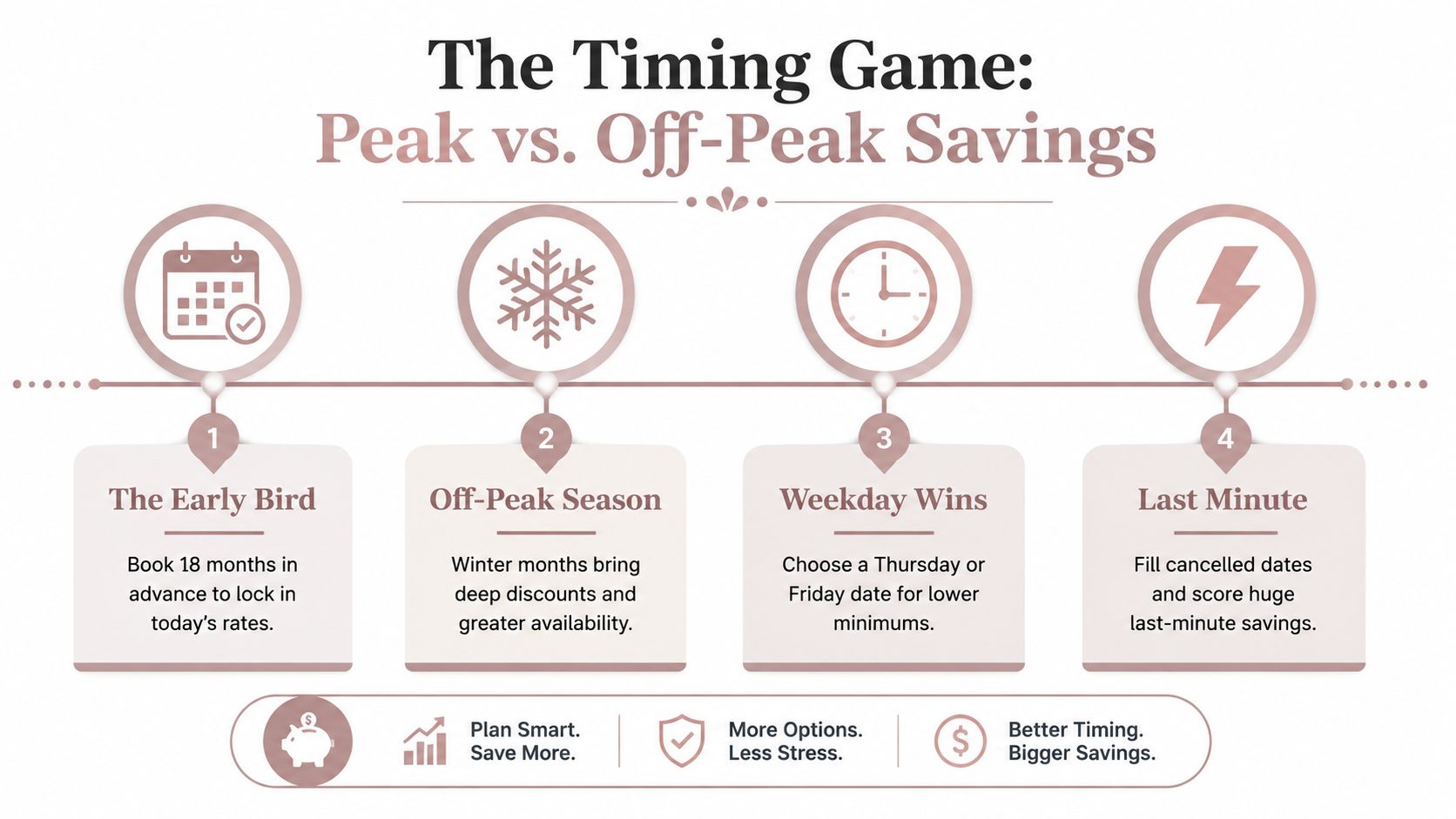
According to UK venue guidance highlighting midweek and shoulder-season availability, weekday weddings and shoulder-season dates from November to March remain a key discount driver. That's the first lever I'd pull before touching anything else.
Start with season
Season affects price because demand clusters hard around pleasant weather, long daylight hours and popular holiday periods. The result is simple. Summer weekends fill first. Winter and shoulder-season dates need more help to sell.
That doesn't mean a winter wedding is a fallback. Historic venues often look stronger in cooler months than modern blank-canvas spaces do. Candlelight, textured interiors, richer food, earlier evening atmosphere, fewer styling requirements. A venue with real character can carry more of the aesthetic work for you.
If you want cheap wedding deals without a bargain-basement feel, I would look here first.
Then change the day
Day of week is often even more practical than season because it lets you keep your preferred month while shifting the price pressure. A Thursday can open options that a Saturday closes immediately. A daytime celebration can also reduce how much food, alcohol and staffing the event requires.
Use this order when comparing dates:
- Change Saturday first if you can.
- Then test shoulder season if the calendar allows.
- Then compare daytime formats such as brunch, lunch or an earlier reception.
- Keep your preferred date only if it still works after full pricing is clear.
A Thursday in a beautiful venue often gives you more wedding for the same money than a Saturday in a venue you only half like.
Lead time matters, but not in the way people think
Couples often assume booking far in advance automatically means the lowest possible cost. Sometimes it helps because it gives you broader choice and more time to compare. But “book early” is less powerful than “book the right date”.
There's also a second timing opportunity that people forget. Cancellations and gaps in a venue calendar can create strong value for couples who can move quickly. That doesn't suit everyone. If you need a long runway for travel plans or lots of custom details, it may create more stress than it saves. But for smaller weddings or local guest lists, flexibility can pay off.
A practical timing filter
Before you enquire anywhere, decide what you're willing to flex on.
- Non-negotiable: Your ceremony style, your rough guest experience, the region.
- Flexible: Month, weekday versus weekend, reception format, start time.
- Bonus opportunities: Recently released dates, shorter booking windows, packaged off-peak offers.
That one exercise prevents the most expensive mistake in wedding planning. Falling in love with a high-demand slot, then trying to claw the money back through dozens of smaller compromises that don't save nearly as much.
Decoding the Deal How to Evaluate Wedding Packages
A wedding package is only a deal if you can compare it properly. Most couples can't at first, because quotes are built in different ways. One includes staffing and tableware. Another excludes both. One gives you a low hire fee but ties you into expensive drinks. Another looks pricier until you realise it already covers half the operational detail.
So don't compare packages by headline. Compare them by total cost shape.
According to UK budget guidance on wedding spend, venue and catering typically account for roughly 40 to 50 per cent of total spend, and cutting 10 guests can save around £1,000 because so many costs multiply with headcount. That's why the guest list is not a social detail. It's your central budgeting tool.
Fix the guest count before anything else
If your numbers are fuzzy, every quote is fuzzy too. Venue size, food, drinks, chairs, linens, favours, staffing and even transport decisions all become unstable when the guest count floats.
A lot of couples try to solve budget pressure by trimming décor, stationery or wedding favours. Those cuts may help at the edges, but they rarely do enough if the guest list is still too large for the budget. Hard truth, but useful truth. A wedding for fewer people usually feels more generous than a stretched wedding for many.
Decide who must be there, not who might be nice to include. That one choice protects the rest of the budget.
Compare packages line by line
When you receive a quote, rebuild it in your own spreadsheet under the same headings for every venue. Don't rely on each venue's wording. Translate everything into your own categories.
Look for these points first:
- Venue use: Exclusive hire, part-site use, ceremony space, reception space, setup access.
- Food structure: Formal meal, buffet, sharing menu, BBQ, hog roast, evening food.
- Drinks model: Reception drinks, table wine, toast drinks, cash bar, corkage terms.
- Operational costs: Staffing, furniture, glassware, linen, cake cutting, setup and clear-down.
- Ceremony costs: Registrar arrangements, room use, timing restrictions.
- Tax and service: Whether VAT and service are included or separate.
If one quote is vague on any of those, it isn't the better deal. It's less complete.
Sample Wedding Package Comparison
| Feature | Package A (All-Inclusive) | Package B (Dry Hire + DIY) |
|---|---|---|
| Venue hire | Included in one quote | Separate base fee |
| Catering | Included | Must source independently |
| Drinks | Package-based | May require separate bar service |
| Staffing | Usually included | Often added separately |
| Furniture and tableware | Often included | May require external rental |
| Setup coordination | Usually clearer | More couple-managed |
| Budget predictability | Higher | Lower |
| Flexibility | Moderate | Higher, but with more admin |
| Risk of hidden extras | Lower if quote is detailed | Higher if suppliers are fragmented |
A dry hire wedding can work beautifully. It can also become a project-management exercise that costs more than expected once outside catering, staffing, rentals and delivery windows start stacking up. An all-inclusive package can feel restrictive if it doesn't match your priorities, but it often gives far better cost visibility.
For couples trying to compare historic venues with transparent package structures, a page like wedding venue prices and package options is useful because it shows how venue hire, catering and drinks can be priced separately but clearly.
Where “budget” bookings often go off course
The phrase “cheap wedding deals” hides an awkward truth. Many cheap-looking offers are only cheap if you don't count what's missing.
Common pressure points include:
- Corkage and bar terms
- Mandatory staffing
- Ceremony room fees
- Furniture or crockery not included
- Supplier restrictions
- Minimum spends tied to date or room
This is why I prefer the phrase all-in realism. The right question isn't “What's your cheapest package?” It's “What will we spend to host the wedding we're describing?”
The best package is the one that matches your priorities
If food matters most, spend there and simplify the room styling. If atmosphere matters most, choose a venue with architectural character so you need less décor. If staying calm matters most, pay for fewer moving parts.
Not every saving is worth taking. DIY only works when the venue setup, supplier coordination and your own tolerance for logistics all line up. Otherwise, you'll save money in one place and spend it back in stress, delays or rushed decisions elsewhere.
The Art of the Ask Negotiation Scripts and Strategies
Many couples hate this part because “negotiation” sounds like hard selling in reverse. In weddings, it works better as clarification. You're not trying to win against the venue. You're trying to build a version of the package that fits your event cleanly.

That approach matters because a low headline figure can hide expensive omissions. As noted in this discussion of cheap venue pricing and compulsory extras, a venue can look affordable until corkage, staffing or ceremony fees are added. So the smartest negotiation often begins with, “Please help me understand what's not included.”
What you can usually ask for
You'll get the best response when your request is specific and operationally reasonable.
Try questions like these:
- Date flexibility: “We're open to weekday dates or shoulder-season availability. Are there dates where you can offer better overall value?”
- Package swaps: “We don't need a formal plated meal. Is there a way to exchange that element for a buffet, BBQ or simpler service style?”
- Bar structure: “Can you show us the difference between a drinks package and a cash bar or more limited hosted option?”
- Unused elements: “If we won't use certain inclusions, can those be removed or replaced rather than paid for anyway?”
- Minimum spend clarity: “What exactly counts toward the minimum, and what sits outside it?”
Those questions are commercial, polite and easy for a venue team to answer.
What usually isn't worth pushing
Peak-date base hire is often the least negotiable part of a quote. If a venue knows a Saturday in a prime month will book, there's no reason for them to discount it heavily.
You'll usually do better by asking for structure changes rather than blunt price cuts. Shift the date. Adjust the food style. Trim the drinks package. Remove a late-night element you don't care about. Reduce setup complexity. Those changes give the venue room to help you without undermining their pricing model.
A strong negotiation question: “If we keep the date flexible and the format simple, where do you see the best value in your packages?”
A script that works well by email
You don't need to sound tough. You need to sound clear.
We love the venue and want to compare options properly before deciding. Our priority is keeping the overall spend controlled rather than maximising guest count or formality. Could you outline which elements are mandatory, which are optional, and whether there's flexibility on date, catering format or drinks structure for better value?
That email does three useful things. It signals serious intent. It shows you understand trade-offs. It invites collaboration instead of confrontation.
A short explainer can help if you're nervous about these conversations:
The tone matters more than people think
Venue teams deal with two extremes all the time. Couples who ask for everything at once, and couples who are too shy to ask anything important. Neither gets the best result.
The sweet spot is calm precision. Tell them what matters. Tell them what doesn't. Ask where they see room to adapt the package. Good venues usually know where savings can happen without damaging the experience, and they'll often guide you toward those choices if you make your priorities clear.
Applying the Rules to a Dream Venue A Battle Abbey Example
Couples often relax at this stage. Once the framework is clear, a premium historic venue stops feeling automatically out of reach.
Take a couple who want the atmosphere of a grand English setting but don't want a sprawling, high-output wedding day. They aren't chasing the lowest possible hire fee. They want quality, but they need control. That's exactly where strategic planning does its best work.
In England and Wales, as noted in this overview of how legal and venue structures shape wedding packages, the way ceremonies and venues are organised has helped make bundled packages for ceremony, reception and catering especially attractive, particularly in historic settings. That's useful because heritage venues often become more affordable when more of the event sits under one coordinated roof.
What an affordable premium wedding actually looks like
Start with scale. An intimate celebration changes everything. Battle Abbey Weddings offers an exclusive part-site option for up to 60 guests, which is a very different budget shape from a much larger celebration. Smaller numbers reduce catering pressure, service complexity and the temptation to overbuild the whole day.
Then apply timing. Choose a Thursday in March rather than a peak summer Saturday. The atmosphere still feels intentional. In many historic venues it feels more atmospheric, because the building itself supplies presence and character without needing extensive décor.
Now simplify the food. If the couple care more about warmth and sociability than formal service, a hog roast or BBQ can create a relaxed, stylish meal without the labour demands of a highly formal dinner. The day still feels distinctive. It just isn't paying for ceremony where ceremony isn't needed.
Why historic venues can work better than expected
Historic venues often look expensive because people imagine they must be paired with the most formal version of every wedding choice. That's rarely true. A strong room, beautiful grounds and recognisable architecture do a lot of visual work for you.
That means couples can often spend less on added styling and focus the budget where guests feel it:
- Food people enjoy
- A comfortable drinks plan
- A well-paced schedule
- A setting with built-in atmosphere
If you're comparing options across the South East or pairing your venue shortlist with city celebration plans, it can also help to browse top London event locations to understand how package styles differ between heritage venues, central event spaces and more flexible hire models.
For couples who want to see how a historic setting functions as a real wedding venue rather than a postcard, this guide to what makes Battle Abbey a historic wedding venue is useful because it shows the practical side of the setting as well as the look of it.
The real trade-off
The trade-off isn't “dream venue or affordable wedding”. It's usually “peak-format wedding or smart-format wedding”.
Once couples accept that distinction, the path gets clearer. Keep the guest list intimate. Pick a lower-demand date. Use a simpler meal format. Favour package clarity over fragmented supplier juggling. Suddenly the venue that looked aspirational starts looking workable.
That's what cheap wedding deals should mean in practice. Not getting less than you wanted. Getting more of what mattered, and less of what didn't.
Conclusion Your Wedding Your Budget Your Rules
A good wedding budget isn't built on denial. It's built on accuracy.
Cheap wedding deals work when you stop treating them like isolated discounts and start treating them like decisions with influence. Timing changes the price environment. Evaluation tells you whether a package is truly good value. Negotiation helps you shape the offer around your priorities instead of paying for default assumptions.
That approach gives couples something more useful than a lower number. It gives them control.
You don't need to impress an imaginary panel of wedding judges. You need a day that feels right, runs smoothly, and doesn't leave you resenting the bill. For some couples that means a weekday lunch reception in a historic room. For others it means a smaller guest list and a more generous food and drinks experience. For others it means keeping the venue ambitious and simplifying everything around it.
All of those are valid.
The best affordable wedding is not the one with the lowest headline cost. It's the one where your money is doing exactly the jobs you care about. If you make decisions in that order, you can protect the experience, avoid the common budget traps, and still create a wedding with beauty, character and a real sense of occasion.
If you're looking for a historic East Sussex venue with clear package options and flexible formats for both intimate and larger celebrations, Battle Abbey Weddings is worth exploring early in your planning. It gives couples a practical way to test the framework above against a real venue, real package choices, and a setting that already brings plenty of atmosphere before you spend a pound on extra styling.