The vows are spoken, the rings exchanged, the first kiss shared. As you turn to face your cheering loved ones, the music that swells is more than just a song. It's the official fanfare for your new life together. This is your recessional, the soundtrack to your triumphant exit and the bridge between the solemnity of your ceremony and the joy of your reception.
In practice, wedding recessional music needs to do two jobs at once. It has to feel emotionally right, and it has to work in the room. At Battle Abbey, that matters more than it does in many modern venues. Historic stone, lofty ceilings, outdoor terraces and dramatic sightlines can make one piece feel magnificent and another feel oddly flat.
The recessional also has a specific role in the order of the day. It begins after the moment you are formally announced and is meant to feel celebratory rather than ceremonial, which is why UK guidance consistently treats it as a distinct cue rather than another ceremony song in the running order, with examples ranging from Handel's “Arrival of the Queen of Sheba” to Earth, Wind & Fire's “September” and Jackie Wilson's “(Your Love Keeps Lifting Me) Higher and Higher” in one major UK overview of wedding recessional songs.
A few practical choices shape the moment quickly:
- Tempo and mood: A brisk, joyful piece lifts guests to their feet. A slower one creates a poised, romantic exit.
- Song length: Your music should comfortably cover your walk, the wedding party behind you, and any pause for applause or photographs.
- Live vs recorded: Live musicians bring character and ceremony. Recorded music gives you exact control over arrangement and pacing.
- Venue acoustics: Strings bloom beautifully in the Abbot's Hall. Outdoors, lighter pieces can disappear unless they're properly supported.
If you're choosing classical repertoire and want to understand permissions and practical use, this guide on how to use classical music legally is a useful place to start.
1. Mendelssohn's Wedding March
Few pieces announce “we are married” as confidently as Mendelssohn's Wedding March from A Midsummer Night's Dream. It has immediate lift, clear rhythm and a sense of tradition that suits a historic setting without any explanation. Guests recognise it within a breath, which is part of its power.
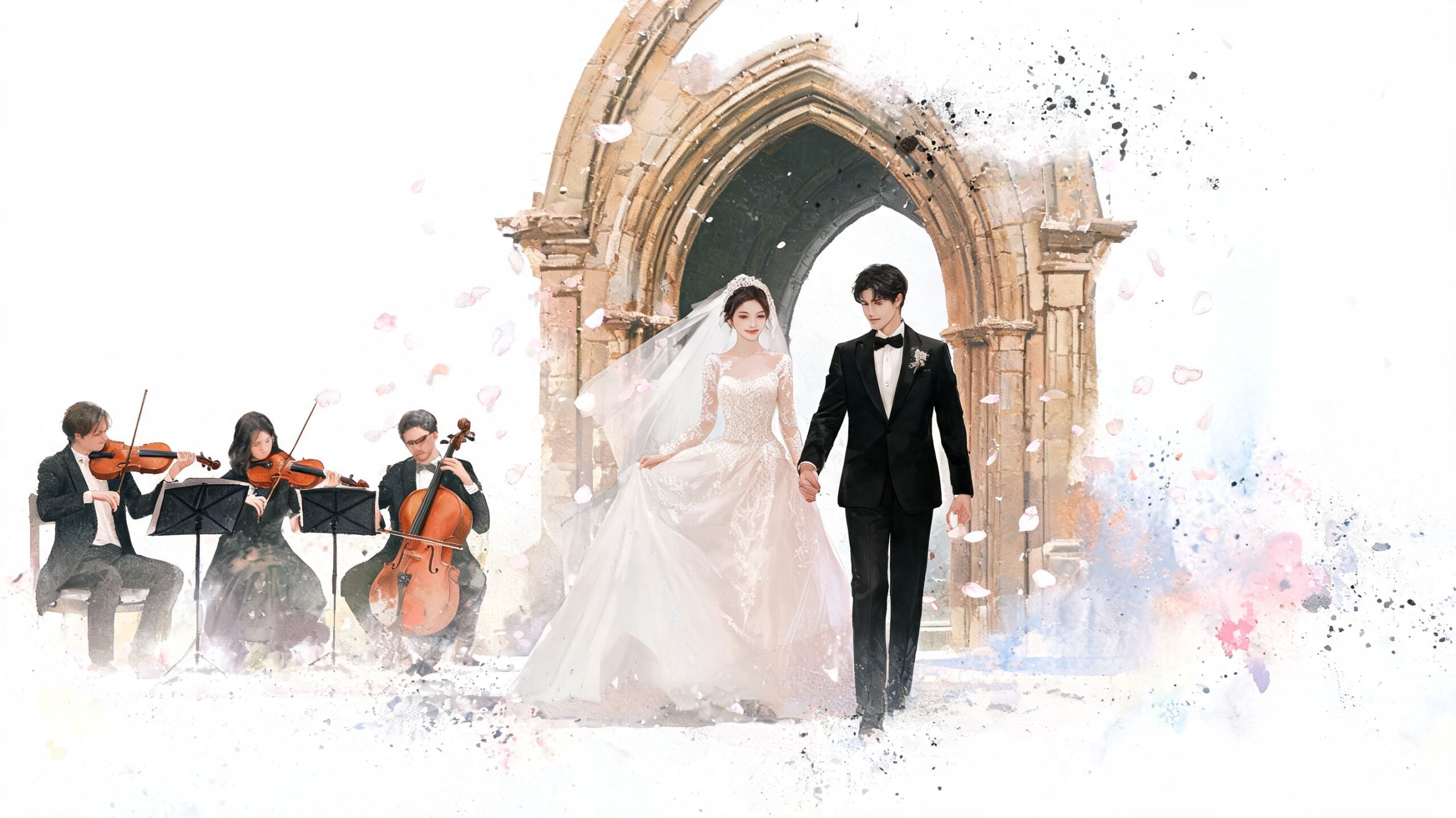
At Battle Abbey, it works especially well when a formal ceremony in the Abbot's Hall calls for a recessional with real stature. The architecture is already doing some of the storytelling for you. This music meets it at the right level.
A visual sense of that moment helps when you're deciding whether you want grandeur or softness.
When it works best
This is the right choice for couples who want their wedding recessional music to feel unmistakably ceremonial for a few seconds, then immediately celebratory. It's especially effective when the aisle is long enough to let the opening phrase land properly.
What doesn't work is rushing it. If you bolt out of the ceremony space at full speed, the music can feel comic rather than elegant. The answer isn't to slow the track down unnaturally. It's to agree your pace with your coordinator and musicians in advance.
- Best fit: Traditional ceremonies, black tie styling, historic interiors
- Less ideal: Very relaxed outdoor ceremonies where you want something airy or contemporary
- Strong pairing: Live organ, string quartet, or a refined recorded orchestral version
For couples building a full ceremony soundscape rather than choosing songs in isolation, Battle Abbey's own wedding music playlist ideas can help you hear how a recessional tone connects to the rest of the day.
Later in planning, it's worth hearing the piece in full rather than relying on memory.
Practical rule: If you choose Mendelssohn, use the exact arrangement you want your musicians or technician to play. Ceremony cues are increasingly treated that precisely, and couples often care about the specific version and timing rather than only the title.
2. Wagner's Bridal Chorus
Wagner's Bridal Chorus carries a softer kind of formality. It's more lyrical than Mendelssohn and less overtly triumphant in its opening bars, which makes it a good option for couples who want elegance without quite so much fanfare.
Used as wedding recessional music, it suits a measured exit. Think less “victory lap” and more “composed, radiant walk into the next chapter”. In a venue with period character, that distinction matters. A romantic ceremony in the Duke's Library or another richly dressed historic room can support this gentler grandeur beautifully.
The trade-off
The challenge with Wagner is expectation. Many guests associate it with the entrance rather than the exit, so if you use it as your recessional, the rest of your ceremony music needs enough contrast to make the structure feel intentional.
That can be a strength, not a weakness. If you'd prefer your processional to feel more modern or intimate, Wagner can provide a graceful return to classicism at the end.
A couple with a strong sense of old-world style often carries this off especially well. Silk, candlelight, a polished order of service and a formal line of attendants all support the music naturally.
Used well, Wagner doesn't sound heavy. It sounds assured.
This piece is strongest with live strings or a small ensemble that can shape the rise and release of each phrase. A thin speaker outdoors won't do it any favours. If your ceremony finishes outside, recorded Wagner needs careful sound support or it risks feeling distant.
3. Elgar's Pomp and Circumstance March No. 1
Elgar gives you British ceremony with shoulders back. Pomp and Circumstance March No. 1 has breadth, confidence and a kind of open-air nobility that feels particularly at home in an English heritage setting.
If your celebration moves from the Abbot's Hall out onto the terrace, this is one of the strongest choices in the list. It can handle movement. It can handle applause. It can handle the visual shift from interior formality to the outdoor surroundings.
Best for a dramatic handoff
At Battle Abbey, this piece makes the most sense when your recessional is not the end of the emotional arc but the start of a wider reveal. You're married, the doors open, guests follow, and the atmosphere expands with the setting.
That's where Elgar beats more delicate music. Softer pieces can get lost in the transition. Elgar grows with it.
For practical planning, map the cue against your wedding order of service. If there's a pause for the announcement, a cheer, then a turn and walk, the opening bars need to begin in exactly the right spot. Start too early and the announcement sits on top of the melody. Start too late and the emotional lift arrives after you've already moved.
- Choose Elgar if: You want an unmistakably British feel and a broad, confident exit
- Avoid Elgar if: Your ceremony style is intimate, bohemian or deliberately understated
- Think about: Whether guests will remain seated briefly or rise immediately, because the music invites a larger gesture from the room
This is also a clever choice for couples who want a recessional that can bridge naturally into drinks on the terrace.
4. Debussy's Clair de Lune
Not every recessional has to sound like a state occasion. Debussy's Clair de Lune, arranged for strings, creates something more private and luminous. It doesn't announce. It glows.
For couples who want wedding recessional music that feels romantic but not overly familiar, this is often the answer. It suits a ceremony where the emotional energy is inward rather than exuberant, and where elegance comes from restraint.

Why it suits outdoor spaces
On the Top Terrace in soft light, or after a ceremony that leans modern in styling, Clair de Lune can feel exquisite. The piece leaves room for atmosphere. It doesn't crowd the moment with too much instruction.
The trade-off is clarity. Outdoors, this music needs either accomplished live players or a well-balanced recorded arrangement. A hesitant quartet or weak speaker setup can make it dissolve into the background.
This is one of those pieces where less is more in the procession itself. Don't force a grand pace onto it. A calm walk, a quick glance between the two of you, and a little room for the guests' reaction does far more.
- Ideal mood: Refined, romantic, understated
- Less suited to: Big cheering exits with confetti and high-volume applause
- Works beautifully with: Late afternoon light, garden views, soft florals and a shorter aisle
If your instinct is “I want the moment to feel beautiful, not theatrical”, Debussy is usually worth serious consideration.
5. Jeremiah Clarke's Trumpet Voluntary
Jeremiah Clarke's Trumpet Voluntary has brightness without the overfamiliarity of Mendelssohn. It feels formal, uplifting and distinctly at home in an old English setting, but it also has a freshness that many couples appreciate when they want tradition with a little personality.
For Battle Abbey, it's a particularly apt fit. The music has the right architectural quality for historic stone and timber, and it carries well in a room with ceremonial character.
Heritage without predictability
A live trumpet with strings can be thrilling here if the balance is right. The trumpet provides the gleam, while the strings soften the edges so the moment still feels like a wedding rather than a civic parade.
If a solo trumpet is too assertive for your taste, choose a chamber arrangement instead. The structure of the music still gives you uplift, but the mood becomes warmer and more intimate.
For couples curating the full ceremony journey, the songs played earlier in the service matter just as much. Battle Abbey's guide to signing the registry songs is useful if you want the recessional to feel like the final step in a coherent musical progression rather than a sudden change of style.
A good recessional shouldn't feel pasted on at the end. It should feel like the ceremony has been moving towards it all along.
This piece is especially strong when the ceremony itself has been traditional, but the couple want a final cue that feels bright rather than solemn.
6. Antonio Vivaldi's Spring
The opening movement of Vivaldi's Spring is one of the happiest pieces in the classical repertoire. It has motion, sparkle and a natural buoyancy that makes people sit up a little straighter before they even realise why.
That's why it works so well as wedding recessional music for spring and summer celebrations. It sounds alive. At Battle Abbey, it's particularly effective when the next scene is drinks outdoors and the whole event is shifting into daylight, conversation and movement.
How to stop it feeling rushed
Because the music is energetic, couples sometimes overmatch it with an overly brisk walk. That's the mistake. You don't need to chase the tempo. Let the piece create excitement while you keep your movement comfortable and deliberate.
Vivaldi is also excellent for mixed-age guest lists. It's recognisably classical, but it doesn't feel formal in a stiff way. Grandparents enjoy it, younger guests respond to the pace, and photographers like the sense of lift it creates in the body language of the couple and wedding party.
- Use it when: You want joy, lightness and forward motion
- Think twice when: The ceremony mood has been solemn or very modern-minimalist
- Best setting: Outdoor terraces, garden exits, champagne-in-hand transitions
This is one of the easiest classical pieces to bridge into post-ceremony hospitality. It sets up that relaxed first glass perfectly.
7. John Philip Sousa's The Stars and Stripes Forever
Sousa isn't an obvious recommendation for every English wedding, which is precisely why it can work for the right couple. If you have a transatlantic story, American family travelling over, or a celebration that deliberately blends traditions, The Stars and Stripes Forever can become a charming and personal recessional rather than a novelty.
The key is arrangement. A full military-band treatment is usually too blunt for a wedding ceremony exit in a historic venue. A refined adaptation for strings or light ensemble keeps the wit and momentum without overwhelming the setting.
Best used with intention
This piece needs context. If there's no meaningful connection, it can feel imported for the sake of it. But when the couple's story supports it, guests often understand the choice immediately and respond with warmth.
Battle Abbey is a strong venue for this kind of personal contrast. The setting is rich with English history, so a carefully chosen American piece can create a memorable conversation between heritage and biography.
There's also a practical advantage. Sousa marches move cleanly. They help the processional line keep shape, which can be useful with larger guest counts or a long route out of the ceremony area.
Choose the piece that sounds like your marriage, not the one that sounds most “correct” on paper.
For destination couples marrying in East Sussex, this can be a witty and affectionate nod to home while still sitting comfortably within an elegant day.
8. Ralph Vaughan Williams' The Lark Ascending
If any piece in this list feels as though it belongs to the East Sussex countryside, it's The Lark Ascending. It has openness, air and an unmistakable sense of English space. Used carefully, it creates a recessional that feels less like a proclamation and more like a release.
At Battle Abbey, that can be spellbinding outdoors. The view, the ruins, the sky and the history of the site all support the music's atmosphere. Couples who are drawn to place, season and scenery often respond to this piece instinctively.
The important caveat
The full work is too expansive for most recessional moments. What you need is a well-chosen excerpt or arrangement with a clear exit point. Without that shaping, the piece can drift rather than carry.
That makes your musicians' judgement important. A violinist or quartet who understand the architecture of the music can preserve the emotional magic while still giving you a practical cue for the ceremony finish.
This is not the choice for a cheering, confetti-heavy dash. It's for couples who want serenity, wonder and a sense that the setting itself is part of the music.
- Strongest setting: Six Penny Lawn, terrace views, outdoor ceremonies
- Best mood: Reflective joy, English romanticism, quiet grandeur
- Less suitable for: Very short exits or highly structured formal choreography
For some couples, this becomes the most memorable musical moment of the entire day because it feels inseparable from the environment around them.
9. Eric Satie's Gymnopédie No. 1
Satie's Gymnopédie No. 1 is the outlier in this list, and that's its appeal. It offers intimacy, modern taste and a certain intellectual calm that many artistic couples find moving. Used as wedding recessional music, it says something different from triumph. It says tenderness, composure and confidence without display.
This works best in a smaller ceremony where guests are close enough to feel the texture of the music. In a very large room with a lot of movement, its subtlety can disappear.
A beautiful contrast piece
Satie is especially effective when the rest of the day includes more traditional elements. Historic venue, classic flowers, formal photography, then this unexpectedly spare and elegant recessional. That contrast can feel chic rather than contrary.
The mistake is choosing it because it seems “cool”. If it doesn't reflect your emotional tone as a couple, it can leave the room slightly underpowered at precisely the moment when the energy should rise. The answer is not to dismiss Satie, but to be honest about the kind of joy you want to express.
A thoughtful string arrangement helps. Solo piano can be gorgeous, but in some ceremony spaces it won't carry enough warmth for the exit unless the room is very intimate.
- Choose Satie if: You value understatement and modern elegance
- Avoid it if: You want cheers, big smiles and obvious musical uplift
- Lovely pairing: Candlelight, editorial styling, a concise ceremony and a smaller guest list
For the right couple, this feels cultured and personal.
10. Léon Boëllmann's Toccata from Suite Gothique
Boëllmann's Toccata from Suite Gothique is for couples who want their exit to feel dramatic, architectural and unmistakably tied to a historic setting. It has that thrilling Gothic sweep which makes stone walls, arches and heritage interiors seem to answer back.
In the right room, it's magnificent. In the wrong one, it's too much. That's the whole trade-off.
When grandeur becomes the point
At Battle Abbey, this piece makes the most sense if the ceremony leans fully into the venue's age and atmosphere. Evening light, candle glow, rich florals, formal attire and a strong processional route all support it beautifully.
An organ is the natural choice if one is available and appropriate. If not, an adaptation for strings can retain some of the flourish while making the overall effect more flexible. What you don't want is a thin electronic imitation. This music depends on scale and texture.
One practical issue often gets overlooked in recessional planning. Timing and sound limits matter as much as aesthetics, especially in historic venues where entertainment conditions may be shaped by licence or local rules. UK guidance often focuses on upbeat song choices but leaves out the operational side, which is why couples should also think about route length, pause points and venue-specific sound conditions when choosing their recessional music.
The best exit music fits the space first, then the playlist.
Boëllmann rewards that kind of planning. If the space, timing and performance are right, the result can feel unforgettable.
Top 10 Wedding Recessional Music Comparison
| Piece | Implementation complexity 🔄 | Resource requirements ⚡ | Expected outcomes & advantages 📊⭐ | Ideal use cases | Quick tip 💡 |
|---|---|---|---|---|---|
| Mendelssohn, "Wedding March" | Moderate, standard classical score; needs skillful timing | String quartet, organ or full orchestra readily available | Instant recognisability; triumphant, formal celebration ⭐ | Traditional ceremonies in historic venues (e.g., Abbot's Hall) | Hire live quartet/organ and coordinate tempo with photographer |
| Wagner, "Bridal Chorus" | Moderate, controlled dynamics and phrasing required | String quartet or small orchestra | Romantic, gradually grand; emotionally evocative ⭐ | Intimate or formal processions; can serve as entrance or recessional | Use for entrance or pair with Mendelssohn for distinct moments |
| Elgar, "Pomp and Circumstance" | Moderate–High, bold scoring and confident ensemble needed | Brass band, full orchestra or large ensemble | Patriotic, powerful and memorable; grand ceremonial impact ⭐ | Large celebrations and terraces where British character is desired | Consider brass or military-style arrangement for drama |
| Debussy, "Clair de Lune" (strings) | Moderate, requires sensitive, impressionistic phrasing | String quartet/small ensemble or high-quality recording | Ethereal, intimate and sophisticated; understated elegance ⭐ | Modern-classic ceremonies and outdoor terraces | Hire pro string quartet or use recorded arrangement outdoors |
| Clarke, "Trumpet Voluntary" | Moderate, clear trumpet lines and ensemble balance | Trumpet + organ or brass ensemble | Bright, period-appropriate uplift; English Baroque charm ⭐ | Historic church/abbey settings seeking heritage authenticity | Pair with venue organ or trumpet with strings for warmth |
| Vivaldi, "Spring" (Allegro) | Moderate–High, fast tempo and precise articulation required | Solo violin + strings or string quartet | Energetic, joyful and lively; ideal for celebratory exits ⭐ | Spring/summer outdoor transitions and brisk recessions | Coordinate brisk pace with photographer to keep comfortable march |
| Sousa, "The Stars and Stripes Forever" (adapted) | Moderate, needs tasteful adaptation from march to wedding context | Adapted string ensemble or light orchestra | Upbeat, memorable and festive; transatlantic flair ⭐ | Couples with US ties or lively outdoor receptions | Arrange for strings (not military band) for wedding suitability |
| Vaughan Williams, "The Lark Ascending" (excerpt) | High, requires expressive soloist and careful adaptation | Solo violin with strings or recording | Transcendent, pastoral and deeply English; evocative atmosphere ⭐ | Outdoor terraces/gardens for nature-inspired ceremonies | Hire experienced soloist or use high-quality recording for outdoors |
| Satie, "Gymnopédie No.1" (arranged) | Low–Moderate, simple harmonies but demands interpretive subtlety | Small ensemble or string quartet | Contemplative, intimate and distinctive; artistic tone ⭐ | Small, creative or introspective ceremonies (≤60 guests) | Best for intimate settings; beware slow pace for long processions |
| Boëllmann, "Toccata" (arranged) | High, technical organ/ensemble demands and acoustics matter | Pipe organ or adapted orchestration | Majestic, gothic and architecturally resonant; dramatic finale ⭐ | Venues with organs or couples wanting medieval/architectural drama | Confirm organ access or commission orchestral adaptation for effect |
Creating Your Unforgettable Exit at Battle Abbey
Your wedding recessional music is brief, but it does a remarkable amount of work. It releases the emotion of the ceremony, tells guests how to feel in the next instant and sets the tone for everything that follows. In a venue like Battle Abbey, where history, architecture and the natural surroundings all have such presence, the right choice doesn't just accompany the moment. It amplifies it.
The most useful way to choose is to think in scenes, not only in songs. The Abbot's Hall asks for something different from the Top Terrace. Indoors, richer classical textures often land beautifully because the room supports them. Outdoors, clarity and pacing matter more. Music that feels enchanting in a playlist can vanish into open air if it lacks shape or projection.
There's also a practical planning point that many couples only discover late. UK music planning has become much more cue-driven than many people realise. In FixTheMusic's analysis of anonymised wedding-music conversations, couples regularly specified mood, do-not-play preferences, genre blending and exact ceremony versions, with wedding music trend data showing that precise version and timing choices are especially common for ceremony songs. That's exactly the right approach for a historic venue. Don't just say “play Vivaldi” or “something by Debussy”. Decide the arrangement, the starting point, whether the music fades or finishes cleanly, and how the cue hands off into applause or guest movement.
Tailoring the music to the space
For the Abbot's Hall, pieces with clear ceremonial presence tend to work best. Mendelssohn, Clarke and Boëllmann all have enough shape to meet the room's character. If you want a gentler atmosphere, Wagner or Debussy can soften the edges while still feeling appropriate to the setting.
For the Top Terrace or Six Penny Lawn, I'd usually steer couples towards pieces that travel well emotionally. Vivaldi and Vaughan Williams are strong choices because they open out into the outdoor surroundings. They don't fight the setting. They join it.
The handoff after the ceremony matters too. Many couples want the recessional to flow naturally into drinks, mingling or an early reception mood. Industry professionals often use DJ Intelligence's widely circulated Top 200 event charts as a practical benchmark for reception expectations, and that's useful here not because your recessional should sound generic, but because it helps you bridge from formal ceremony into familiar celebration with intention.
Battle Abbey Weddings is one relevant option if you're looking for a venue where that sort of coordination can be built into the day. The site offers ceremonies and receptions within the historic Battle Abbey estate in East Sussex, with spaces including the Abbot's Hall, Duke's Library, Dining Room/Bar, Top Terrace and Six Penny Lawn, plus support from an experienced planner and celebrations licensed until midnight.
The best wedding recessional music is the piece that sounds right in your space, with your route, your guests and your story. Choose for the moment you are going to have, not the one a playlist suggests. When the cue lands perfectly, the music won't feel like a detail. It will feel like the exact right beginning.
If you're planning portraits immediately after the ceremony, this advice on how to entertain wedding guests during portraits is also worth considering, because a smooth transition keeps the mood your recessional created.
If you're considering Battle Abbey Weddings for your celebration, it's worth exploring how the venue's historic interiors and outdoor terraces could shape your ceremony music as much as your décor. The team can help you plan a recessional that fits the space, the timing and the atmosphere of the day.