You're probably looking at Hampton Court House with two competing thoughts in your head. First: it's beautiful. Second: can it work for my guest list without the day feeling cramped, stop-start, or overcomplicated?
That's the right question to ask.
A lot of coverage of Hampton Court House weddings stops at the romance of the façade, the gardens, and the polished interiors. That part matters. But once you're planning a real wedding, especially one at the upper end of the venue's comfort level, you need better answers than “stunning backdrop” and “exclusive setting”. You need to know how guests move, where the pressure points are, what historic-house restrictions mean in practice, and whether the gardens help the day flow or merely look lovely in photographs.
Hampton Court House can be an enchanting place to marry. It can also punish vague planning. The couples who have the smoothest celebrations here are the ones who treat the venue as both a characterful house and a technical site.
An Introduction to Hampton Court House Weddings
Guests arrive expecting one thing and quickly realise they're somewhere far more private than the name suggests. Hampton Court House sits in the orbit of one of the country's most famous royal landmarks, yet it offers a different kind of grandeur. It feels enclosed, self-contained, and personal in a way that many large heritage venues don't.
That difference matters. If you want the drama of history without the scale of a major visitor attraction, Hampton Court House weddings have a strong appeal. The building brings 18th-century elegance, and the gardens soften it. You get formality, but not stiffness. You get atmosphere, but not a venue that overwhelms the people in it.
Couples often confuse the House with the Palace. They're separate venues, with very different event styles. If you're still weighing up historic settings across the capital and surrounding counties, this wider look at wedding venues in and around London is useful for comparing scale, setting, and guest experience.
Why the House appeals to couples who want intimacy with presence
The strongest version of this venue is not “palace-lite”. It's a house wedding with a sense of occasion. That's a different proposition entirely.
The appeal usually comes down to three things:
- A private feel: Guests don't feel as though they're borrowing space from a museum or public attraction.
- A layered setting: The interiors and gardens give a wedding day visual variety without requiring transport between locations.
- A softer kind of grandeur: The house has stature, but it still suits celebrations that are warm rather than ceremonial.
The best historic venues don't just look impressive. They let people relax inside the formality.
Who it suits best
Hampton Court House is often at its best for couples who want a classic English backdrop but don't want their wedding swallowed by scale. It suits elegant civil ceremonies, garden-led drinks receptions, and celebrations where the visual tone matters as much as the timetable.
It's less suited to couples who want a very late, nightclub-style evening or a highly production-heavy event with lots of large equipment, constant layout changes, and a loose attitude to operational rules. Historic buildings rarely reward that approach, and this one certainly doesn't.
Your Ceremony and Reception Spaces
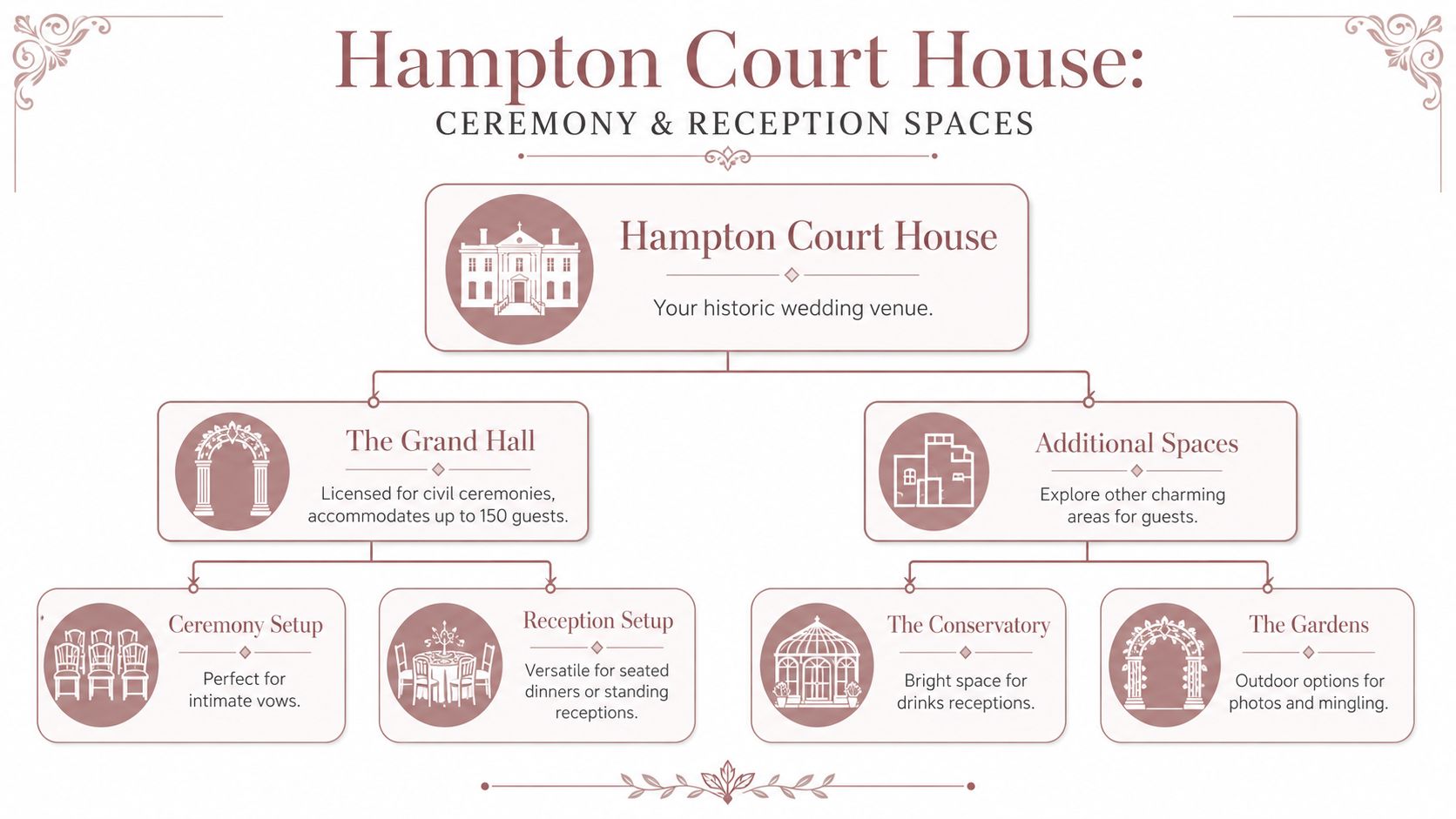
Guests feel this venue best in motion. They arrive, gather themselves, take their seats in the Grand Hall, then spill out into the gardens and lighter reception areas. For larger weddings, that sequence matters because a beautiful house can still feel awkward if 150 guests are left wondering where to go next.
The Grand Hall
The Grand Hall sets the tone from the start. It is licensed for up to 150 seated ceremony guests, as noted in this Hampton Court House venue guide, and that limit shapes plenty of planning decisions before you get to flowers or music.
The room already has presence. It does not need heavy styling to feel significant. In practice, the strongest ceremonies here usually keep the layout clean, use florals to frame the front rather than dominate it, and protect sightlines for the back rows. That last point matters more than couples expect in historic rooms, especially once photographers, musicians, and registrars are all working in the same footprint.
The main trade-off is flexibility. A listed room of this kind gives atmosphere, but it does not behave like a blank canvas. Large structures, involved staging, or ambitious technical setups can be difficult to approve and even harder to install without slowing the day down.
How the day works best
For weddings of this size, the day needs clear chapters. Ceremony in one mood. Drinks in another. Dinner with a proper sense of arrival. Dancing once the formal part has done its job.
A practical pattern usually looks like this:
- Ceremony in the Grand Hall: Guests are seated, focused, and contained in one defined space.
- Drinks reception in the gardens or adjoining areas: This creates breathing room and gives the ceremony space time to be reset if needed.
- Dinner in the main reception setting: A direct call to move works better than a gradual drift, especially with a larger guest count.
- Evening celebration in a space that can darken and soften: Lighting and layout make a noticeable difference once the day turns from formal to festive.
For couples comparing different heritage venues, this guide to wedding ceremony and reception locations is useful because the relationship between spaces is as important as how each room looks in photographs.
Using the gardens well
The gardens are not just a pretty backdrop. They solve crowding, improve the rhythm of the day, and give 150-plus guests somewhere to spread out without the wedding losing shape.
That said, garden use needs discipline. Drinks service has to be positioned sensibly. Elderly relatives need an easy route and enough seating. If you want confetti, a group photo, canapés, and couple portraits outside, those moments need to be timed so guests are occupied rather than parked. I often advise couples to decide early what the gardens are doing for them. Reception space, photo setting, guest breathing room, or all three. If it is all three, the schedule has to reflect that.
Weather is the obvious variable, but not the only one. Ground conditions, shade, and travel distance back into the house all affect how comfortable guests feel and how quickly the event can pivot if needed.
What works and what doesn't in a listed house
The practical reality of a Grade II* listed venue is simple. The building sets the terms.
That affects event delivery in ways couples do not always see at first glance:
| Planning area | What usually works | What often doesn't |
|---|---|---|
| Ceremony styling | Elegant florals, restrained aisle design, freestanding pieces | Oversized structures that fight the room |
| AV | Compact, discreet sound and lighting plans | Large rigs that need extensive fixing or complex load-in |
| Room turns | Simple resets with clear staffing | Multiple dramatic flips with tight timing |
| Supplier setup | Teams who've planned listed venues before | Suppliers assuming a blank-canvas workflow |
Planning rule: In a historic house, every extra production layer should earn its place by making the guest experience better.
The feel of the reception spaces
What works so well here is contrast. The ceremony can feel formal and grounded, then the reception opens out into something looser and more sociable. That shift keeps the day from feeling visually or emotionally flat.
The best Hampton Court House weddings do not force one room to do every job. They use the house and gardens in sequence, with purpose, so guests always know where the day is heading and still feel free to enjoy it.
Understanding Costs at Hampton Court House
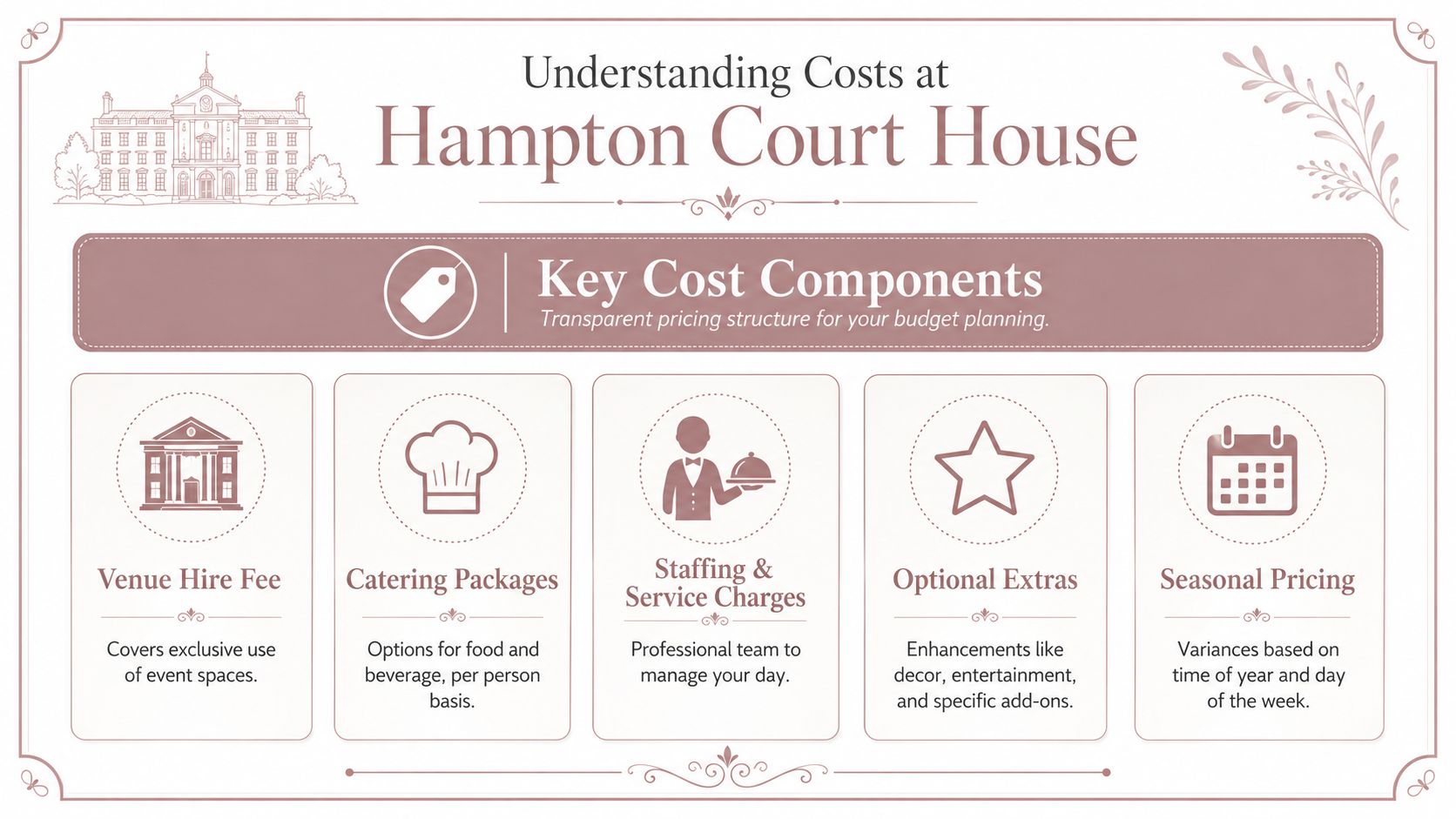
A 150-guest wedding at Hampton Court House can look deceptively simple on paper. The house is beautiful, the gardens do a lot of visual work for you, and the guest experience feels effortless when it is planned well. The budget tells a different story. What costs money here is not just access to the rooms. It is the staffing, timing, and backup planning needed to keep guests comfortable as the day moves between house and gardens.
What the venue hire typically covers
Venue hire covers use of the house and grounds within the terms the venue allows. At a property like this, that often includes the spaces themselves, the existing character of the setting, and the operational guardrails that keep the day running safely.
Couples can normally expect costs in this category to include:
- Exclusive use of agreed spaces: Ceremony rooms, reception rooms, and selected garden areas within your package.
- Venue management oversight: The in-house team managing access, timings, and venue-side supervision.
- Existing furniture and approved infrastructure: Items the property already holds and permits for wedding use.
This is the figure couples compare first, but it is only one layer of the budget. For a broader view of how historic houses, marquees, and all-inclusive venues structure pricing, this guide to wedding venues and prices is a useful benchmark.
What sits outside the hire fee
Budgets quickly widen, especially for larger guest counts.
A realistic Hampton Court House budget often needs separate allowances for:
- Catering and drinks: One of the largest costs after venue hire, particularly once you factor in reception drinks, dinner, evening food, and bar structure.
- Staffing and service charges: This matters even more if your format is labour-heavy.
- Floristry: The rooms do not need overdecorating, but long tables, stair moments, and garden focal points still add up.
- Production: Sound, lighting, staging, power distribution, and technical support where required.
- Weather cover: If cocktails, group photos, or guest mingling depend on the gardens, the fallback plan needs proper budget behind it.
For big weddings, I advise couples to cost the transitions, not just the headline elements. A drinks reception spread across lawns sounds relaxed and romantic. It also needs enough staff, bars in the right place, and a wet-weather option that does not force 150 guests into a bottleneck.
Why listed-building realities affect cost
Historic venues charge for complexity as much as beauty. Hampton Court House is not a blank canvas, and that is part of its appeal. It also means installations need care, supplier access can be more controlled, and ambitious production has to work around the building rather than the other way round.
That affects real budget lines. Setup can take longer. Specialist delivery crews may be needed for heavier floral or lighting schemes. Room turns need enough hands to happen cleanly without guests feeling parked between spaces. If your plan relies heavily on the gardens, poor weather can trigger extra furniture moves, additional staffing, and more covered service infrastructure than couples first expect.
Cheap assumptions often become expensive fixes.
A better way to budget for the day
The most useful question is not “What does Hampton Court House cost?” The better question is “What does our version of this wedding need in order to feel generous and well run?”
Use these three filters when you build the budget:
- What does the house already do well without extra spend?
- What has to be added for 150-plus guests to move comfortably between rooms and gardens?
- Which costs are decorative, and which protect the guest experience?
That third question saves money. Candle upgrades are decorative. Extra covered service space, additional loos if required by the format, or a stronger staffing plan are operational. Protect the operational spend first.
Timeline pressure affects cost too. Late decisions often mean premium labour, rushed production hires, or fewer supplier options. Couples working through transport timings and guest movement can borrow useful ideas from All Black Limo's timeline advice, especially if different parts of the day depend on tight sequencing.
At this venue, the smartest budgets are the ones that respect flow. Not just the look of the day, but how 150 guests will eat, drink, move, wait, and stay comfortable from the first arrival to the last dance.
Dining and Supplier Options
Food matters more in a historic venue than couples sometimes expect. The setting creates anticipation. Guests sit down expecting the meal to match the surroundings.
That doesn't mean everything has to be formal. It does mean the catering style must fit the movement of the day. If your drinks reception is spread across garden and interior spaces, and dinner follows after a pause for photographs, the menu needs to hold quality without creating service drag.
Choosing a menu that fits the venue
At Hampton Court House, the smartest menu decisions usually come from practicality rather than trend-following. A plated wedding breakfast can feel polished and right for the setting. Bowl food or more relaxed service can also work, but only if the guest count, staffing plan, and furniture layout support it.
When reviewing catering options, ask suppliers these questions:
- How does this menu hold during delayed service? Historic venues can involve longer transitions than city hotels.
- Can you manage dietary requirements cleanly? Not awkwardly, not reactively. Cleanly.
- What does your service look like in mixed indoor and outdoor use? Garden drinks receptions change tray service, bar queues, and timing.
Preferred teams versus outside suppliers
Many heritage venues work best with suppliers who already understand the site. That isn't gatekeeping. It's operational common sense.
A florist who knows where installations can stand safely, a band that understands sound limitations, or a caterer who's familiar with access points and back-of-house realities will usually give you a calmer day than a brilliant team learning the venue on the fly.
That said, couples shouldn't choose recommended suppliers blindly. Use this filter:
| Supplier type | What to ask first |
|---|---|
| Caterer | Have you served this style of wedding in a listed venue before? |
| Florist | How do you design for rooms that already have strong character? |
| Band or DJ | How do you adapt volume and setup to heritage-site rules? |
| Photographer | Can you work quickly so guests aren't left waiting between spaces? |
One area couples often underestimate is transport timing. A late car arrival can knock ceremony prep, couple portraits, and even catering pace. If you're building your running order, All Black Limo's timeline advice is worth reading because it breaks down where transport delays ripple through the day.
Good suppliers don't just make things look lovely. They reduce friction you would otherwise feel all day.
Planning Your Wedding Day Logistics
A 160-guest wedding at Hampton Court House can feel glorious for one hour and disjointed the next if the day has not been mapped properly. I see the pressure points in the same places every time. Guests drifting after the ceremony, a bar queue forming in the prettiest part of the garden, family groups blocking service paths, and the couple losing twenty minutes because nobody gave a clear call to move inside.
The grounds are one of the venue's biggest strengths. They also need to be treated as working event space, especially once your numbers move past 150. The question is not whether the gardens are beautiful. It is whether they can carry drinks, photos, conversation, staff movement, and directional hosting at the same time without the day losing shape.
Guest flow for larger weddings
At this venue, scale changes everything. Eight acres sounds generous on paper, but large weddings rarely use all of that space well. They gather in the same photogenic pockets, and that is where planning either saves the atmosphere or lets it sag.
For bigger guest counts, I advise assigning each outdoor area a single job. One area handles arrival and first directions. Another holds drinks service with enough width for staff to pass behind guests. A quieter pocket is kept back for couple portraits or older relatives who want a calmer conversation. Staff also need a clean route for glassware, canapés, and any furniture moves.
That separation matters more than couples expect.
Historic gardens can feel open during a site visit and much tighter on the day once you add chairs, musicians, dresses with volume, family groups, and people stopping every few yards to talk. If every attractive corner is doing three things at once, circulation slows and the energy drops.
Sound, atmosphere, and the reality of outdoor hosting
Music outdoors needs a different mindset from music in a ballroom. Sound disperses quickly, guests spread out, and what felt romantic in the planning stage can become thin or oddly distant in practice.
That is why pre-dinner garden music tends to work best at a smaller scale. A string duo, roaming musicians, or a well-placed acoustic set often creates better atmosphere than trying to force an evening-party setup into the gardens too early. Save the fuller sound for the point in the day when guests are gathered with intention and the room can hold the energy.
Weather planning also needs to be blunt, not hopeful. Couples should know exactly what shifts if the ground is wet, if temperatures drop, or if a garden drinks reception has to be shortened. The best plans here are not the most ambitious. They are the ones that still feel polished after a late weather call.
The gardens need structure. Beauty is already built in.
Building a timeline that keeps 150 plus guests together
Large weddings need clearer cues than intimate ones. Guests will not all follow subtle signals, and they should not have to guess where to go next.
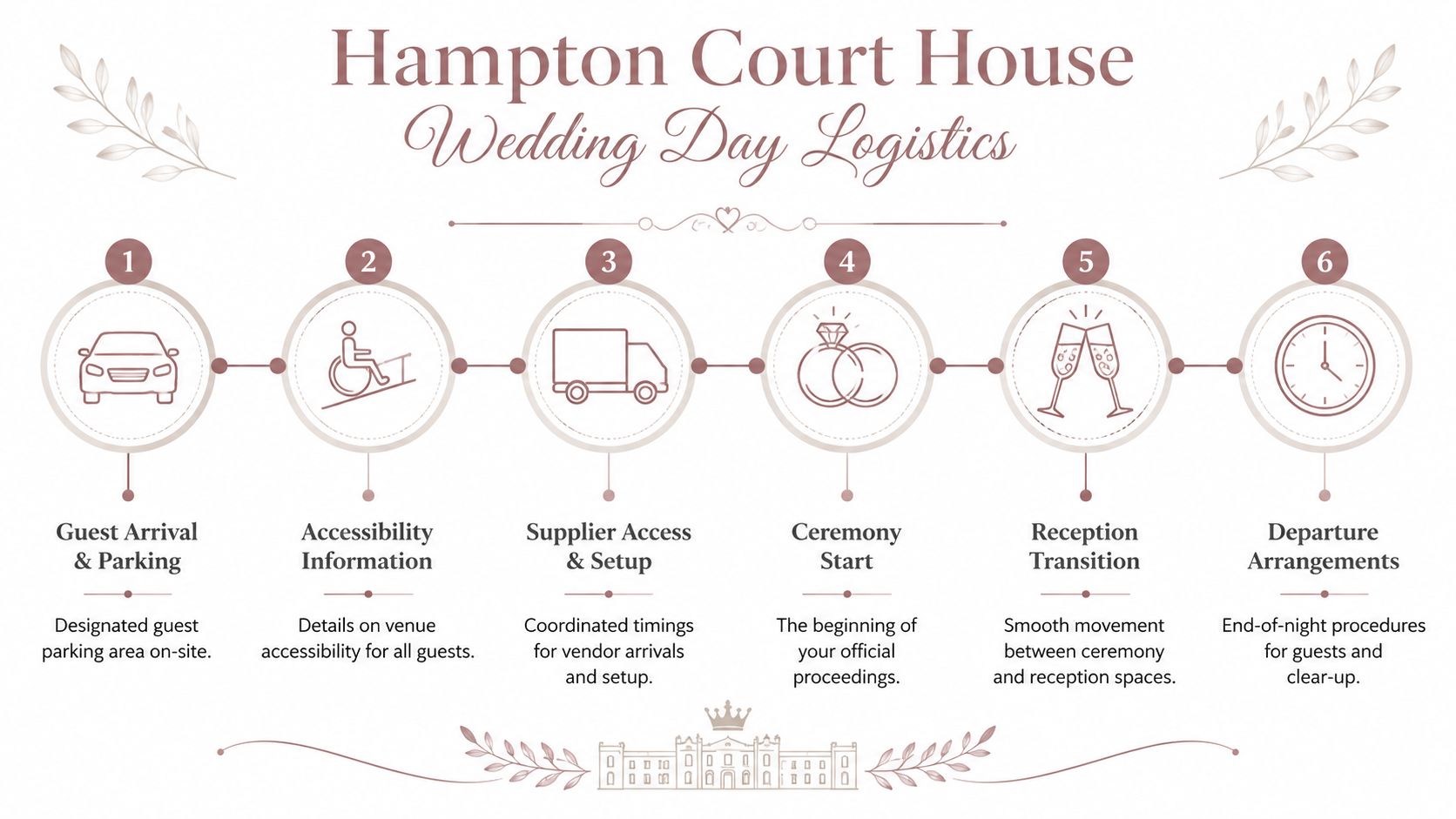
A strong running order at Hampton Court House often includes:
- Early supplier access so florists, production teams, and caterers can load in without creating stress at guest arrival.
- A tight arrival window that gives people time to settle but keeps ceremony momentum.
- An immediate post-ceremony direction with staff or signage sending everyone to the same drinks area.
- A clear call to dinner because a big guest list does not self-organise.
- A deliberate evening reset with lighting, music, and bar service changing the mood fast enough that the day feels like it is progressing.
This is also the stage to pressure-test comfort, not just timings. Ask the venue team where older guests can be dropped, which routes are easiest for anyone with limited mobility, how long the walk is between key points, and what changes if outdoor use is reduced. Those answers matter more than couples realise, because guest comfort shapes how relaxed the whole celebration feels.
For visual planning inspiration, it helps to explore Liz by Design weddings and study how well-run celebrations use open-air space without letting it sprawl.
What works best at this venue
The strongest Hampton Court House weddings keep movement simple, give the gardens a defined role, and accept that a historic house performs best with a plan that respects its layout. Couples who do that get the romance people come for, without the avoidable friction that larger guest counts can create.
Creating Timeless Wedding Photos
Hampton Court House photographs best when the day isn't overpacked. That's the first truth to hold onto. A venue with this much architectural and garden character doesn't need a frantic portrait schedule. It needs enough space in the timeline for the setting to breathe.
The backdrops worth prioritising
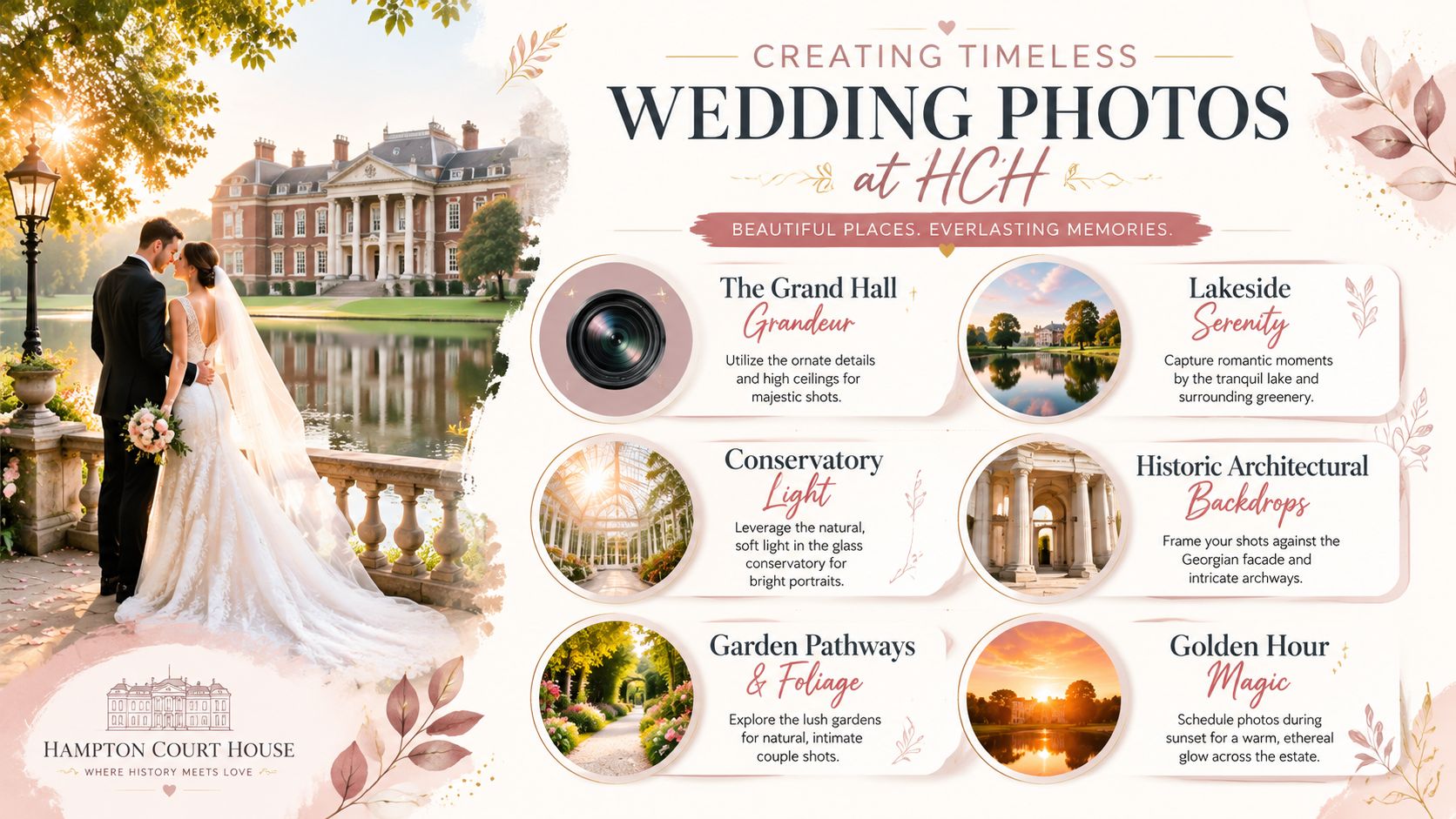
The most memorable albums here usually balance grandeur with intimacy. You want some frames that show the scale of the house, and others that feel discovered rather than staged.
Photographers generally get the most variety from:
- The main façade: Best for clean, classic portraits with a sense of arrival.
- Garden pathways and softer planted areas: Better for movement, relaxed couple portraits, and family groups that don't feel formal.
- Light-filled interior spaces: Useful when the weather turns or when you want polished editorial-style images.
- Water and reflective garden features: Strong later in the day when the light softens.
The shell grotto and more secluded corners of the grounds tend to work best when used sparingly. They're special because they feel tucked away. Treat them as a quiet interlude, not a full portrait marathon.
Timing matters more than location
At this venue, light and guest flow affect photographs as much as the backdrop itself. If you disappear for too long during drinks, the day can lose momentum. If you leave all couple portraits until after dinner, you may get better light but flatter energy.
A balanced approach usually works best. Take a short set of portraits soon after the ceremony while guests settle into drinks, then step out again later for a quieter set when the grounds have a different mood.
If you're still shortlisting visual styles, it helps to explore Liz by Design weddings and compare how different photographers handle movement, architecture, and natural light in historic settings.
The strongest wedding photographs at heritage venues rarely come from doing more. They come from noticing where the setting already gives you shape, texture, and calm.
How to Book Your Hampton Court House Wedding
A strong booking process starts long before you pay a deposit. For a house and gardens like this, the right first conversation can save weeks of reworking guest flow, catering plans, and wet-weather contingencies later, especially if you are trying to host 150 or more guests without the day feeling crowded.
Start with a precise enquiry. Include your preferred month, realistic guest count, ceremony location, expected finish time, and how heavily you want to use the gardens. If drinks, portraits, or a full garden reception matter to you, say so at the outset. Historic venues can host beautiful large weddings, but the success of the day depends on how each part of the schedule moves from one space to the next.
A practical booking path
- Book a viewing with your real numbers in mind. A venue can feel generous for 80 and far more complex for 150-plus. Walk the route your guests will take, not just the rooms you like most.
- Ask operational questions before you fall in love with the setting. Check access for suppliers, load-in times, sound limits, power, curfews, and what happens if the garden plan has to move indoors.
- Request the full hire details in writing. Look closely at what is included, what needs approval, and which costs sit outside the venue fee.
- Clarify the hold process and decision deadline. Good dates go quickly, particularly in late spring and early autumn.
- Line up your planner, caterer, and production team early. At heritage venues, the day runs better when the people handling timing, furniture, lighting, and guest movement are working from the same plan from the start.
One point catches couples out more often than it should. Hampton Court House and Hampton Court Palace are different venues, with different scale, rules, and atmosphere. The Palace is the larger, more ceremonial option. The House suits couples who want a private-house character and a wedding that feels more contained, even with a sizeable guest list. If you are comparing the two, use the official Hampton Court Palace events information for current capacities and event permissions rather than relying on third-party venue roundups.
Final questions to settle before you commit
- Confetti and fireworks: Ask for the current written policy before booking either supplier.
- Drone photography: Permission is never automatic at heritage properties.
- Wet-weather planning: Ask the venue to show you exactly where guests go, where drinks are served, and how the room turn works if the gardens are unusable.
- Guest flow for larger weddings: For 150-plus guests, ask where bottlenecks happen. Entrances, bar points, cloakroom areas, and garden access matter as much as the ceremony room itself.
A pretty viewing tells you very little. A useful viewing answers how the day will work.
If you're comparing historic venues that can handle atmosphere and logistics in equal measure, Battle Abbey Weddings is well worth a look. It offers a distinctive heritage setting in East Sussex with flexible options for intimate celebrations and larger guest lists, plus the kind of practical planning support that makes complex wedding days feel calm.