The wedding is over, the flowers are fading beautifully in the kitchen, and your marriage certificate is sitting in a safe place while you wonder what happens next. For many couples, this is the point where the romance of a new surname collides with passport forms, bank logins and the sudden realisation that none of this updates itself.
The good news is that how to change your name after marriage UK style is usually much simpler than people expect. It helps to treat it as a short project rather than a vague life admin task. Get your documents in order, deal with the highest-friction items first, and time everything around your honeymoon instead of trying to force it into the busiest week of your life.
Your Post-Wedding Name Change Explained
Most couples assume a name change after marriage is a legal procedure. In practice, for the standard route in England and Wales, it's mainly an administrative process.
If you're taking your spouse's surname, your marriage certificate is usually the key document. In England and Wales, it is typically accepted as documentary evidence for changing your name with organisations such as the Passport Office and DVLA, so you don't usually need a deed poll for that straightforward change, as explained by the UK Deed Poll Service.
That distinction matters because it changes the tone of the whole task. You're not asking for permission to become someone else. You're showing organisations evidence that your records now need to match the name you intend to use.
What this means in real life
For most newlyweds, the process looks like this:
- Get your marriage certificate and keep it accessible.
- Decide exactly what name you're using on official records.
- Update your core ID first, then everything else that relies on it.
- Work through accounts in a sensible order rather than sending paperwork everywhere at once.
Practical rule: If your change is a simple move to your spouse's surname, start by assuming the marriage certificate is enough, then check each organisation's own evidence rules before posting anything.
This is also the point where wider post-wedding admin tends to bunch together. Couples often update beneficiaries, review wills, and look again at shared finances. If you're sorting those practicalities at the same time, it can help to review things like joint life insurance policies alongside your name-change paperwork so your records stay aligned.
The part many couples overcomplicate
You don't have to do everything in the week after the wedding. You also don't have to change your surname at all. The administrative route is there if you want it, not because the law demands it.
If you're still in the planning stage and want the ceremony side fully clear before you think about surname paperwork, a solid starting point is this guide to a registry office wedding in the UK. It helps couples understand the formal marriage paperwork that later supports a name change.
Gathering Your Essential Documents
Before you notify a single bank or government department, pause and assemble your paperwork properly. This is the stage that saves the most stress later.
A surprising amount of frustration comes from sending the wrong version of a document to the wrong place. Some organisations are content with a certified copy. Others insist on the original certificate. A photocopy usually won't satisfy anyone dealing with identity records.
There's also a broader shift in how couples approach surnames. An Independent report said 90% of British women took their husband's last name in a 2016 survey, while requests to retain a maiden name alongside a spouse's surname rose by 30% between 2020 and 2021, showing that alternatives have become more visible in practice, according to the Independent's reporting on post-marriage naming choices.
The documents to gather first
Start with a short folder, physical or digital, for the essentials:
- Marriage certificate. This is the cornerstone document for a standard surname change.
- Photo ID in your current name. Usually your passport or driving licence.
- Proof of address. Some banks and providers may ask for this.
- Existing account details. Sort codes, policy numbers, mortgage references, employee number, pension numbers.
- A written list of your intended name format. This sounds minor, but it prevents inconsistent applications.
If you're still arranging the legal side of your wedding itself, this overview of how to get married in the UK is useful context because it helps couples understand how the ceremony paperwork and certificate fit into the wider process.
Original certificate or certified copy
At this stage, couples often lose time.
An original marriage certificate is the official document issued by the registrar. A certified copy is an official copy issued through proper channels and may be accepted by some institutions if they explicitly say so. A photocopy is your own reproduction and is rarely enough for formal record changes.
The smart approach is simple. Check each organisation's evidence policy before posting documents, because replacing time is harder than replacing paper.
A practical system that works well is to keep one certificate untouched at home, then use additional official copies where institutions still want documents sent by post. That reduces the risk of your only certificate sitting in the wrong internal mail room.
When you might need a deed poll
For a straightforward surname change after marriage, you generally won't. But some naming choices fall outside the clean marriage-certificate route.
You may need a deed poll if you want to:
- Create a brand-new combined surname rather than use one already shown by marriage evidence
- Change a middle name
- Make a more complex alteration that isn't clearly supported by the marriage certificate alone
That doesn't mean your choice is unusual. It just means the paperwork changes.
A quick visual walkthrough can help before you begin:
The Official Name Change Checklist Who to Tell and How
The cleanest workflow is document-led. Use your marriage certificate to update your passport and driving licence first, then use those updated records to cascade the change to banks and other providers. For property held at HM Land Registry, a name change after marriage is handled with form AP1, and the guidance noted in this process says no fee is payable, as outlined in the Guides for Brides name-change guidance.
That order works because some organisations are more comfortable updating their records when they can see one or two pieces of government-issued ID already in the new name. It reduces back-and-forth and cuts down on “please send more evidence” letters.
Start with the priority records
Think of these as your anchor documents.
Passport
If you plan to use your new name for travel later, this record matters most. It often becomes the ID that enables other updates.Driving licence
This is another high-value identity document and one that many financial organisations recognise quickly. If you want a practical overview of what supporting paperwork is often needed, this licence name change evidence checklist is a helpful reference before you apply.Bank and building society accounts
Once your key ID is underway or complete, financial institutions tend to be much easier to deal with.
Working rule: Don't start with loyalty accounts, subscriptions and online shopping profiles. Start with the records that other institutions trust.
UK Name Change Quick Reference Guide
| Organisation | Document Needed | Typical Cost (2026) | Avg. Processing Time |
|---|---|---|---|
| HM Passport Office | Marriage certificate and passport application documents | Check current Passport Office fee before applying | Varies by application route |
| DVLA | Marriage certificate and driving licence update application | Check current DVLA guidance | Varies by application route |
| HMRC | Usually marriage certificate and updated identity details if requested | No standard charge stated here | Varies |
| Employer payroll and HR | Marriage certificate and internal HR form if used | Usually no fee | Depends on employer |
| Bank or building society | Marriage certificate, plus ID or branch verification if required | Usually no fee, though some providers may have admin rules | Varies by provider |
| Pension provider | Marriage certificate and provider's own form | Usually no fee | Varies by provider |
| Mortgage provider | Marriage certificate and account verification | Varies by lender | Varies |
| Council tax and electoral records | Marriage certificate and local authority update process | Usually no fee | Varies by council |
| GP and dentist | Marriage certificate or ID if requested | Usually no fee | Varies by practice |
| HM Land Registry | Form AP1 and supporting evidence such as marriage certificate | No fee | Varies |
The practical order that works
Rather than treating this as one giant list, split it into waves.
Wave one should include records that prove who you are. Passport, driving licence, and any immigration or travel-related records if relevant to your circumstances.
Wave two is financial and employment. Banks, credit cards, mortgage, savings, payroll, pension, insurance.
Wave three is everything else that causes irritation rather than legal problems. Utilities, GP, dentist, local memberships, airline loyalty schemes, retail accounts, professional directories, and email display names.
A few friction points to expect
Some banks still prefer an in-person branch visit. Some providers only update one product at a time even if you hold several with the same brand. Others want the name changed on your debit card before they'll reissue linked documents.
For HM Land Registry, accuracy matters more than volume. The AP1 route is straightforward when completed cleanly, but untidy submissions create unnecessary delay. Use the required panels only, include the supporting evidence clearly, and don't overfill the form with irrelevant information.
Keep a live tracker
A simple spreadsheet works better than memory. Include:
- Organisation name
- Date submitted
- What evidence you sent
- Whether originals were returned
- Date confirmed
- Any follow-up needed
This is the difference between a tidy project and a month of wondering whether your pension provider ever received your envelope.
Strategically Timing Your Name Change
The biggest timing mistake couples make is trying to finish every update before the honeymoon. It sounds efficient. It often creates the very delays they're trying to avoid.
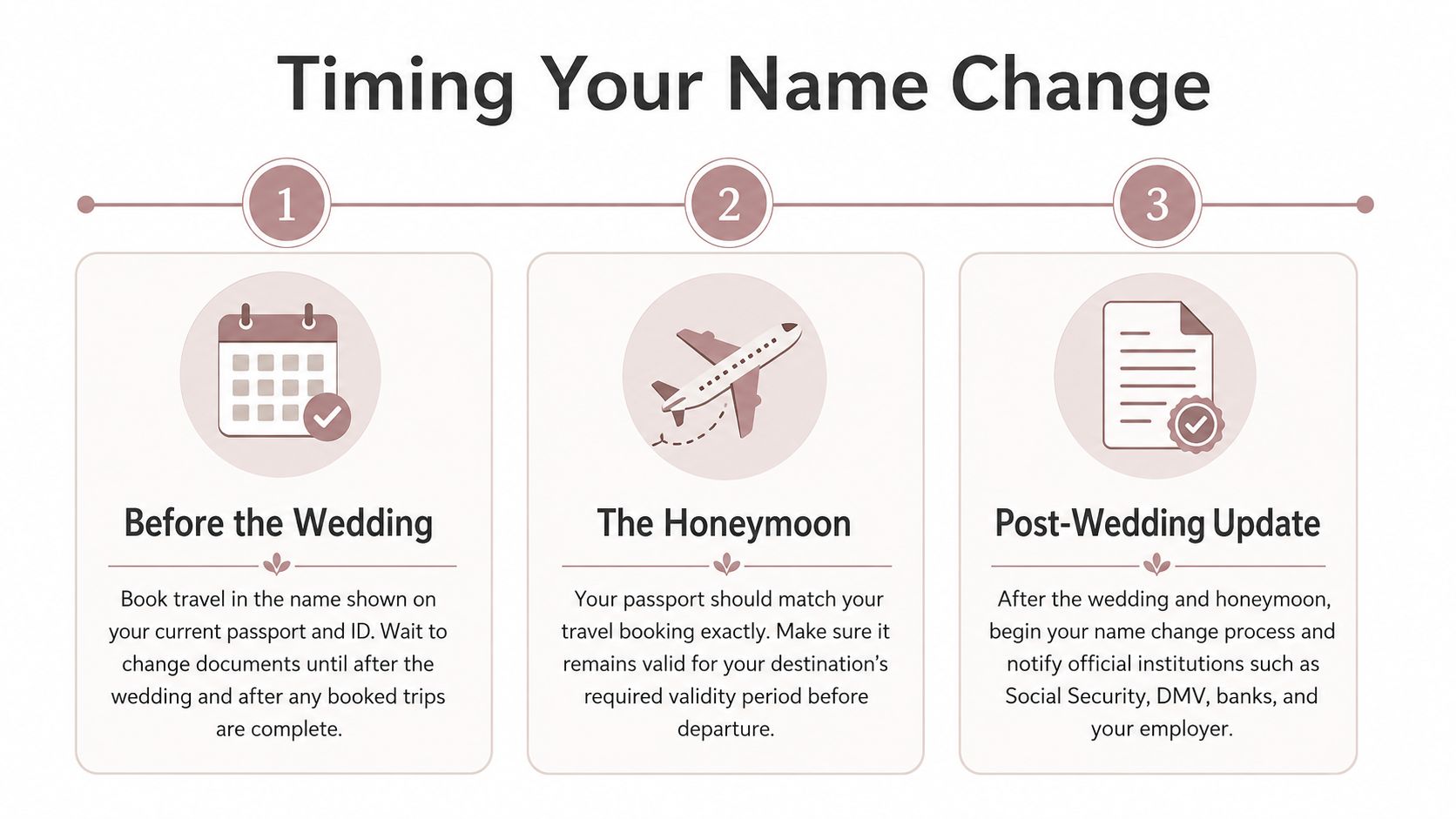
The highest-friction steps are usually the passport and driving licence, and they can take 6 to 10 weeks to process. The same guidance warns that any mismatch between the name on a booking and the name on a passport can create avoidable travel delays, which is why sequencing matters so much, according to this UK post-marriage name-change timeline guidance.
The safest honeymoon rule
If you're travelling soon after the wedding, book the honeymoon in the name that already appears on your passport. That is usually the safest and least stressful route.
I've seen couples assume they can “just update the passport quickly after the wedding”. That gamble can affect flights, visas, travel insurance records and even hotel bookings if everything isn't perfectly aligned.
Book travel in the passport name you already hold, then deal with the official name change once you're back and no one is waiting at a check-in desk.
A calmer timeline
A wedding works better when admin has its own lane. This timeline is the one I recommend most often.
Before the wedding
- Decide whether you're changing your name at all
- Choose the exact format of the new surname
- Book any honeymoon travel in your current passport name unless you have very clear time and evidence to do otherwise
- Make a list of every organisation you'll need to update
If you're balancing this with the wider logistics of the event, a detailed wedding planning timeline helps keep paperwork from colliding with final seating plans and supplier deadlines.
In the first days after the wedding
Order or collect your marriage certificate and store it safely. Don't try to complete every name-change task while you're also unpacking gifts, paying final supplier balances and recovering from the weekend.
This is the stage for organising, not rushing.
After the honeymoon
Begin the formal updates in sequence. Start the passport and driving licence applications, then move on to financial records and the rest.
This approach is less glamorous, but it works. You reduce the odds of document mismatch, avoid duplicate applications, and stop the honeymoon becoming a race against postal processing.
What doesn't work
Three habits create most of the mess:
- Booking travel in a new surname before the passport matches
- Sending your only certificate to several places in quick succession
- Updating low-priority accounts before core ID
Each one sounds harmless. Together, they create confusion, repeated paperwork and last-minute phone calls no newlywed wants to make.
Handling Alternatives and Special Circumstances
Not everyone wants the standard path, and that's where many guides fall short. In England and Wales, there is no legal requirement to change your name after marriage, and official updates are not automatic. The travel point matters too. If your passport still shows your old name, booking flights in a new one is risky, as explained in this Hitched guide to changing your name after marriage.
If you want to keep your surname
You can keep it. There is no extra legal step required just because you've married.
Some people still choose to update their title socially while keeping the same surname. Others keep one name professionally and another socially. The key is consistency on official records. Decide where you need legal alignment and where social preference is enough.
Double-barrelled surnames and more complex choices
A double-barrelled surname can often be handled using the marriage certificate when the change clearly reflects the marriage. That tends to be more straightforward than creating an entirely new surname.
More complex changes usually need more formal paperwork. Examples include:
- Meshing two surnames into a new one
- Changing a middle name at the same time
- Adopting a name that isn't clearly evidenced by the marriage certificate
In those situations, a deed poll is often the cleaner route.
Choose the version of your name that you'll actually want to use in daily life. The paperwork is manageable. Reversing a rushed decision is what usually feels tedious.
Professional names, international records and children
Professional identity deserves a separate thought. If your career is established under one surname, you may prefer to keep using it at work even if your personal records change. That's common, but you need to be clear with HR, payroll and any regulated professional body so records don't drift apart.
If one or both of you are not British citizens, extra checks may apply through your home country's passport authority or consular rules. The UK marriage certificate may support the change, but foreign authorities may ask for additional evidence or follow a different process entirely.
Children's records can also need separate attention if the family is trying to align surnames across passports, schools or medical records. That isn't usually part of the automatic marriage admin. It needs its own checks with the relevant authority.
Your Name Change Questions Answered
Can I become Mrs without changing my surname
Yes. The UK Deed Poll Service says that if you're keeping your maiden name, you don't need a deed poll just to reflect that your title has changed to Mrs. You can notify organisations that your surname stays the same while your title changes.
Is there a time limit to change my name after marriage
No fixed deadline is set out in the guidance discussed here. Many couples do it quickly because it suits them. Others wait until they renew a passport, change jobs, move house or have the energy for the admin.
What if I want to go back to my previous surname later
If your circumstances change later, the practical route will depend on what records need updating and what evidence each organisation wants. Some reversions are handled with supporting legal documents linked to the change in status. Where the route isn't straightforward, it's worth checking the exact evidence requirements of each organisation before you begin.
What if I'm not a British citizen
Start with the authority that issued your passport. UK organisations may accept your marriage certificate for some record updates, but your nationality, immigration status and home-country rules may affect how your primary identity documents are changed.
If you're still planning the wedding itself and want a venue team that understands both the romance and the paperwork around the day, Battle Abbey Weddings offers a historic East Sussex setting with experienced planning support, licensed ceremony spaces and practical guidance that helps couples move from wedding planning into married life with less stress.