You’re probably holding two ideas in your head at once. You want the ceremony to feel magical when you step into view and see everyone you love looking back at you. You also need the room to work properly, especially in a historic venue where walls, beams, terraces, and listed-building rules shape every decision.
That’s why theatre style seating remains such a dependable choice. It’s elegant, easy for guests to understand, and wonderfully focused. When it’s planned well, it doesn’t feel like “rows of chairs”. It feels like a clear, shared gaze toward the most important moment of the day.
Historic venues add another layer. They offer atmosphere you could never manufacture in a blank marquee or hotel suite, but they also ask more of the layout. A straight import from a modern conference room rarely works. In places like Battle Abbey, theatre style seating has to respect the building, frame the views, and still let guests move comfortably and safely.
Envisioning Your Perfect Ceremony
Most couples start with the aisle. You picture the walk, the music, the faces in the front row, and the point where the room seems to narrow into one meaningful line toward your partner. That’s the emotional strength of theatre style seating.

At its simplest, theatre style seating means chairs arranged in rows facing a focal point. For a wedding, that focal point is usually the ceremony table, floral arch, fireplace, window view, or the exact spot where you’ll exchange vows. Think of it as a private viewing of the most personal event you’ll ever host. Every chair supports the same purpose. Every line in the room leads attention forward.
That’s why this layout feels so timeless. It creates order without stiffness. Guests know where to look, photographers get cleaner sightlines, and the ceremony gains a sense of occasion the moment people take their seats.
Why couples keep coming back to it
Theatre style seating works especially well when you want the ceremony to feel:
- Focused because everyone faces the same direction
- Intimate because shared attention creates emotional closeness
- Formal enough for the setting without feeling overly rigid
- Efficient when you need to seat a larger guest list in one ceremony space
It also gives you a proper aisle. That matters more than many couples realise. The aisle isn’t just a walkway. It’s the visual spine of the ceremony.
Practical rule: If you want the moment of arrival to feel clear and cinematic, theatre style seating usually gives you the strongest framework.
Where people get confused
Couples often assume theatre style seating is plain by default. It isn’t. The layout is classic, but the final look depends on chair choice, spacing, floral styling, aisle treatment, and how you use the room’s architecture.
In a historic venue, that architecture does half the styling for you. Stone walls, leaded windows, timber beams, and terrace views add character before you place a single chair. Your job isn’t to overpower those features. It’s to arrange guests so the room can do its work.
That’s where good planning turns a simple layout into something unforgettable.
The Blueprint for Flawless Theatre Seating
A theatre-style plan usually looks simple on paper. Then you arrive in a historic room with a fireplace that shifts the focal point, uneven wall lines, and a doorway exactly where you hoped to place the last row. That is why the best layouts start with measurements and movement, then build toward beauty.
At Battle Abbey and similar heritage venues, the room sets the rules first. Protected architecture, worn stone thresholds, deep window reveals, and original features all affect where chairs can sit and how guests will move. Good planning respects those features and still gives the ceremony a clear, dramatic shape.
Start with the chair, not the floorplan
Couples often approve a layout before choosing the actual ceremony chair. That is where spacing problems begin.
A slim Chiavari, a ghost chair, and an upholstered armchair may all look elegant in a mood board, but they occupy the room very differently. The distinction between seat width and seat centres is important because one measures the chair itself, while the other measures how much personal space each guest gets. In practical terms, historic venues usually reward a little generosity here. Rows look calmer, guests sit more comfortably, and the room feels considered rather than crowded.
If your venue includes irregular alcoves or narrowing walls, measure the widest part of the chair as it will be used, not as it appears in a supplier photo. A chair with a curved back or decorative arm can steal the inches you thought you had.
Row depth decides comfort faster than couples expect
Row depth is the distance from one row to the next. It works like legroom on a train. People may not comment when it is comfortable, but they notice immediately when it is tight.
In a wedding setting, that affects more than comfort. It affects how easily an elderly guest can sit down, whether a parent can step out with a child without disturbing half the row, and how polished the ceremony feels once everyone is seated. Historic venues can magnify this issue because older rooms were not designed for modern chair grids. A slight slope, a projecting radiator cover, or a stone pier can interrupt what looked like a tidy run of rows.
Seatway clearance matters for the same reason. Guests need enough space to enter and leave rows without twisting sideways or brushing against every chair on the way in.
If a layout only works when every guest moves carefully and in the right order, it is too tight for a wedding ceremony.
Aisles need to feel generous in historic spaces
The aisle is not just empty space left between chairs. In a listed venue, it is the line that brings order to architecture that may be beautifully irregular.
A central aisle often suits a grand hall, but it is not the only answer. In some heritage rooms, a slightly offset aisle can preserve a better view of a window, screen, or fireplace while avoiding an awkward obstruction near the front. Side gangways also deserve proper attention. They help ushers seat guests calmly, give photographers cleaner access, and reduce the stop-start feeling that happens when everyone must enter from one point only.
For couples sketching options before a site visit, these expert tips for room layout can help you test circulation and furniture spacing in a practical way.
Capacity should follow experience, not the other way around
It is tempting to ask, “How many chairs can we fit?” A better question is, “How many guests can this room hold gracefully?”
That shift is especially useful in historic UK venues. You may be working around protected flooring, fixed architectural features, or a ceremony spot that must remain visually open to show off the room’s best perspective. At Battle Abbey, for example, the strongest theatre-style plans usually frame the ceremony against the architecture rather than trying to fill every corner with seating. A row removed at the back or a little more width in the aisle can improve the whole experience. The room breathes. Guests settle faster. Photographs make better use of the setting.
If your day also includes outdoor elements or a weather backup plan, it helps to review wedding tents and weather planning at the same time as your indoor ceremony layout, so entrances, holding areas, and guest flow all work together.
A simple planning sequence keeps the process manageable:
- Choose the exact chair first so your measurements reflect the actual footprint, not an estimate.
- Mark fixed features early such as fireplaces, pillars, steps, radiators, doors, and protected architectural details.
- Set row depth before counting capacity so comfort and access are built into the plan.
- Test the aisle in person by walking it from entrance to ceremony point.
- Leave breathing space where the room needs it because symmetry in a historic venue should feel natural, not forced.
The best theatre seating does not fight an old building. It works with it, the way a well-cut lining works inside a period gown. Guests may never name the individual decisions, but they will feel the ease of them from the moment they take their seats.
Mapping Your Ceremony at Battle Abbey
Historic venues rarely reward a copy-and-paste plan. The same theatre style seating principles can feel completely different once they meet stone walls, long sightlines, low beams, and outdoor terraces. Battle Abbey is a good example because each ceremony area asks for its own approach rather than one universal template.
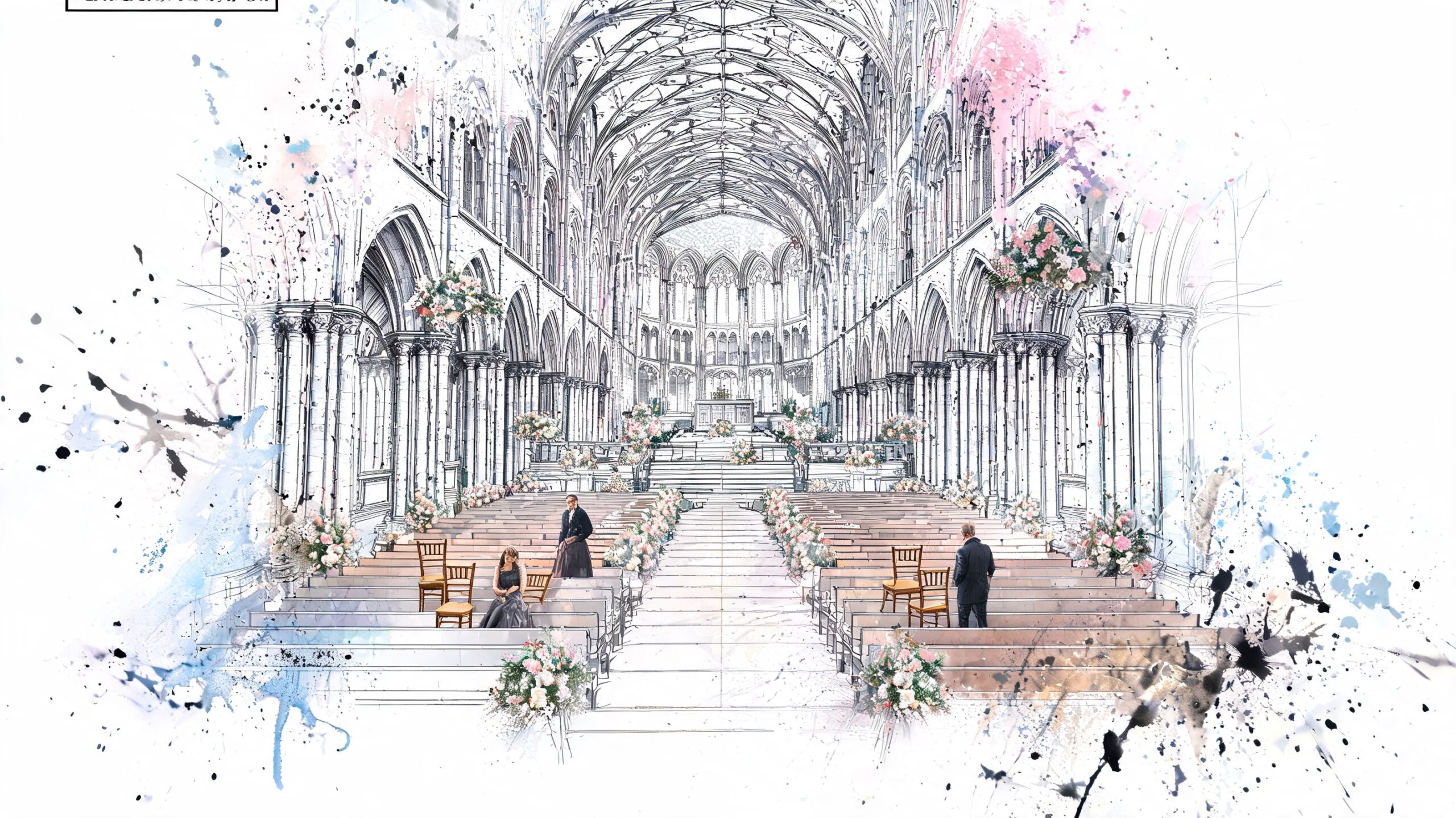
The charm is obvious. The planning nuance is what makes it work.
Abbot’s Hall for a fuller guest list
Abbot’s Hall suits the larger theatre-style ceremony best because the room can carry a sense of procession. For weddings in the 75 to 250 guest range described in the venue background, the goal isn’t only to fit rows in. It’s to decide what the room should frame.
A traditional central aisle with balanced blocks of chairs usually gives the strongest ceremony feel here. In a larger historic hall, symmetry calms the eye. It lets the architecture read clearly in photographs and keeps attention on the front without visual clutter.
If the room allows it, orient the focal point so guests see both the ceremony and some suggestion of the historic setting beyond it. That could be a fireplace, a window line, or a backdrop that nods to the wider estate rather than turning everyone toward a blank wall.
Duke’s Library for a smaller gathering
The Duke’s Library asks for a softer hand. Intimate weddings don’t benefit from empty rows, even in a beautiful room. In a smaller ceremony, theatre style seating often works best when it’s shortened, widened slightly, and allowed to breathe.
That can mean fewer rows with a more generous central aisle. It can also mean trimming the outer edges instead of trying to fill every possible corner. A historic room feels more luxurious when the seating plan respects its proportions.
In a small ceremony, spare space isn’t wasted space. It’s what allows the room to feel considered.
Top Terrace and Six Penny Lawn
Outdoor theatre style seating changes the emotional tone immediately. The layout is still orderly, but the backdrop becomes part of the ceremony design. On a terrace or lawn, the best orientation usually gives the front row a clear line to the view without forcing the couple to stand with harsh light in their eyes or wind at the microphone.
Straight rows can look excellent outdoors because the natural surroundings soften them. If the terrain is slightly irregular, use the line of the horizon or architectural remains as your visual guide rather than insisting on rigid geometry.
A few practical choices matter more outside:
- Chair stability on uneven ground
- Aisle surface for heels and mobility aids
- Speaker placement that doesn’t block the view
- Weather backup that preserves the ceremony flow
Couples who are drawn to these spaces often find it helpful to understand the broader character of the estate through this overview of what makes Battle Abbey a perfect historic wedding venue.
Ensuring Every Guest Has the Perfect View
A guest takes her seat in a medieval hall, smooths her outfit, and looks up. Instead of seeing your faces clearly, she finds herself peering around a stone pier and the hat in front of her. In a historic venue, sightlines need more care than they do in a modern blank-canvas room.
That is especially true in places such as Battle Abbey, where the architecture gives the ceremony much of its atmosphere. Ancient walls, deep window reveals, uneven floor levels, and beautiful structural features create drama, but they also ask for a seating plan that is tested in the space, not just sketched neatly on paper.

How to improve sightlines without losing charm
The first adjustment is often staggered seating. Rows still read as orderly and elegant, but each chair sits slightly off the line of the one in front. It works much like arranging people on steps for a group photograph. Guests look through the gaps instead of directly into the back of someone’s head.
A gentle curve can help too, particularly at the outer edges. In a heritage room, perfectly rigid rows sometimes push side guests out of the moment visually, even when they are physically quite close. A soft fan shape turns their attention back toward the ceremony and makes the whole layout feel more welcoming.
A simple guide usually works well:
- Use straight rows in narrower rooms with a strong central focal point
- Add staggered offsets once the guest count grows and heads begin to stack visually
- Curve the outer rows slightly when side sections start to feel detached
For couples planning a larger guest list, it helps to compare ceremony spaces that can support these adjustments gracefully in larger wedding venues for theatre-style layouts.
Working around heritage features
Historic details are part of the romance, but they must be treated with integrity. A stone pier, fireplace, timber post, or change in floor level can subtly block the exact view a guest came to enjoy. In a venue like Battle Abbey, the goal is not to force the room into modern symmetry. The goal is to let the architecture lead, then place the chairs with intention.
For this reason, the best test happens at seated eye level. Stand at the ceremony point, then move out into the guest rows. Sit in the third row on the left. Try the end chair on the right. Check the places older relatives are most likely to choose because they often prefer easy access and a clear line of sight. What looks balanced on a floor plan can feel very different once real people are in the room.
A good seating plan is tested from guest height, in guest positions, before it is finalised.
At Battle Abbey, that often means accepting a little asymmetry for the sake of a better experience. One side may need a shorter row. A front block may need to start slightly farther back to preserve a clean view past a historic feature. Those choices rarely weaken the look of the ceremony. More often, they make the room feel considered and calm.
Hearing matters as much as seeing
Guests remember a ceremony best when they can follow every word without effort. Historic stone interiors can soften consonants and blur vows. Outdoor spaces can carry sound away just as quickly as they carry it across a lawn.
Discreet microphones and carefully positioned speakers usually solve the problem without disturbing the setting. Indoors, aim sound toward the seated guests rather than letting it bounce around the walls. Outdoors, keep equipment low-profile and place it so the back rows hear clearly without cluttering the view from the front.
The best theatre-style seating plan does two things at once. It frames the couple beautifully, and it lets every guest feel included in the moment.
Planning for Guest Flow Safety and Accessibility
A ceremony can look perfectly ordered on paper and still feel awkward the moment guests begin to arrive. At a historic venue, that gap matters. A stone doorway may narrow the approach. A change in floor level may slow one side of the room. A beautiful pillar may force a row to stop short. Good theatre style seating accounts for all of that before the first guest takes a seat.
At Battle Abbey, guest flow is usually less about fitting in the highest possible chair count and more about creating a calm route through a building that was never designed as a modern event shell. That is often the right approach in heritage spaces. People remember whether they felt looked after.
Plan the routes first
Start by tracing the journey each group of guests will take. Elderly relatives, parents with children, wheelchair users, photographers, registrars, and the couple all move through the room differently. If everyone relies on the same narrow passage, small delays build quickly and the ceremony can feel fussy rather than graceful.
A stronger plan usually gives each route a clear job:
- A central aisle for the entrance and the visual focus of the ceremony
- Side access routes so guests can reach seats without crossing the main view
- A clear area at the back for late arrivals, ushers, and any discreet operational movement
This matters even more if you are comparing venues suited to larger wedding celebrations, because circulation affects comfort just as much as capacity.
A useful rule is simple. If a guest has to twist sideways, shuffle past chair legs, or ask three people to stand, the layout needs refining.
Accessibility should feel natural, not added on
The best accessible seating plans do not place one guest group off to the side as though they arrived after the room was designed. They build choice into the plan from the start.
In practice, that means offering more than one good position for guests with mobility needs. Some may want to sit near the front for a close view. Others may prefer an aisle seat halfway back, close to an exit or with extra space beside them. Historic venues especially benefit from this approach because fixed features often make one area easier to reach than another.
| Guest need | Helpful layout response |
|---|---|
| Wheelchair access | Spaces within the main seating pattern, with clear approach routes |
| Limited mobility | Aisle seats with easy entry and chairs that feel stable on older floors |
| Walking aids | Wider turning points near row ends and no décor spilling into access space |
| Hearing support | Seats in areas with clear sound coverage and an unobstructed view of the couple |
An experienced venue team makes a real difference. They know which doorway is easiest, which surface becomes uneven after rain, and which historic threshold needs extra care.
Heritage buildings need discipline
Protected architecture rewards restraint. A lantern cluster that looks charming in a styling sketch can become a trip point in low light. Draped fabric can hide changes in level. Meadow arrangements can creep into aisle edges by several inches, which is enough to make movement awkward in a room with old walls and irregular boundaries.
Battle Abbey is a good example. Its character comes from age, texture, and atmosphere, so the layout works best when practical decisions support those qualities rather than competing with them. Clear aisle lines, tidy chair spacing, discreet signage, and well-managed cable runs keep the ceremony feeling polished while respecting the building.
Safety, accessibility, and beauty should work together. In the best theatre style plans for historic venues, guests move easily, staff can do their jobs unobtrusively, and the romance of the setting remains fully in view.
Exploring Alternatives to Theatre Style Seating
A couple walks into a medieval hall expecting neat, forward-facing rows, then notices the room itself has other ideas. One wall pulls slightly off square, a carved screen deserves to be seen, and a stone arch creates a natural focal point that is not quite centred. In historic UK venues, the best ceremony layout often starts with the building rather than the diagram.
Theatre style seating remains the clearest choice for many ceremonies. It is orderly, familiar, and space-efficient. Yet in a listed venue, especially one with irregular proportions or standout architectural features, another arrangement can sometimes serve the room and the vows more beautifully.
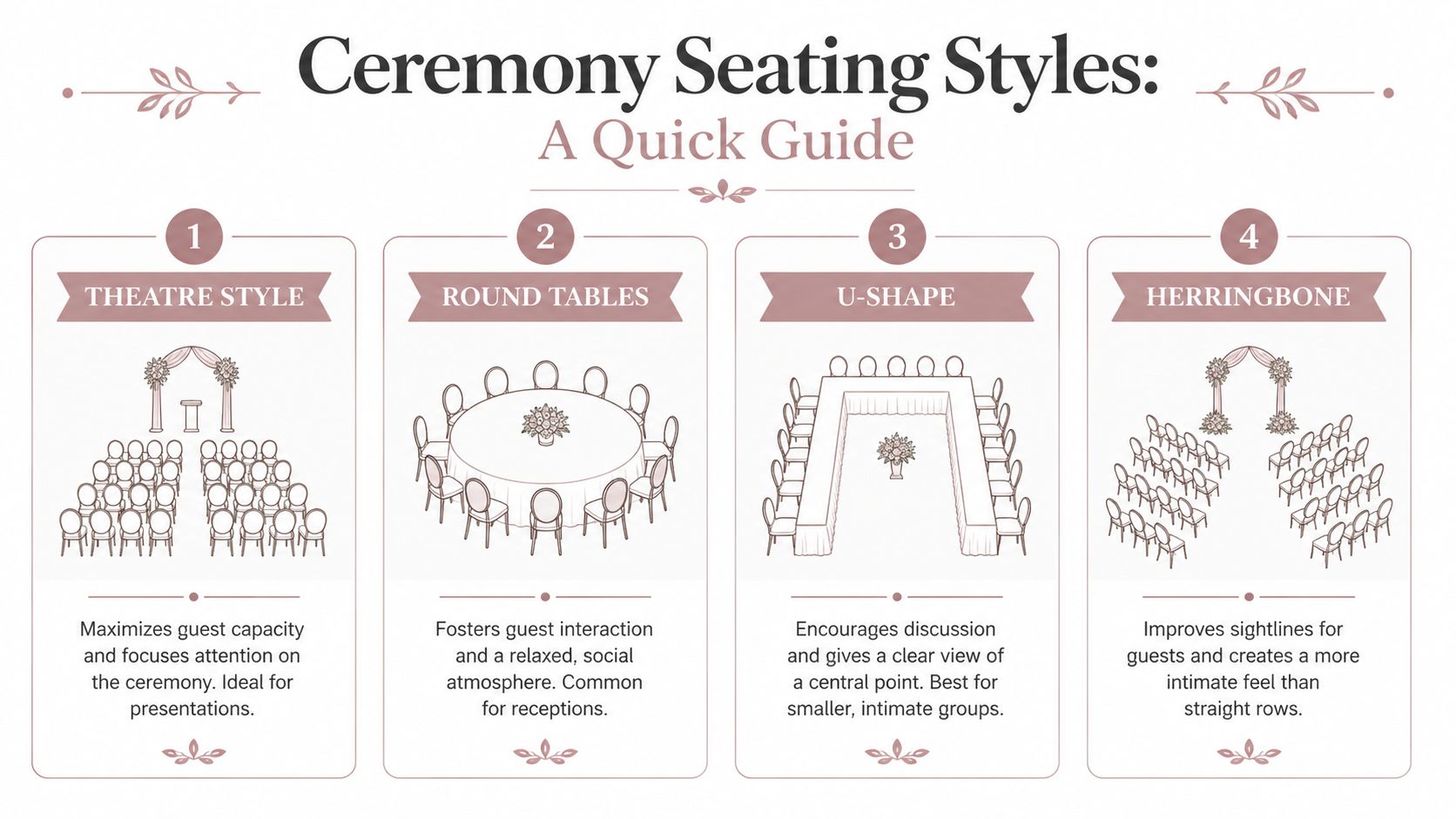
A quick comparison
| Layout | Best for | Main strength | Main compromise |
|---|---|---|---|
| Theatre style | Classic ceremonies, larger guest lists | Strong focus and efficient seating | Less interaction between guests |
| Semi-circle or horseshoe | Smaller ceremonies | More connected atmosphere | Uses more floor space |
| Runway style | Dramatic entrances | Strong visual impact | Some guests face across rather than forward |
| Lounge style | Relaxed outdoor or post-ceremony settings | Informal, stylish mood | Less structure and less uniform sightline control |
| Herringbone | Rooms with awkward width | Better angles toward the front | Slightly less capacity than straight rows |
When another layout may suit you better
A semi-circle suits ceremonies that need warmth and closeness more than strict formality. Guests feel gathered around the moment rather than lined up to watch it. In a historic room, that can soften hard edges and make the architecture feel like part of the scene.
A runway layout places guests on either side of the aisle, with the ceremony point at the end. It can look striking in a long hall or cloister-like space. The planning challenge is simple but important. During the vows, some guests will be viewing from the side, so chair angles and the couple's standing position need careful adjustment.
A herringbone layout often solves the problem of broad, slightly awkward rooms. Instead of forcing every chair into rigid straight lines, you angle the rows gently inward. It works like turning a table slightly so more people can see the centrepiece. The room feels more intimate, and more guests get a cleaner view.
Some of the best ceremony plans are hybrids. The centre block stays theatre style for structure and capacity, while the outer rows fan slightly or shift into herringbone angles to suit the room.
A strong option for intimate heritage weddings
For smaller weddings in heritage spaces, ¾ arena seating is worth considering. Guests are arranged around the ceremony area on three sides, which creates a sense of inclusion without fully surrounding the couple. It can be especially effective in venues where the backdrop is not a single flat wall, but a combination of stonework, arches, windows, or historic detailing.
At Battle Abbey, for example, the appeal of the setting lies in its layers. You are rarely working with a blank, rectangular room. You are working with age, texture, and sightlines that shift as you move. A ¾ arena plan can make better use of those qualities by drawing guests around the ceremony space and opening more angles onto the architecture. It also helps when one side of the room cannot be used fully because of a protected feature, an uneven boundary, or a circulation route that needs to remain clear.
The compromise is space. Curved or partially wrapped seating nearly always reduces overall capacity compared with straight rows. That is why this format tends to work best for intimate guest counts, where atmosphere matters more than fitting in every possible chair.
A simple decision guide helps:
- Choose theatre style if you want formality, clarity, and the highest chair count.
- Choose semi-circle or ¾ arena if guest connection and architectural views matter more than maximum numbers.
- Choose herringbone if the room is wider than it is deep, or the walls are not perfectly regular.
- Choose lounge or mixed seating if the event is relaxed in tone and closer to a gathering than a traditional ceremony.
The right layout should suit the room, respect the building, and help every guest feel part of the promises being made. In a historic venue, that balance usually creates the most memorable result.
Decorating Your Ceremony Chairs and Aisle
Theatre style seating gives you one major decorative advantage. It creates instant direction. The eye already knows where to travel, so your styling can be simpler and more refined.
That’s especially helpful in a historic venue. You don’t need to fight for atmosphere. The room already has it.
Dress the aisle first
If you only style one part of the ceremony layout, style the aisle. That’s the line everyone follows with their eyes from the first guest arrival to the final recessional.
Aisle decoration usually works best when it sits low and repeats rhythmically. Consider:
- Lanterns or hurricane vases spaced evenly along the route
- Meadow-style florals placed at intervals rather than in one continuous dense run
- Petals or foliage accents that soften the floor without becoming slippery
- Reserved row markers for family seats nearest the front
The key is restraint. If décor spills into walking space or snags hems, it stops feeling romantic very quickly.
Keep chair styling light
Ceremony chairs don’t need much. In fact, they rarely benefit from much. A single tied ribbon, a small posy, or a clean row-end arrangement often does more than covers and heavy dressing.
Try to decorate in layers:
- Start with the chair shape and material.
- Add a modest accent if the chairs need softening.
- Put your strongest floral emphasis at the front rows or row ends.
- Save the largest statement pieces for the ceremony focal point.
Let the architecture lead
If the room has stone, timber, stained glass, ruins, or a long terrace view, let those features carry visual weight. Your florals and fabrics should support the building, not compete with it.
That usually means choosing a palette and style that feels settled in the room. Airy garden flowers, candlelight, and natural textures often sit more comfortably in heritage spaces than glossy, overbuilt installations.
A theatre style ceremony looks most elegant when the décor sharpens the focus already created by the seating plan. Guests should feel guided, not crowded.
Your Wedding Seating Checklist and FAQs
A good ceremony layout is a chain of decisions. When one link is rushed, the rest can wobble. A simple check before final sign-off saves most seating problems.
Your checklist
- Confirm the actual guest count before finalising row numbers.
- Measure the ceremony space properly and note doors, fireplaces, beams, steps, and uneven areas.
- Choose the chair model early because width and silhouette change the plan.
- Mark the focal point first so rows support the ceremony rather than drifting in the room.
- Set aisle routes clearly for the processional, guest access, and staff movement.
- Test sightlines from seated positions in the front, middle, and sides.
- Integrate accessibility thoughtfully so all guests have dignified choices.
- Add décor last and keep every route clear.
Common questions
Can theatre style seating work for the wedding breakfast too
Usually, no. Theatre style seating is designed for watching, not dining. It’s excellent for the ceremony, speeches in some cases, or a presentation-style moment. A wedding breakfast needs table-based seating that supports conversation, service, and comfort over a longer period.
Is it too formal for a relaxed wedding
Not necessarily. The layout is formal in structure, but the mood depends on chair style, flowers, music, and the ceremony script. Wooden chairs, soft florals, and a garden-led aisle treatment can make theatre style seating feel warm rather than stiff.
What if the weather changes an outdoor plan
Have the backup layout prepared in full, not just discussed loosely. That means knowing where the chairs move, how the aisle changes, where sound equipment goes, and how the visual focus is preserved indoors.
The calmest weddings aren’t the ones without weather risk. They’re the ones with a backup plan that still feels beautiful.
How early should we finalise the seating layout
Earlier than most couples think. Final tweaks happen late, but the overall layout should be settled once your ceremony space, chair style, and approximate guest range are confirmed. That gives time to test comfort, access, and styling without rushing decisions in the final week.
If you’re looking for a venue where theatre style seating can be shaped around historic interiors, dramatic terraces, and a bespoke wedding plan, Battle Abbey Weddings offers a rare combination of atmosphere, flexibility, and experienced support.