You’re probably doing what almost every newly engaged couple does. You’ve opened far too many tabs, saved a gallery full of venues for weddings, and fallen in love with at least three places that make no practical sense once you think about your guest list, your budget, or your grandmother’s mobility.
That’s normal.
A wedding venue search starts as romance and turns into operations very quickly. One minute you’re admiring candlelit halls and sweeping lawns. The next, you’re asking whether the venue is licensed, whether you can bring your own caterer, how late the music can run, and what happens if it rains at exactly the moment you’ve planned drinks outdoors.
I’ll say this plainly. The right venue is not the prettiest one on Instagram. It’s the one that can hold your day together without compromise. It has to suit your numbers, support the style of celebration you prefer, and handle the practical demands that never show in a hero photograph.
Your Wedding Venue Journey Begins Here
Most couples start with a feeling, not a plan. They know they want something romantic, atmospheric, and memorable. They don’t yet know whether that means a Georgian manor, a country house, a marquee in a field, or a historic estate with ruins and formal rooms.
That early stage can feel messy because the UK market doesn’t always hand you neat, comparable data. So you have to rely on something better. Your own priorities, a disciplined shortlist, and a clear understanding of what each venue offers.
Historic settings tend to stand out for good reason. Couples aren’t usually searching for a blank box they have to build from scratch. They want a place with character already built in. In Southeast England, that appetite for heritage, atmosphere, and a sense of story is obvious in the kinds of venues couples keep returning to. Venues such as Battle Abbey, with over 30 years’ experience, offer exclusive hire for celebrations ranging from intimate events for 60 up to larger weddings for 250, along with transparent pricing for 2025 to 2027, which is exactly the sort of clarity couples need when they’re narrowing options in a crowded market, as noted in this wedding venue market overview.
If you’re still at the stage of figuring out what matters most, I’d start with a grounded planning resource like how to choose your wedding venue. It helps turn vague preferences into real criteria.
The venue isn’t just where your wedding happens. It decides how your wedding feels, flows, and photographs.
Treat this search like the foundation of the whole event, because that’s exactly what it is.
Creating Your Wedding Venue Blueprint
Don’t book venue tours before you’ve built your blueprint. That’s how couples waste weekends, confuse themselves, and get attached to spaces that were never right for them.
You need three things in place first. Budget. Guest count. Vision. Not in a dreamy, loose way. In writing.
Start with budget, not fantasy
Your venue budget must include more than hire fee. Couples often focus on the headline price and forget everything attached to it. Catering minimums, drinks, furniture, staffing, setup access, ceremony fees, sound restrictions, and weather backup all change the true cost of a venue.
If you’re considering a heritage property, read the pricing structure carefully. Some historic venues are refreshingly clear. Others are opaque enough to create problems later.
Build a worksheet with these lines:
- Venue hire for the space itself
- Food and drink commitments including any minimum spend
- Furniture and tableware if not included
- Ceremony costs if you’re marrying on site
- Staffing and service charges
- Setup and breakdown access
- Contingency spend for heating, cover, or weather backup
- Supplier extras such as generator, lighting, or transport if needed
A venue that looks expensive at first glance can be better value than one with a lower starting figure but a long list of extras. I’d choose clarity over ambiguity every time.
Practical rule: If a venue won’t explain the full cost structure early, move on.
Fix your guest count properly
You do not need the exact final RSVP total before searching. You do need a disciplined estimate.
Split your list into three groups:
Non-negotiables
Immediate family, closest friends, and the people you’d be upset to celebrate without.Important additions
Extended family, wider friendship circle, and colleagues you want there.Optional invites
Pleasant but not essential additions if budget and capacity allow.
This gives you a working range instead of one inflated number. That range matters because there’s a huge difference between a wedding that feels elegant and one that feels cramped, or worse, sparse.
The available UK-specific research in the source material is limited, which is exactly why couples need to define their own priorities carefully when choosing heritage venues. That includes balancing period character with modern comfort, thinking through weather contingency planning, and deciding whether your celebration suits an intimate guest list or a larger-format event, as reflected in this summary of UK historic venue search priorities.
A space can technically fit your numbers and still feel wrong. Capacity on paper is not the same as comfort in reality.
Decide what you want the day to feel like
“Romantic” isn’t enough. Neither is “classic” or “modern rustic.” Those labels are too vague to help you filter venues.
Ask yourselves better questions:
- Do you want the ceremony and reception in one place?
- Do you want guests to feel immersed in history, or do you want a cleaner contemporary setting?
- Do you care more about dramatic photographs or operational ease?
- Are you hosting a long lunch, a formal dinner, or a lively evening-led celebration?
- Do you want outdoor drinks, lawn games, and terrace views?
- Do elderly guests need level access, nearby loos, and easy parking?
- Do you want exclusive use, or are you comfortable sharing the site?
Create non-negotiables and nice-to-haves
Sensible couples thereby save themselves weeks of wasted effort.
Use two columns.
| Must have | Nice to have |
|---|---|
| Ceremony licence on site | On-site accommodation |
| Capacity that fits your real numbers | Late finish |
| Clear wet-weather plan | Fire pits or outdoor extras |
| Transparent pricing | Flexible menu style |
| Accessibility for key guests | Dramatic photo locations |
Don’t let the nice-to-haves bully the must-haves.
If you want a more venue-specific framework for sorting these priorities, this guide to choosing a wedding venue is the sort of checklist I’d recommend using before you contact anyone.
Write one sentence that defines your venue search
Do this before you enquire anywhere.
For example: “We want a historic venue in Southeast England for a ceremony, dinner, and drinks reception that feels elegant but relaxed, works for older relatives, and doesn’t hide costs.”
That sentence becomes your filter. If a venue can’t satisfy it, don’t rationalise. Cross it off.
The Ultimate Guide to Researching and Shortlisting Venues
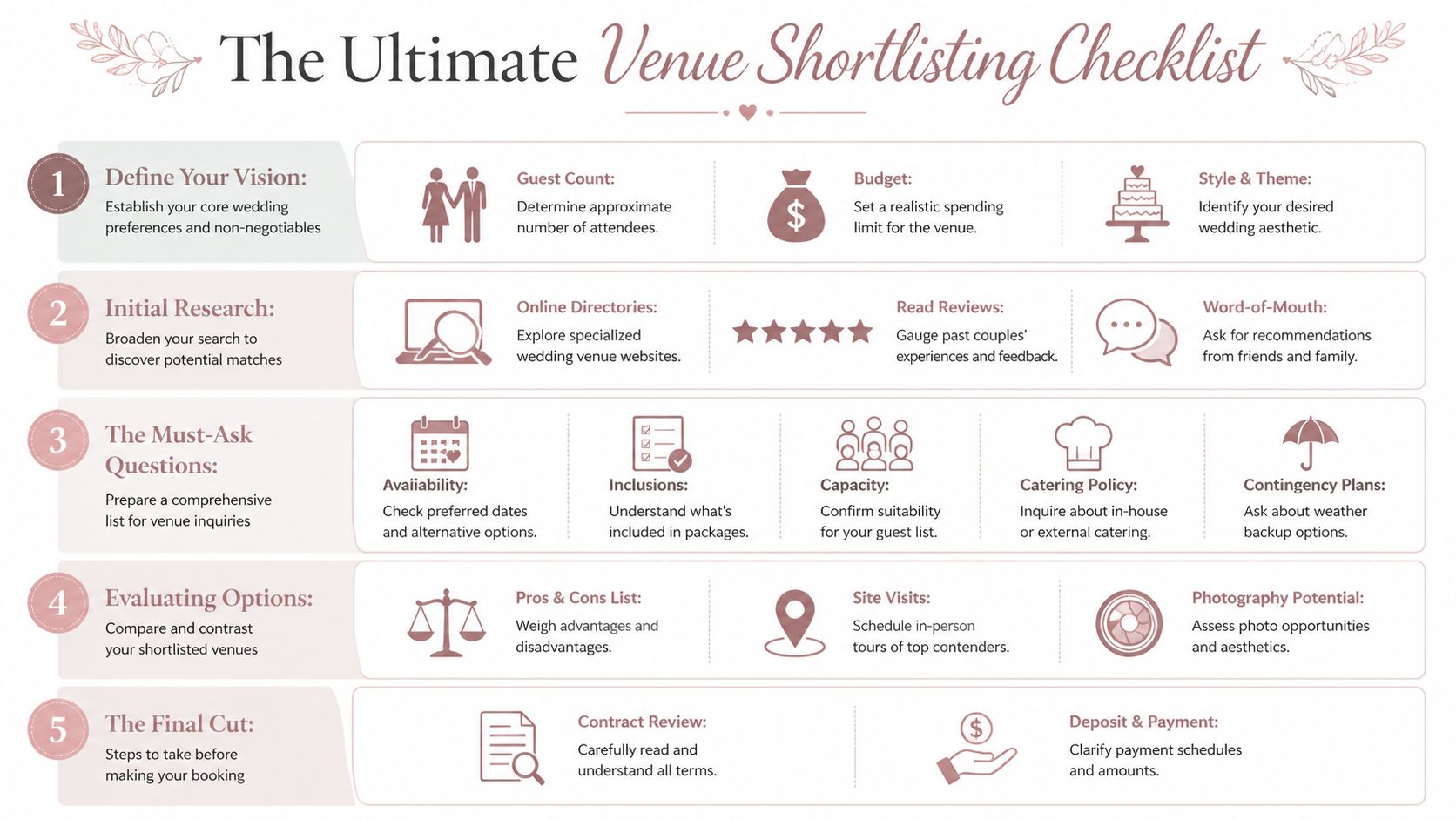
Research is where calm couples pull ahead. You don’t need to see fifteen places. You need to eliminate the wrong ones before you ever leave home.
Start with a spreadsheet. One row per venue. One column per question. If you rely on memory, every venue starts to blur into the next one.
Build a shortlist that deserves a site visit
Your first pass should be ruthless. Remove any venue that fails on obvious essentials.
Look for these basics on the website or in the first reply:
- Capacity fit that suits your likely numbers, not just your dream estimate
- Location logic for your guests, transport, and accommodation
- Ceremony options if you want the full day in one place
- Pricing transparency so you can tell what’s included
- Catering structure because food policy shapes the whole budget
- Style match between the venue’s permanent character and your vision
If that information is missing, ask for it once. If the answer is still vague, cross the venue off.
Ask operational questions, not decorative ones
Couples often spend too much time asking whether confetti is allowed and not enough time asking what affects the day.
Here are the questions that matter.
Legal and licensing
- Is the venue licensed for civil ceremonies?
- Are there restrictions on amplified music?
- What are the finish times for bar, music, and guest departure?
- Are there rules specific to the building or estate that affect your plans?
Access and logistics
- When can suppliers access the site?
- Can you set up the day before?
- Who manages breakdown after the wedding?
- Where do coaches, taxis, and disabled guests arrive?
- Are there steps, uneven surfaces, or long walking routes between key spaces?
Food and drink
- Is catering in-house, preferred list only, or fully open?
- Is there a minimum spend?
- What menu styles work well in the space?
- Can the venue handle dietary requirements smoothly?
- Are drinks packages flexible?
Furniture and styling
- What’s included as standard?
- Are there restrictions on candles, hanging décor, open flame, confetti, or installations?
- Can florists and stylists access walls, beams, terraces, or ruins?
Wet-weather backup
- What happens if outdoor drinks can’t happen?
- Does the indoor backup feel like a real plan or a compromise?
- How many guests can that backup space comfortably hold?
A backup plan that nobody wants to use isn’t a plan. It’s a risk.
Compare apples with apples
One venue may seem cheaper until you realise it excludes furniture, staffing, and setup time. Another may appear expensive until you discover that the fee includes exclusive use, planning support, and core operational essentials.
That’s why every line in your spreadsheet needs to be standardised.
| Venue | Hire style | Capacity | Catering policy | Setup access | Weather backup | Pricing clarity |
|---|---|---|---|---|---|---|
| Venue A | Exclusive | Fits numbers | In-house | Day before possible | Strong | Clear |
| Venue B | Shared site | Tight fit | External only | Same day only | Weak | Vague |
| Venue C | Exclusive | Comfortable | Preferred list | Limited | Good | Clear |
Organised couples tend to make better decisions. According to data adapted for the UK market, couples who mismatch guest count to venue size report 25 to 30% higher dissatisfaction, while couples who use a planner and detailed question lists see success rates rise to 85%. The same source notes that venues using transparent pricing avoid the sort of opacity associated with 60 to 70% lead loss, which tells you exactly why vague pricing should concern couples as much as venues, according to Venue Vows’ analysis.
Watch how the venue communicates
A venue’s email habits tell you a lot about what planning will feel like.
Good signs:
- Direct answers to your actual questions
- Clear documents rather than piecemeal replies
- Realistic language about what works and what doesn’t
- Consistent response quality from first enquiry onward
Poor signs:
- Selective answers that dodge cost or policy
- Pressure tactics before you’ve had enough information
- Overpromising on capacity or flexibility
- Confusion about who is handling your enquiry
If communication is scattered before booking, it usually won’t improve after booking.
Keep your shortlist small
I’d rather see a couple tour three well-qualified venues than eight random ones.
A strong shortlist usually includes:
- One venue that fits all practical needs cleanly
- One venue that stretches your vision a little
- One venue that offers a different style but still satisfies the core brief
That mix gives you perspective without chaos.
Don’t let photos do all the thinking
Venues for weddings are sold visually, and that’s fair. Weddings are visual events. But your guests don’t attend a photo gallery. They attend a live experience.
Look for signs of how the venue functions when fully occupied. Where do guests gather? Where do they queue? Where do they sit when they’re tired? How far is the walk from ceremony to drinks? Where do suppliers disappear to? Where do coats go? Where do children calm down if needed?
These answers matter more than one beautifully styled image of a tablescape.
Spotlight on Historic Venues A Battle Abbey Case Study
You arrive at a historic venue on a bright afternoon. The stonework is extraordinary, the views are unforgettable, and for ten minutes you can already see the photographs. Then the practical questions start. Where do guests gather if the weather turns. How far does an older relative need to walk. What can your florist attach. Where does dinner sit in relation to the ceremony room.
That is the test of a heritage property.
Historic venues reward couples who want atmosphere with substance. They also demand sharper questions than a hotel or purpose-built event space. At a listed site, the setting is doing a great deal of the visual work for you, but the restrictions are real. Access, timings, preservation rules, outdoor contingency plans, and supplier setup all matter. A useful overview of those pressure points appears in this guide to heritage wedding logistics.
What makes heritage venues different
At a historic property, beauty is rarely the problem. Function is.
Generic venue advice often stays too broad to be useful here. You need to know what the building allows, what the grounds support, and how the day flows once guests are inside it. The right question is not “Do we love the look of it?” The right question is “Can this place deliver the kind of wedding we want without friction?”
Battle Abbey is a strong case study because it shows how a heritage venue should work in practice. It is not relying on one photogenic corner. Different parts of the estate serve different parts of the day, which is exactly what you want in a property with real character.
Applying the checklist to a real setting
At Battle Abbey, ceremonies are held in the Abbot’s Hall. Wedding breakfasts can take place in the Duke’s Library or the Dining Room and Bar, depending on your guest count and format. Drinks and canapés can be served on the Top Terrace or Six Penny Lawn, where the ruins and battlefield views become part of the guest experience, not just the background.
That distinction matters.
A good historic venue should let the day unfold naturally from one setting to the next. You want each space to have a clear job. Ceremony rooms should feel focused. Reception areas should encourage movement and conversation. Dining spaces should hold the room properly once tables, staff, and entertainment are in place. Heritage venues fall short when they are all romance and no plan.
Comparing hire styles at a historic estate
Battle Abbey also shows why couples need to ask about the version of the venue they are booking, not just the venue name.
| Feature | Exclusive Part-Site Hire (Intimate) | Exclusive Full-Site Hire (Large) |
|---|---|---|
| Guest suitability | Up to 60 guests | 75 to 250 guests |
| Ceremony space | Abbot’s Hall | Abbot’s Hall |
| Wedding breakfast | Dining Room and Bar | Duke’s Library |
| Atmosphere | Smaller, more private celebration | Full-estate experience |
| Outdoor drinks reception | Selected estate areas | Wider use of terrace and lawn spaces |
| Planning style | Tighter guest experience with focused flow | Multi-space celebration with broader movement |
This is why I tell couples to stop using vague labels like “manor house wedding” or “historic venue wedding” as if they mean one thing. A heritage property can suit a small, contained celebration beautifully. The same property can also handle a much larger event if the rooms, staffing, and timings support it. Ask which format the venue handles best, and ask what changes between the two.
The questions that matter most at a historic venue
These are the questions I would put at the top of the list for any heritage site, including Battle Abbey:
How accessible is the day from start to finish
Do not ask whether the venue is accessible in general. Ask how a guest with limited mobility gets from arrival to ceremony, then to drinks, dinner, and loos.What is the weather plan for outdoor moments
A lawn or terrace is a bonus, not a strategy. The indoor alternative must still feel special.How does catering work on the site
Heritage buildings often have practical limits that affect service style, kitchen access, and turnaround times. A team familiar with the property usually makes a noticeable difference.How much setup time do suppliers get
Historic rooms can involve tighter installation rules, narrower access points, and stricter protection measures for floors, walls, and furniture.What restrictions apply to décor, lighting, and sound
These rules are normal in protected buildings. The problem is not the restriction. The problem is discovering it too late.
Specific questions get useful answers. Assumptions get expensive surprises.
Character matters. Operations decide the booking.
Couples choose historic venues because they want a wedding that feels rooted in a real place. Old stone, formal rooms, views with history, and architectural detail create atmosphere before you spend a pound on styling. That is a serious advantage. It often means you can spend more carefully because the venue already has presence.
Still, character does not rescue poor logistics. Guests must be able to move through the site comfortably. Your caterers must be able to serve the meal you want. Your planner, florist, band, and photographer must be able to work within the building’s rules without the day feeling constrained.
If you want a clearer picture of how that balance works at one heritage property, read what makes Battle Abbey the perfect historic wedding venue.
That is the standard to use with any historic venue. Admire the setting, then test the operation. When both are strong, you get something far better than a pretty backdrop. You get a wedding that feels convincing from the first arrival to the last dance.
From Venue Tour to Final Booking
You arrive for a venue tour full of hope. Forty minutes later, you should leave with evidence.
A strong venue still feels convincing once the charm wears off and the practical questions start. That is especially true with historic properties. At a place like Battle Abbey, the romance is obvious the moment you step onto the grounds. Your job is to confirm that the day will work just as well behind the scenes as it does in the photographs.
What to test on the tour
Start before you enter the main room. Look at the drive in, signage, parking, drop-off point, and the first few minutes your guests will experience. If arrival feels muddled during a calm weekday visit, it will feel worse with coaches, suppliers, heels on gravel, and a hundred people asking where to go.
Then walk the wedding in sequence. Do not skip ahead to the prettiest space and assume the rest will sort itself out.
Follow the day as your guests will experience it:
- Arrival
- Ceremony
- Drinks reception
- Wedding breakfast
- Evening celebration
- Departure
At each stage, ask one blunt question. What happens here in real terms? Where do people wait, sit, queue, shelter, chat, and move next? Historic venues often shine because the celebration unfolds across several rooms or outdoor areas. That only feels polished when the transitions are clear and comfortable.
Ask to see the parts that actually affect the day
Any venue can style a table beautifully. Fewer are equally confident showing you the operational details.
Ask to see:
- Loos, because guests always remember them
- Wet-weather spaces that would be used
- Catering access and prep routes
- Power supply for musicians, DJs, and lighting
- The evening setup with tables and dancing in mind
- Storage, cloakroom, or somewhere for personal items
- Accessible routes for guests with mobility needs
If the answer is vague, press again. If the team avoids the question, take that seriously.
Judge the team as carefully as the venue
A beautiful building can carry atmosphere. It cannot manage timings, supplier access, room turns, or weather pressure. The team does that.
Listen to how they answer. Good venue managers are clear, specific, and calm. They tell you what works well in the building, what needs adapting, and what is not allowed. That candour is a good sign. Sales patter is not.
Historic venues make this distinction sharper. Couples often fall for the setting first, then discover late restrictions on candles, amplified music, confetti, load-in times, or floor protection. You want those answers on the tour, not after the deposit is paid.
Take these questions to ask a wedding venue with you and write the answers down. Memory gets unreliable the second you walk into a dramatic room.
If the team cannot explain how your day will run, keep looking.
The contract decides what you are actually buying
This is the point where couples get sentimental and careless. Do the opposite.
Read the contract slowly and check it against your notes from the visit. If a promise from the tour is missing from the paperwork, treat it as not agreed.
Focus on these points:
- Exactly what the hire fee includes
- Payment dates and deposit terms
- Cancellation and postponement clauses
- Responsibility for damage or losses
- Rules on external suppliers
- Setup and breakdown access times
- Finish time, music cut-off, and licensing limits
- Food and drink minimums or bar terms
- Wet-weather arrangements
- Building or grounds restrictions
Historic properties need extra attention here because permissions, timings, and usage rules can be tighter than couples expect. At Battle Abbey or any comparable heritage venue, those details are not minor. They shape the whole plan.
If it is not written into the contract, do not budget on it, promise it to suppliers, or build your timeline around it.
Send one final confirmation before you pay
A short confirmation email can save you weeks of confusion later.
List the operational points you agreed and ask the venue to confirm them in writing. Keep it clean and factual:
- ceremony location
- reception spaces
- final guest capacity agreed
- supplier access timing
- catering arrangement
- wet-weather plan
- finish time
- furniture included
- any specific permissions granted
That is not being difficult. It is how organised couples avoid expensive misunderstandings.
Make the decision after the emotion settles
Leave the venue. Sit down somewhere quiet. Compare notes separately first, then together.
Use this table and answer:
| Question | Yes or No |
|---|---|
| Does it fit our real guest count comfortably? | |
| Can we afford it once all likely costs are included? | |
| Did the team answer clearly and confidently? | |
| Is the wet-weather plan good enough for us? | |
| Will our key guests be comfortable there? | |
| Does the venue’s character suit the wedding we want? | |
| Can we picture the timeline working calmly? |
If several answers are hesitant, pause.
The right venue gives you confidence, not just excitement. Once that booking is secure, the rest of planning gets lighter. You can start making the day feel like your own, from the menu to the music to how you will prepare a memorable first dance.
Your Perfect Place Awaits
Choosing among venues for weddings can feel heavier than couples expect because it carries so much of the day inside it. Once the venue is right, dozens of other decisions become easier. The style is clearer. The logistics sharpen up. The guest experience starts to take shape.
That’s why the process works best when you keep it simple. Build the blueprint first. Research hard before you visit. Tour with open eyes. Book only when the contract confirms what you’ve been promised.
The couples who enjoy wedding planning most aren’t the ones who get lucky. They’re the ones who make one strong decision at a time.
Historic venues prove that especially well. When the setting has genuine story, architectural character, and a layout that supports the way people celebrate, the day carries itself differently. It feels grounded. Guests remember it as an experience, not just an event in a pretty room.
And once the venue is sorted, you get to move on to the joyful parts. The menu. The music. The flowers. The ceremony details. Even the small things couples often leave too late, like prepare a memorable first dance, become much more enjoyable when the foundation is already secure.
Trust your judgement, but don’t let it drift. Romance matters. So do access routes, catering terms, and weather plans. The sweet spot is a venue that gives you both.
That’s the place you’re looking for. Not perfection in the abstract. A setting that fits your wedding so well it stops feeling like a checklist and starts feeling like your day.
If you’re looking for a historic East Sussex setting with clear venue options for intimate celebrations or larger exclusive-use weddings, Battle Abbey Weddings is a practical place to start your search. You’ll find details on ceremony spaces, guest capacities, catering options, and pricing so you can assess whether the venue fits your plans properly before you book a tour.