Half board plus usually means accommodation, breakfast, an evening meal, and a limited selection of drinks with that meal. The important part is that the “plus” varies from venue to venue, so it doesn't automatically mean all drinks, all meals, or an all-inclusive package.
If you're planning a wedding and comparing guest accommodation options, this is exactly the sort of phrase that can slow you down. You're trying to choose rooms, build a budget, and make sure guests are comfortable, then a venue brochure drops in terms like half board, full board, and half board plus as though everyone already knows what they mean.
Most couples don't.
That's especially true when you're organising a celebration around an overnight stay, a rehearsal dinner, or a venue with a strong sense of place. At a historic setting, meal timing and drink inclusions can shape the whole rhythm of the wedding weekend. A package that sounds polished on paper can feel very different in practice once you ask who gets dinner, what drinks are included, and when service starts and ends.
Planning Your Perfect Stay The Puzzle of Hotel Meal Plans
You might be staring at a proposal right now, wondering whether half board plus is a smart option for your guests or just another bit of hotel jargon. That reaction is completely normal. Couples often know what they want the weekend to feel like, relaxed, welcoming, well organised, but the hospitality language can make simple decisions feel oddly technical.

For weddings, the confusion matters more than it does on an ordinary holiday. You're not just choosing meals for yourselves. You may be thinking about parents arriving the night before, friends staying over after the reception, or guests who don't know the local area and would appreciate one dependable meal built into their stay.
That's why understanding meal plans early can make the rest of planning easier. It helps you judge value, spot hidden extras, and decide whether a package supports the atmosphere you want.
Why couples get stuck on this term
The phrase sounds simple. It also sounds more generous than standard half board, which leads many people to assume it covers a lot more than it actually does.
In reality, the label tells you less than you'd expect. One venue might use it to mean dinner with water. Another might include a glass of wine or beer. Another might add a small perk that has little to do with your wedding schedule.
If you're still comparing venues, it helps to get the broader accommodation picture straight before you dive into package wording. This guide to how to choose a wedding venue is useful for thinking through guest flow, practicalities, and what matters beyond the pretty photographs.
A meal plan isn't just a catering detail. For a wedding, it affects arrival experience, guest comfort, and how many decisions people need to make for themselves.
What this means for your wedding weekend
A good accommodation package reduces friction. Guests know where breakfast is, when dinner happens, and whether they need to budget separately for drinks.
A vague package creates questions instead. Do guests need to book a restaurant slot? Is dinner formal or casual? Are drinks included only during the meal? Can that dinner happen on the night before the wedding, or only on the wedding night itself?
Those are practical planning questions, not small print. They affect how smooth the celebration feels from the first arrival to the final checkout.
Understanding the Difference Half Board and Half Board Plus
The easiest way to understand what is half board plus is to start with the base package.
In the UK hotel and holiday-packaging market, half board is generally defined as accommodation plus breakfast and one other meal, usually dinner. KAYAK's UK travel guide describes it as “bed, breakfast and lunch or dinner,” and notes the usual pattern in UK travel terms, while the same explainer also reflects the common understanding that drinks are usually not part of standard half board in the UK market through linked operator guidance in its overview of what half board means in practice.
Half board in plain English
Think of half board as the middle option.
It sits between bed and breakfast, where guests get a room and morning meal only, and fuller meal plans that cover more of the day. For a wedding stay, it often suits guests who want one fixed meal at the venue but still want freedom at other times.
In plain terms, half board usually means:
- Room and breakfast: Guests wake up with breakfast included.
- One more meal: This is commonly dinner, though some properties may allow lunch instead.
- No automatic drinks package: Standard half board usually doesn't mean wine, beer, cocktails, or open bar access.
So what changes when you add plus
Half board plus starts with that same structure, then adds a small upgrade.
A simple way to think about it is a phone plan. Standard half board is your basic bundle. Half board plus is that same bundle with an added feature. It's useful, but it doesn't turn the package into something completely different.
Practical rule: If standard half board covers the meal, half board plus usually sweetens the meal. It doesn't usually add a whole new meal.
That distinction matters because couples often hear “plus” and assume it means broader hospitality. In many cases, it's narrower than that. The package may only improve the dinner experience slightly, rather than expanding the whole stay.
Why the distinction matters for weddings
For an ordinary break, a fuzzy meal-plan term can be mildly annoying. For a wedding, it can affect guest expectations.
If your guests think half board plus means broad drinks coverage, they may arrive assuming far more is included than the venue intended. That can create awkward moments at the bar, confusion over meal times, or extra spending that wasn't obvious at booking stage.
The best approach is to separate the phrase into two parts:
| Term | What it usually means |
|---|---|
| Half board | Room, breakfast, and one main meal |
| Plus | A limited added inclusion decided by the property |
Once you see it that way, the wording becomes much easier to assess calmly.
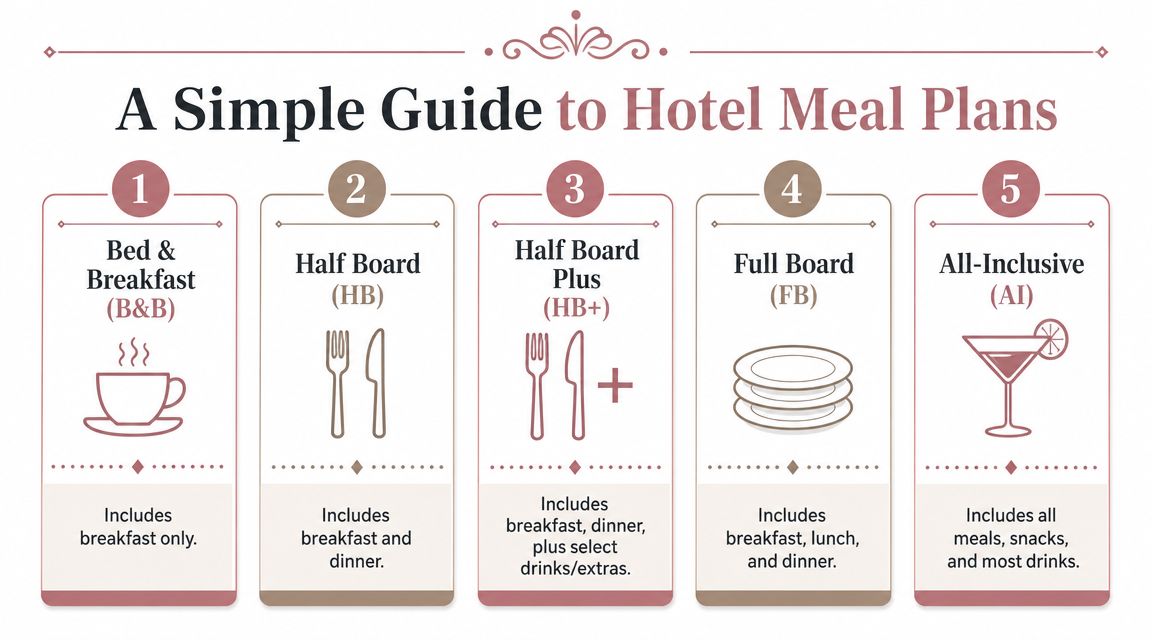
A Simple Guide to Hotel Meal Plans
When couples compare accommodation for a wedding, it helps to place half board plus next to the other common plans. The names sound technical, but the question is simpler: how much of your guests' eating and drinking do you want handled in advance?
The common options side by side
| Meal plan | Usually includes | Best suited to |
|---|---|---|
| Bed & Breakfast | Room and breakfast | Guests who'll be out most of the day or want full freedom |
| Half Board | Room, breakfast, and one main meal | Guests who want structure without committing every meal to the venue |
| Half Board Plus | Half board, plus selected drinks or small extras | Couples who want guests to feel looked after without moving to a heavier package |
| Full Board | Room plus breakfast, lunch, and dinner | Guests staying on site for most of the day |
| All-Inclusive | Meals, snacks, and most drinks | Holiday-style stays where guests want almost everything prepaid |
How each one feels in a wedding setting
Bed & Breakfast works well when your guests are local-ish, independent, or likely to explore nearby cafés and pubs. It keeps the room package lean. The trade-off is that guests make more of their own arrangements.
Half Board feels more hosted. Breakfast is taken care of, and there's one reliable meal built in. That can be especially useful if many people arrive the night before and would rather not organise dinner after travelling.
Half Board Plus is often the most misunderstood option. It sounds close to all-inclusive, but it usually isn't. What it often offers is a slightly more polished dinner experience, perhaps with selected drinks or another small extra attached.
Full Board can suit a very contained wedding weekend where guests remain on site for most of the day. It's less useful if people will be moving between the ceremony, local activities, and other off-site plans.
All-Inclusive is the broadest plan, but it's also the one couples most often overestimate when trying to apply holiday logic to a wedding venue. A wedding isn't a beach resort week. Guests may spend much of the celebration in structured events, so broad daytime snack-and-drink access may not be the thing that matters most.
Choosing based on guest behaviour, not package names
Ask yourselves a few practical questions:
- Are guests arriving late? A plan with dinner included may save a lot of hassle.
- Will they spend time exploring locally? If yes, they may not need a heavier package.
- Do you want one hosted-feeling meal outside the wedding day itself? Half board or half board plus can help.
- Are you trying to reduce decision fatigue for family members? More inclusion often means fewer moving parts.
The best package isn't the one with the fanciest name. It's the one that matches how your guests will actually spend the weekend.
Decoding the Details What Does The Plus Include
This is the part couples need to read carefully. The “plus” is not a universal category. In UK travel and hotel use, it's typically an operator-specific upgrade rather than a formal standard. In practical discussion, it may mean “a glass of wine or a beer with dinner & also water,” but those inclusions vary significantly by property, as shown in this UK-facing explanation of half board plus usage.
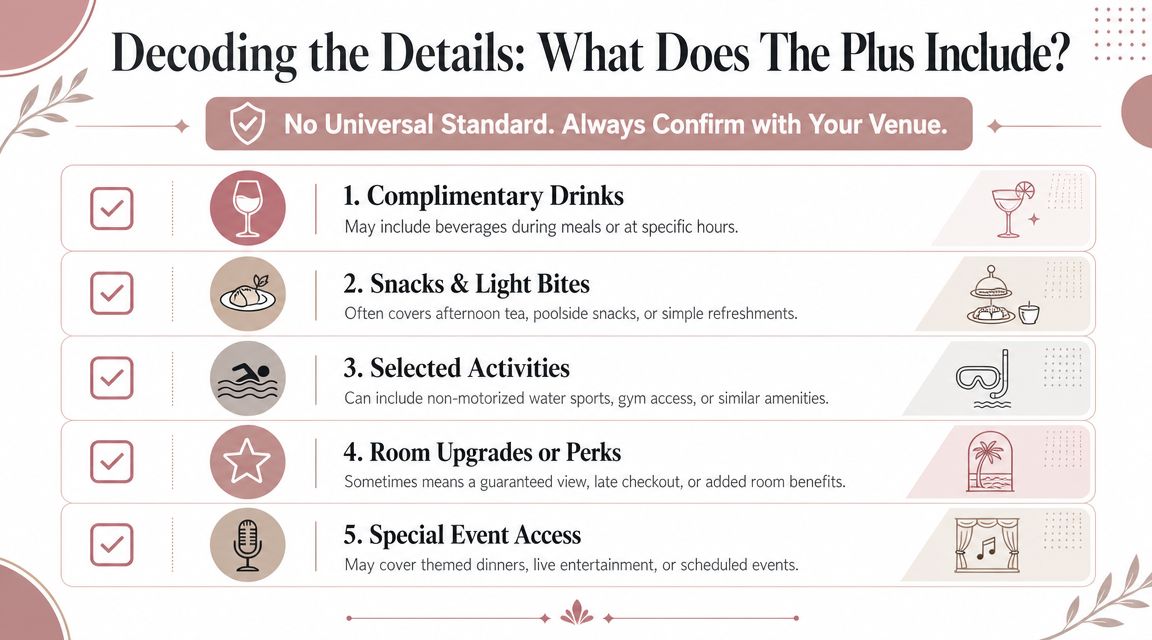
That's the core reason this term trips people up. The wording sounds fixed. The inclusions often aren't.
What venues commonly mean by plus
In wedding-related accommodation, the “plus” often points to one of these additions:
- Selected drinks with dinner: This may be water, a glass of wine, or a beer.
- A limited beverage allowance: Drinks are included only during the meal service window.
- Small dining upgrades: A slightly broader choice of restaurant or menu style.
- Minor hospitality perks: Sometimes the plus is more about convenience than volume.
The challenge is that two venues can both say “half board plus” while offering very different guest experiences.
What it often does not include
Expectations require managing. Half board plus often does not mean the following unless the venue writes it into the package:
- Unlimited drinks all evening
- Cocktails, premium spirits, or full bar access
- Extra meals beyond breakfast and the included main meal
- Drinks outside the set meal period
- Automatic coverage for wedding breakfast drinks or reception bar service
That last point matters a lot. A guest accommodation plan and your wedding catering plan are often separate things. Couples sometimes blend them together in their minds because both involve food and drink at the same venue.
They're usually priced and managed differently.
How to judge whether the plus is useful
Use this quick test:
| If the venue says… | You should ask… |
|---|---|
| “Drinks included with dinner” | Which drinks, how many, and for how long? |
| “Enhanced dining plan” | Is that extra choice, extra value, or just different wording? |
| “Flexible restaurant access” | Which restaurant, which menu, and on which dates? |
If you're reviewing sample packages, it helps to compare accommodation wording with detailed food-and-drink options elsewhere. Looking at venue-style examples such as these menus with prices can make it easier to spot whether a package gives real value or just sounds generous.
No couple should sign off on “plus” as a vague promise. It needs to translate into named drinks, named meals, and clear service times.
Essential Questions for Your Wedding Venue
When you're discussing guest accommodation, this is the point where polite curiosity needs to become precise questioning. Hospitality guidance recommends confirming meal timing, menu format, and beverage inclusions in advance because some properties allow lunch instead of dinner, while others exclude alcohol. It also advises turning the phrase into a written inclusions schedule before contracting in this glossary explanation of how half board packages should be confirmed.
For weddings, I'd consider that an absolute requirement. If the venue can't tell you exactly what half board plus means in writing, then you don't yet know what you're buying.
The questions worth asking straight away
Bring these into your venue meeting or email thread:
- Which meal is included? Ask whether the main meal is always dinner, or whether lunch can be substituted.
- Which guests does the package cover? Does it apply to everyone staying overnight, only certain room categories, or only named members of the wedding party?
- What exactly is included in the plus element? Ask for the specific drinks or extras by name.
- When are those drinks served? During dinner only, at check-in, or across a longer window?
- Is there a limit? Venues may include selected drinks, but that doesn't always mean unlimited service.
- What menu format applies? Buffet, set menu, restricted choice, or full restaurant menu?
- Does this connect to the wedding day itself? For example, does it have any impact on the wedding breakfast, reception drinks, or evening bar arrangements?
Questions that protect your budget
Budget issues usually don't come from obvious headline prices. They come from assumptions.
Ask these in a second round if needed:
- What isn't included? This is often the most useful question of all.
- Will guests be charged separately for alcohol beyond the listed inclusion?
- Are children's meals handled within the same package or separately?
- Can dietary requirements be accommodated within the included dinner, or do they trigger supplements?
- What happens if guests arrive after the dinner service window?
If the package affects guest experience, ask for it as a schedule. Meal, time, drinks, limits, venue, and any exclusions.
Why this matters for event flow
Historic venues and country-house style weddings often have a more structured rhythm than modern city stays. Arrival times, ceremony spaces, dinner timings, and bar cutoffs all need to sit together neatly. If your guests' accommodation package includes dinner, you need to know whether that helps the schedule or competes with it.
For example, if guests arrive the evening before, a built-in dinner can create a calm start to the weekend. If the venue's included meal falls at an awkward time on the wedding day itself, it might be less useful than it first appears.
That same thinking helps when reviewing the rest of your weekend planning. Entertainment, supplier access, and meal service often overlap in subtle ways, so couples sometimes find broader planning resources useful too, such as this wedding entertainment hire guide when mapping the flow of reception spaces and evening timing.
Ask for one final document
Before you agree to anything, ask for a simple written summary that includes:
| Item | What should be written down |
|---|---|
| Meal count | Breakfast plus which other meal |
| Service timing | Dates and time windows |
| Drink inclusion | Exact beverages included |
| Limits | Quantity, serving period, or restrictions |
| Exclusions | Alcohol types, premium upgrades, room service, or extras |
| Guest scope | Who receives the package |
If you want more venue-meeting prompts beyond food and accommodation, this checklist of questions to ask a wedding venue is a good one to keep open during calls.
Common Scenarios And Frequently Asked Questions
A few real-life wedding situations make the decision clearer than any definition can.
Three common scenarios
Guests arrive the night before the wedding
Half board plus can work well here if the included evening meal is available on arrival night and the drinks inclusion is enough to make that dinner feel welcoming. It gives everyone a soft landing after travel.
You want a relaxed wedding weekend, not a tightly packed schedule
Standard half board may be enough. Guests get breakfast and one set meal, but they still have room to explore locally or meet friends elsewhere without feeling tied to the venue all day.
You're planning a multi-day celebration with lots of hosted elements
Here, details matter most. If you're coordinating extra meals, late-night food, or post-wedding gatherings, ask whether the accommodation package overlaps with your event catering. If your plans need added staffing support, specialist providers such as Relief Chefs UK event recruitment can also help planners think more clearly about service logistics behind the scenes.
Frequently asked questions
Is half board plus good value for wedding guests
It can be, if the included dinner and drinks are things your guests would genuinely use. It's less attractive if the “plus” is very narrow or poorly timed.
Does half board plus usually include alcohol
Sometimes, but not automatically. Some venues include only water. Others may include a glass of wine or beer with dinner. You need the exact list in writing.
Can it apply to the wedding breakfast too
Usually, couples should assume accommodation meal plans and wedding catering are separate unless the venue clearly combines them in one package.
Is the package negotiable
Often, parts of it can be clarified, adjusted, or reframed. Even when the name stays the same, venues may be able to explain options around timing, menu structure, or guest eligibility more clearly.
If you're looking for a historic East Sussex venue that can help you build a wedding around guest experience as well as beautiful surroundings, Battle Abbey Weddings is well worth exploring. Their team can help you think through ceremony space, reception flow, catering choices, and the practical details that make a wedding weekend feel smooth for everyone staying over.