You're probably somewhere between inspiration and logistics right now. You've saved beautiful images of candlelit tables, handwritten menus, and champagne on the terrace, then opened a spreadsheet and realised the wedding food menu has to do far more than look lovely. It has to suit your budget, your guest list, your venue, the weather, the service team, and the people who need something different on their plate.
That's where couples often feel the ground shift. Food isn't one decision. It's a chain of decisions, and each one affects the next.
At a historic venue, that matters even more. Grand rooms invite a more formal rhythm. Outdoor terraces call for dishes that can cope with a breeze, a delay, or a change of plan. A strong menu feels romantic to guests because it feels effortless. Behind the scenes, it's carefully built.
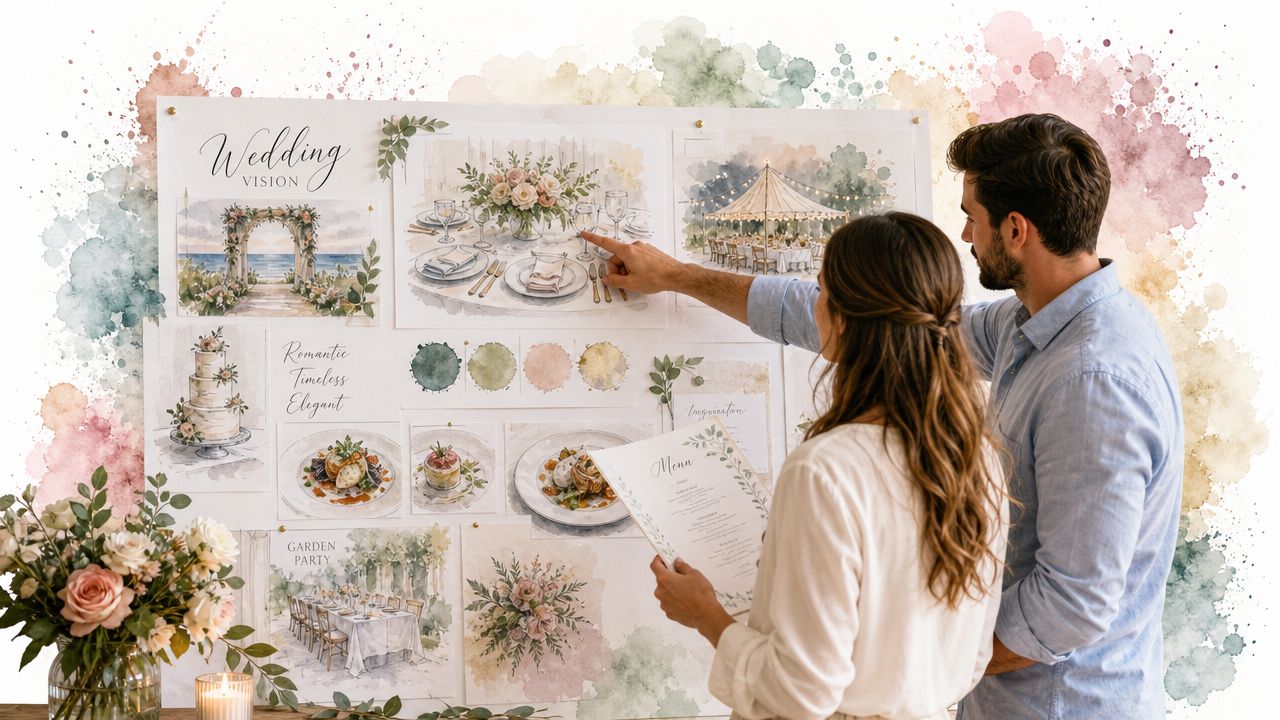
Aligning Your Menu with Your Wedding Vision
The best wedding food menu starts with three decisions made in the right order. Budget, guest count, and atmosphere come first. If you begin with a dream dish and try to reverse-engineer everything else around it, compromises usually appear later in the form of rushed service, awkward timing, or a bill that no longer feels comfortable.
Start with budget, not because it limits you, but because it clarifies you
Couples sometimes hear “set the catering budget first” and assume that means settling. It doesn't. It means choosing where the experience should feel most generous. The ONS-linked discussion of catering inflation and wedding menu trends notes that catering costs have remained a key inflation pressure point, with CPI inflation having peaked at 11.1% in October 2022 and easing afterwards. For weddings planned across 2025 to 2027, that still leaves couples budgeting in a post-shock environment rather than a flat-cost one.
In practice, that's why value-led structures often work so well. A classic three-course banquet can feel polished and generous while keeping portioning, staffing intensity, and waste under control. A hog roast or BBQ can create abundance and theatre, but only if the format suits the pace of the day and the guest profile.
Practical rule: Choose the format that protects the guest experience first, then style the menu within it.
A useful way to frame the spend is this:
| Priority | Usually worth protecting | Better place to simplify |
|---|---|---|
| Guest comfort | Enough food at the right times, smooth service, dietary coverage | Extra complexity in garnishes or too many separate choices |
| Atmosphere | A format that fits the room and the mood | Trend-led additions that don't suit your day |
| Quality | Seasonal produce and strong execution | Overly long menus with too many moving parts |
Let guest count shape the menu style
A guest list doesn't just change how much food you need. It changes what is sensible to serve. A menu for an intimate group can carry more bespoke plating and more delicate finishing. A larger celebration needs dishes that hold their quality from first plate to last plate.
That's why service style and menu design should be discussed together. If you're inviting a broad mix of ages and appetites, the right answer often isn't the most fashionable answer. It's the one that lets everyone eat well, comfortably, and on time.
Tie the menu to the feeling of the day
A wedding food menu should belong to the setting. Formal spaces tend to suit a structured meal with a clear beginning, middle, and end. Garden receptions and terrace drinks lend themselves to lighter canapés, generous shared dishes, or evening food with a more relaxed cadence.
Seasonality helps here. It gives the menu a sense of place, and it usually improves flavour and practicality at the same time. Ingredients at their best need less fuss. They also connect the meal to the natural setting around you, which matters in East Sussex where the surroundings already do so much of the storytelling.
If you're still shaping the wider look and feel of the celebration, the McLaren Vale Cellars blog on weddings is a useful reminder that place, food, and atmosphere often work best when they're planned as one whole rather than as separate choices.
Choosing a Service Format That Tells Your Story
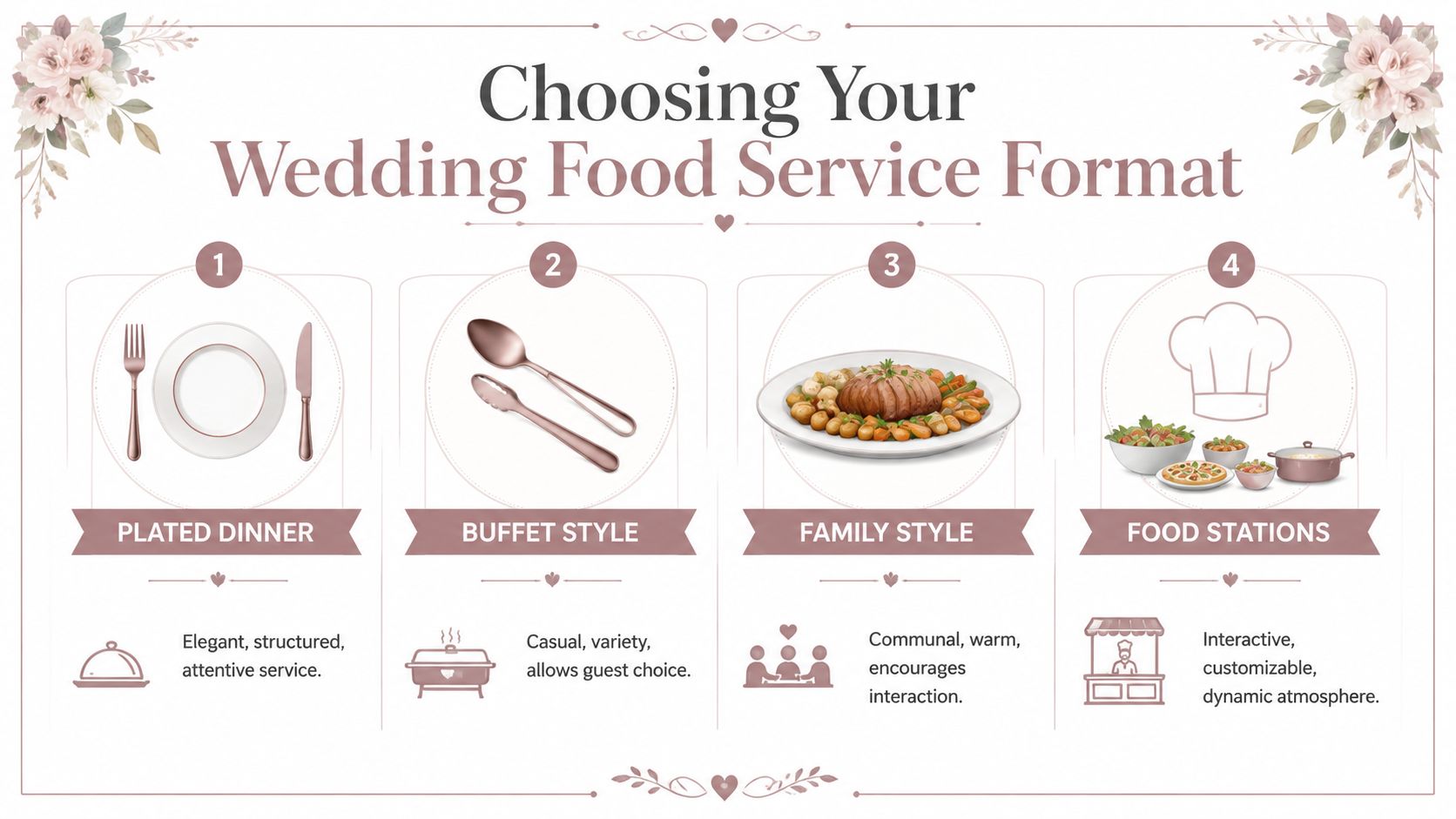
The same menu served in different ways can create entirely different weddings. Service format controls the pace of conversation, the flow of the room, and how formal the day feels once everyone takes their seats.
Plated dinner for elegance and rhythm
A plated meal gives the clearest sense of occasion. It works beautifully when you want a traditional wedding breakfast, speeches woven neatly between courses, and a room that feels calm and ceremonial.
The advantages are obvious. Everyone is served in sequence. The photographs feel cohesive. The event has structure. The trade-off is that plated service is less forgiving if timings run late or if menu choices are too complicated.
A good plated framework often looks like this:
- Starter with clean presentation such as a seasonal soup or composed starter that can be finished quickly
- Main course built for stable service with one core protein, a dependable vegetarian equivalent, and sides that plate cleanly
- Dessert that travels well from kitchen to table without losing texture
Buffet and stations for movement and choice
Buffets and food stations create a different energy. Guests move, mingle, and choose what suits them. This can be ideal for couples who want the meal to feel generous and sociable rather than ceremonial.
Independent analysis of menu searches shows rising interest in Mediterranean, Asian-fusion, and Latin-inspired profiles, with cuisine terms such as “Mexican,” “Pakistani,” “Tandoori,” and “South Indian” showing strong traction in 2025, as discussed in this wedding menu design guide. These flavours often work especially well in station form, where guests can personalise a plate without disrupting a more formal overall structure.
For couples considering a broader spread, these wedding buffet menu ideas are useful to review alongside the room layout and guest flow.
The strongest buffet isn't the one with the most dishes. It's the one where guests understand the choices quickly and the queue never becomes part of the memory.
Family style and BBQ for warmth and theatre
Family style sits between formal and relaxed. Platters arrive at the table, guests serve one another, and the mood becomes more convivial. It can be welcoming, but it depends on table size, guest confidence, and enough space for serving dishes to circulate gracefully.
BBQs and hog roasts bring theatre. They suit outdoor receptions, longer summer evenings, and celebrations that want a less scripted pace. They're also practical if you want a premium atmosphere without the stiffness of a plated banquet.
That said, a BBQ isn't automatically simple. A crowd still needs a clear service plan, reliable holding temperatures, and strong sequencing. This BBQ for a crowd guide is useful for understanding the mechanics that make large-format outdoor food feel smooth rather than chaotic.
Here's a quick comparison:
| Format | Best for | Watch out for |
|---|---|---|
| Plated dinner | Formal rooms, speeches, classic wedding breakfast | Complex choices, fragile dishes, timing drift |
| Buffet | Variety, mixed tastes, relaxed reception | Queues, unclear labelling, uneven guest flow |
| Family style | Warmth, table interaction, shared experience | Table space, serving ease, portion management |
| Stations or BBQ | Outdoor energy, theatre, flexible cuisine styles | Weather exposure, staffing at key points, pacing |
Crafting the Culinary Journey of Your Day
A wedding menu shouldn't peak too early and disappear by sunset. The day works best when food arrives in chapters. Guests need something light after the ceremony, something substantial when they sit down, and something restorative once the dancing has properly started.
Reception drinks and canapés
The first food your guests eat sets expectations. If the ceremony has been emotional and the drinks reception is outdoors, this stage needs to feel easy, elegant, and generous. People are greeting one another, finding their bearings, and often drinking before they've properly eaten.
Canapés should do three things well:
- Eat neatly in one or two bites
- Stay attractive if service slows slightly
- Offer variety across meat, fish, vegetarian, and allergen-aware options
Seasonality demonstrates its value. Lighter bites suit warmer days on the terrace. More substantial hot options help if the air turns cool. Keep the range disciplined. Too many styles can make the drinks reception feel disjointed rather than abundant.
The wedding breakfast
The main meal is where story and logistics have to align. A well-built three-course menu has contrast. The starter should wake up the appetite, not fill it. The main should feel celebratory and reassuring. Dessert should either bring freshness or comfort, but it shouldn't fight the rest of the meal.
A balanced framework might look like this:
- Opening course with a clear flavour direction, often seasonal and clean
- Main course with visual presence, dependable sides, and a vegetarian option that feels intentional
- Dessert chosen for both flavour and its ability to arrive in excellent condition
For venues with lawns, terraces, or reception spaces that may shift indoors, weather resilience matters. Hospitality guidance increasingly emphasises flexible formats as climate variability continues, and the strongest menus are designed so dishes still hold their quality during delays or temperature swings, as noted in this guide to weather-resilient wedding menu ideas.
Choose at least one course that still works beautifully if service is delayed by a few minutes. That single decision often saves the flow of the whole meal.
Evening food that revives the party
Evening food is rarely remembered for refinement. It's remembered for timing. Served too early, it goes untouched. Served too late, guests have already faded.
The most successful late food has a clear purpose. It should be warm, satisfying, easy to hold, and fast to serve. Think of it as hospitality, not as an afterthought. If the main meal was formal, evening food can loosen the tone. If the day has been relaxed throughout, a smarter late-night offering can add a small note of polish.
A cohesive wedding food menu doesn't repeat the same energy all day. It moves with the celebration. Lightness at arrival. Substance at the table. Comfort at the end.
Ensuring Every Guest Feels Welcome at the Table
The most gracious wedding food menu is often the one guests barely notice as “inclusive” because it feels thoughtful. Nobody wants to be the person asking a nervous question over a plate. Nobody wants to feel like their meal was an awkward exception prepared at the last minute.
That's why dietary planning belongs in the heart of the menu discussion, not at the edges of it.
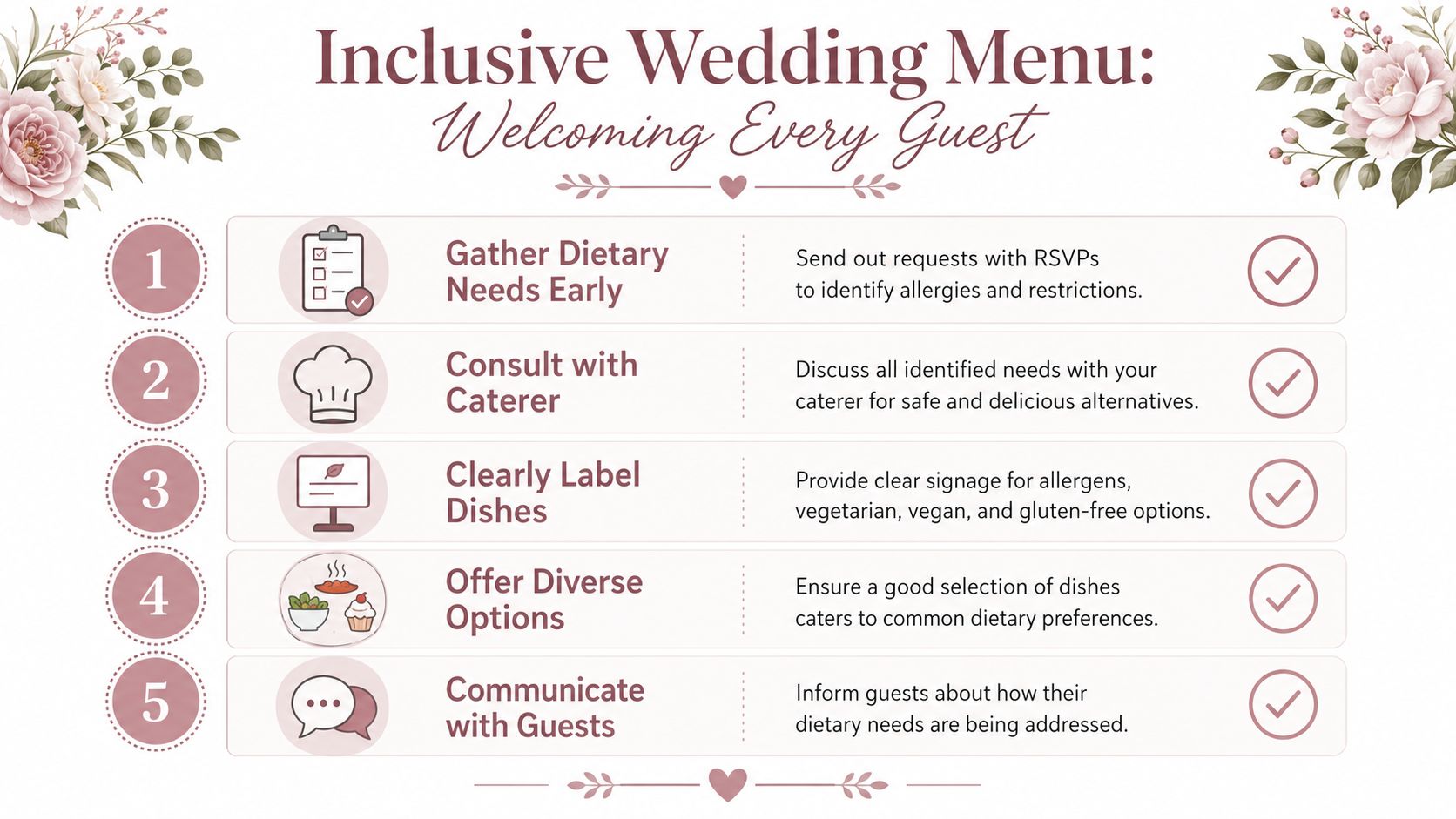
Gather information early and in one place
The Food Standards Agency reports that around 2 million people in the UK live with a diagnosed food allergy, and clear allergen information is a legal and ethical requirement, as summarised in this article on wedding food ideas and menu safety. That's the legal backdrop. The hospitality lesson is just as important. Last-minute verbal notes are unreliable.
Use the RSVP process to ask clear questions. Then keep every answer in one working document shared with the planning and catering teams. Don't separate “serious allergies” from “preferences” too casually either. Both affect menu design, and both affect service.
A practical RSVP line could ask guests to list:
- Diagnosed allergies that require strict avoidance
- Intolerances or restrictions such as gluten-free needs
- Lifestyle choices including vegetarian or vegan preferences
Design for safety, not just substitution
A weak approach to dietary catering is to treat each request as an isolated swap. A stronger one is to build the whole menu architecture with flexibility in mind.
That means:
- Safe defaults where possible, so fewer plates need separate handling
- Vegetarian mains with full menu dignity, not side-dish energy
- Desserts and sauces reviewed carefully, because hidden allergens often appear there
- Front-of-house briefings so the right plate reaches the right guest without confusion
The UK framework around the 14 regulated allergens makes communication and segregation essential. In practice, caterers often need marked menus, separate prep arrangements, and a clear handover between kitchen and service teams.
Guest-care test: If a guest with a restriction asks, “Will I be able to eat comfortably here?”, the answer should be immediate and calm.
Presentation matters too
Couples sometimes worry that allergen-aware service will make the table feel clinical. It doesn't have to. The key is to make information visible without making anyone feel singled out.
A simple system works best:
| Element | What works | What doesn't |
|---|---|---|
| Menu wording | Plain, specific dish names | Vague labels that force guests to ask |
| Service briefing | Staff know who needs what before service starts | On-the-spot checking in front of the table |
| Alternative plates | Similar presentation and care | Meals that look obviously lesser |
At Battle Abbey Weddings, a venue's planning discipline is evident as couples can work with an in-house catering team on bespoke menus built around locally sourced ingredients and service formats from banquets to BBQs. What matters most from a guest-care perspective is that the menu can be adapted with planning, rather than patched together on the day.
The Wedding Tasting A Guide to Perfecting Your Choices
Many couples treat the tasting as a reward for getting through the paperwork. It's more useful than that. A tasting is where romance meets operations, and that's exactly why it matters.

A dish can be delicious in a calm tasting room and disappointing in service. The difference is usually not flavour. It's heat retention, plating speed, garnish stability, or the simple fact that one course sat a few minutes longer than expected before reaching the table.
According to this guide on designing menus that work in any weather, a key professional workflow is to stress-test service conditions. The benchmark isn't just taste. It's service stability. Caterers should verify how dishes are plated, held, and finished, and whether they can survive heat, cold, and timing drift without losing quality.
Ask operational questions, not just culinary ones
At the tasting, ask what happens between kitchen and guest. That's where quality control lives.
Use questions like these:
- How is this dish plated at scale and what parts are added last?
- Can the protein hold well if speeches run long?
- Is this course still good at room temperature, or does it depend on immediate service?
- What changes if it rains and the reception flow shifts indoors?
- Can the garnish or sauce cope with heat, cold, or a delay?
These are the same instincts behind wider hospitality compliance. For example, this advice on precautionary allergen declarations in hospitality is a useful reminder that wording, process, and kitchen discipline all matter when translating plans into safe service.
Stress-test the menu like a planner would
A tasting should answer three separate questions.
| Question | What you're checking | Why it matters |
|---|---|---|
| Does it taste right | Flavour, balance, portion feel | Guests should enjoy it |
| Does it look right | Presentation, colour, sense of occasion | The room reads the meal before it eats it |
| Does it survive the day | Holding, finishing, timing resilience | Weddings rarely run to the minute |
If you're building your meeting checklist, these questions to ask a wedding venue will help frame the broader conversation around catering, logistics, and what happens if plans shift.
Here's a useful visual before your tasting appointment:
If a dish only works in perfect conditions, it isn't ready for a wedding day.
The strongest menu choices are rarely the fussiest. They're the ones that still feel beautiful after a walk from kitchen to room, a short wait for speeches, and the ordinary unpredictability of live events.
Your Wedding Menu Planning Timeline
The easiest way to make food planning feel calm is to decide the right things at the right time. Couples get into trouble when they finalise too early, before the guest list or schedule is clear, or too late, when dietary information and staffing decisions start to pile up.
Early planning stage
At the beginning, the useful decisions are broad. Choose the style of celebration, the likely guest count range, and the kind of meal you want people to remember. This is the point to decide whether the day leans formal, relaxed, or somewhere in between.
Shortlist based on fit, not fantasy alone. A menu that suits a historic dining room will often be different from one designed around a long terrace drinks reception and a late outdoor party.
Mid-planning stage
Once the date, venue details, and shape of the day are firm, the menu can become more specific. This is when you refine the service format, discuss seasonal direction, and identify where dietary flexibility needs to be built in from the start.
The Food Standards Agency's family food and dietary research shows that around 1 in 5 UK adults avoid or restrict certain foods, and for a wedding of 100 guests planners can statistically expect to manage approximately 20 individual dietary profiles, as summarised in this guide to expected wedding menu trends in 2026. That's why a structured timeline isn't just tidy. It's essential.
A sensible mid-stage checklist includes:
- Confirming the main service format so staffing and kitchen planning stay realistic
- Issuing RSVP wording that captures dietary needs clearly
- Booking the tasting while seasonal ingredients and likely menu direction can still be adjusted
- Reviewing fallback plans for outdoor elements of the day
Final weeks before the wedding
This is the stage for precision. Guest numbers settle. Seating plans sharpen. Named dietary requirements should be checked again and matched to final menu records.
Use this final run-through:
- Lock the final headcount by the date your caterer requires
- Confirm every dietary note and ensure names match the seating plan
- Approve final menu wording for printed menus and service briefings
- Review service timings for canapés, meal service, and evening food
- Check the wet-weather version of the plan, even if the forecast looks kind
If you'd like to sense-check the practical side of cost and format before that stage, these menus with prices help couples compare options while keeping the overall guest experience in view.
The reward for this structure is simple. When the day arrives, you're not chasing allergens, wondering whether there's enough evening food, or trying to remember which course needed a backup plan. You can sit down, look around the room, and enjoy the fact that everyone else can do the same.
If you're looking for a historic East Sussex venue where the wedding food menu is planned with as much care as the setting itself, Battle Abbey Weddings offers ceremonies, receptions, and bespoke catering designed around the rhythm of the day, the needs of your guests, and the character of the space.