A couple steps out of the car expecting a country-house visit and finds something older, quieter, more intimate. The brick skin looks composed and restrained, then the story deepens: inside waits a Norman core that has watched marriages, inheritances, repairs, and changing fashions pass over it for centuries.
An Introduction to England's Timeless Romance
Some wedding venues impress at first glance and fade once the day is over. Burton Agnes Manor House does something different. It keeps unfolding, because the place isn't only decorative. It feels inhabited by time.
That matters when you're choosing where to make vows or where to spend a meaningful day out together. A modern venue can offer polish. A historic manor offers continuity. You don't just stand in a beautiful room. You stand in a setting where age, repair, inheritance, and memory have shaped every surface.
Why older places feel different
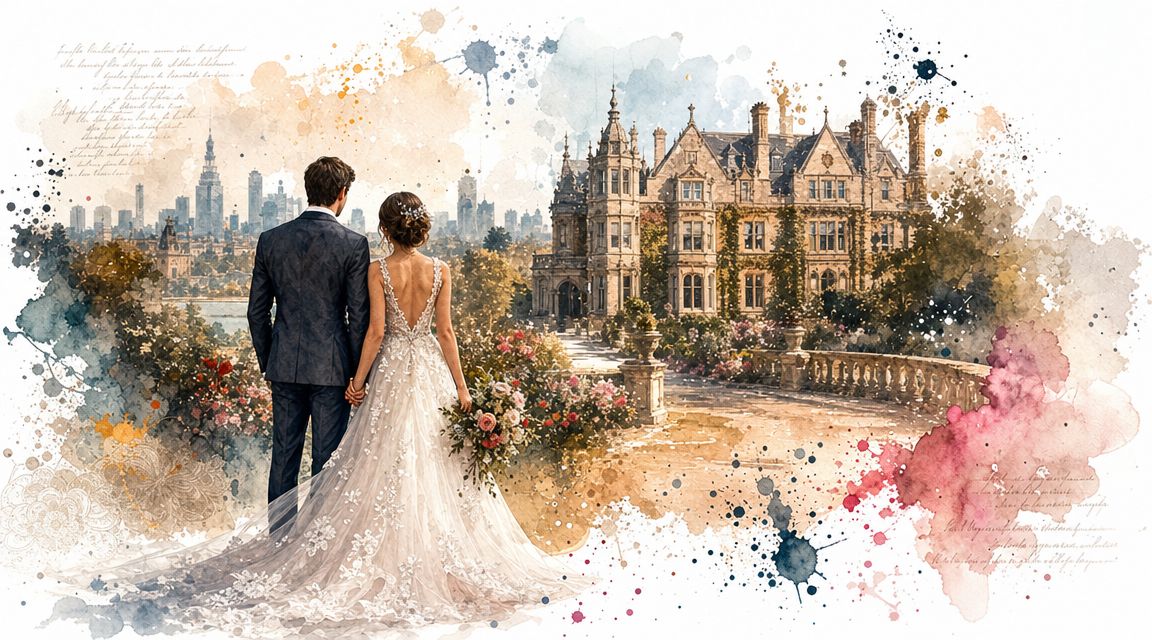
At Burton Agnes, romance isn't only about flowers, candles, or the cut of a dress. It's in the slight gravity of an old threshold. It's in timber and stone that don't need staging to feel significant. Couples often want a venue that says something before anyone speaks. This is that sort of place.
For visitors, the effect is similar. You arrive expecting history as information, but what you remember is atmosphere. The house doesn't present itself as a museum piece detached from life. It feels like a place where life kept happening, generation after generation.
A heritage venue changes the emotional temperature of a wedding day. Ordinary moments, arriving, waiting, turning to face each other, feel more ceremonial.
A setting that links past and present
What makes Burton Agnes Manor House especially compelling is how closely its history and present-day experience are tied together. The building's age isn't a side note for the guidebook. It shapes the walk through the rooms, the quality of the light, the textures in photographs, and the sense that a celebration here joins an already long narrative.
For engaged couples, that's powerful. Your wedding stops being a standalone event and becomes part of a place with a memory longer than any single family album. For visitors planning a heritage day out, the same truth applies in a gentler way. You're looking at more than an old structure. You're stepping into a story that's still legible in stone, roofline, and surviving plan.
A Journey Through 850 Years of History
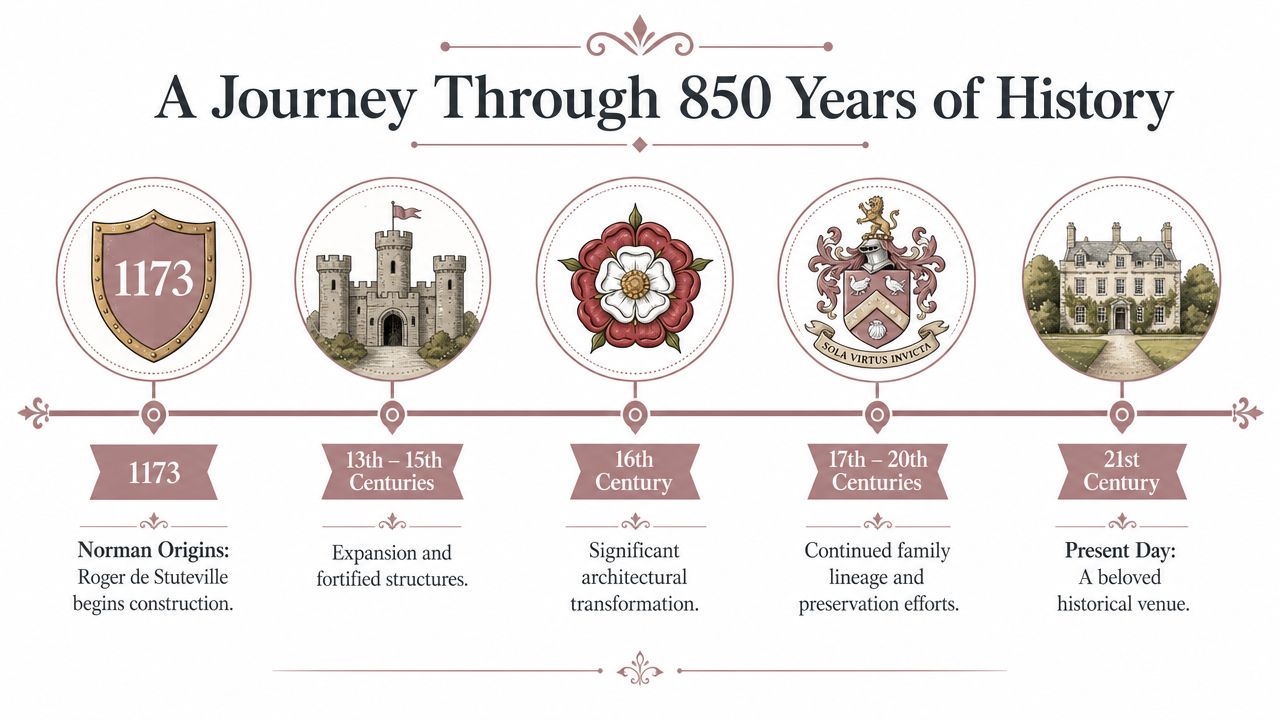
A bride steps down into the undercroft and her voice drops without anyone asking. Stone does that. It gathers sound, cools the air, and makes a modern moment feel older than the calendar says it is. At Burton Agnes, that effect begins with the building itself, because the Old Hall was raised in the Norman period by Roger de Stuteville in the late 12th century, with one account giving the date as 1173. The estate then passed through family lines rather than by sale, which helps explain why the place feels inherited rather than assembled.
The house that kept changing, and kept its memory
Burton Agnes did not survive by standing still. It passed by marriage in the 13th century, received major repair work in the 15th, and was altered again in the early 18th century, as noted earlier. Those phases matter because visitors can feel them room by room. One surface belongs to a later fashion. Another detail carries a much older line. The result is not a staged medieval set, but a family house shaped by successive generations who cared enough to mend, roof, and adapt what they had received.
That is part of the romance for couples. The setting already contains the idea at the heart of a marriage. Continuity through change.
A wedding venue with that kind of biography photographs differently too. Corners hold shadow. Openings frame people with more depth. If you enjoy heritage houses where history is built into the visitor experience rather than explained from a distance, the atmosphere at Burton Agnes shares something with the historic character of Brodsworth Hall and Gardens, though Burton Agnes has its own quieter, more intimate mood.
What survives in the stone
The manor is especially affecting because important early fabric still remains. The Norman undercroft gives the house its gravity. A surviving 15th-century roof brings a different note, less severe, more visibly cared for, as if the medieval household has only just stepped out of view.
Those features shape the experience in ways guidebooks rarely separate from practical use. Visitors often pause longer in the older spaces because the light is lower and the textures are richer. Couples planning styling usually need less decoration than they first expect. Rooms with genuine age already have pattern, colour, and weight.
A small, thoughtful furnishing choice can be enough. For anyone considering antique-inspired pieces for a drinks display or lounge corner, Quote My Wall's cabinet selection guide offers a helpful starting point for choosing something that suits an old interior rather than competing with it.
The surprise behind the later exterior
One of Burton Agnes's quiet pleasures is that the building does not reveal itself all at once. Later work disguises an older core, so the manor rewards attention. What seems at first glance to be a later face contains a much earlier structure within it, including the undercroft and the former first-floor hall described in earlier scholarship.
That hidden depth is more than an architectural curiosity. It changes how the house is felt. You arrive at a building that appears composed and settled, then discover layers beneath the surface. For historians, that makes Burton Agnes unusually absorbing. For visitors and engaged couples, it gives the place a sense of revelation. The story is not mounted on a plaque and left there. It is built into the walls, and every step through the manor brings another century into view.
Planning Your Visit to the Manor House
A couple arrives just after lunch, expecting one front desk, one ticket, one tidy route through house and gardens. Instead, Burton Agnes asks for a little more attention than that. The reward is a better day. You move through the estate with the same alertness the building itself encourages, noticing where one story ends and another begins.
That starts before you leave home.
Know who runs what
English Heritage's visitor information for Burton Agnes Manor House explains that the manor house opens in line with Burton Agnes Hall, while the Hall and gardens are managed separately from English Heritage. For visitors, that affects opening hours, admission planning, and what kind of visit you are booking.
The distinction feels small on a screen and much larger at the gate. Couples visiting to test the atmosphere for a future celebration often want the day to feel unhurried. A little clarity beforehand protects that mood. Instead of spending the first half hour working out who manages which part of the estate, you can give your attention to the place itself, the old stone, the shifting light, the sense that each part of the property belongs to a different chapter of the same long story.
The details that make the day run well
Practicalities shape the romance here more than many visitors expect. English Heritage advises booking admission online, and the Burton Agnes Hall site states that cash is no longer accepted on site. Miss those details and the visit begins with avoidable frustration. Get them right and the day opens properly, with time to notice the texture of the house rather than the mechanics of entry.
A simple checklist helps:
- Book before travelling: do not rely on sorting admission when you arrive.
- Check opening times close to your visit: seasonal hours can change.
- Treat the manor, hall, and gardens as connected but separately managed parts of the experience: that avoids confusion over access and timing.
- Bring a card or digital payment method: cash is not accepted on site.
One small administrative choice can change the whole tone of an afternoon.
If you are comparing Yorkshire heritage days out, this guide to visiting Brodsworth Hall and Gardens is a helpful comparison, especially for seeing how historic houses shape a visit through practical arrangements as much as through architecture.
Plan for the visit you actually want
Burton Agnes suits two kinds of visit. One is purposeful and short, often chosen by engaged couples who want to feel the character of the manor, test the journey, and picture how guests might move through the setting. The other is slower, built around a fuller estate day, where the manor house becomes one scene in a longer experience of East Yorkshire history.
Both work well. The difference lies in pace.
A focused visit lets you study atmosphere with fresh eyes. You notice where the approach feels most dramatic, where a quiet conversation would sit naturally, where old interiors do the decorative work for you before a single flower is placed. A longer day gives the house more room to unfold. Its layered history feels less like information and more like company, something that stays with you as you move through the grounds and begin to understand why the estate has such a particular emotional pull.
At Burton Agnes, planning is part of the pleasure. The better prepared you are, the more fully the manor can do what old houses do best, draw you out of the ordinary and into a setting where centuries still shape the day.
Envisioning Your Wedding at Burton Agnes
The first thing to understand about a wedding at Burton Agnes Manor House is scale. This isn't the sort of setting that asks for spectacle in every corner. It invites intimacy, texture, and restraint. That can be far more moving.
A couple could begin the day with quiet anticipation rather than grand theatrical build-up. Guests arrive aware that this is a house with age in its bones. The walk into the building does some of the work usually asked of décor. Old fabric, historic proportions, and softened light create atmosphere before a florist places a single stem.
Ceremony mood and room character
The emotional strength of a manor house wedding comes from how the architecture frames people. In a setting like this, vows feel enclosed by history rather than staged against a blank backdrop. That's ideal for couples who want the ceremony to feel grounded and personal.
The earlier description of the building's hidden medieval core matters here. A room with surviving age has its own discipline. It encourages styling that is careful, elegant, and responsive to the house rather than imposed on it.
A thoughtful wedding plan at Burton Agnes usually leans on a few principles:
- Let the building lead: Use arrangements that echo the manor's tones instead of competing with them.
- Keep installations light-touch: Older interiors reward simplicity.
- Choose details with texture: Linen, candlelight, handwritten paper goods, and antique-inspired vessels sit naturally in a heritage space.
Drinks, movement, and the feel of the day
One of the loveliest qualities of a house like this is transition. A wedding doesn't happen in one static pose. It unfolds through arrivals, greetings, drinks, wandering conversations, and moments when people pause to look up at a beam, a wall, or a doorway.
That's where manor houses shine. They give guests small discoveries. An older room naturally prompts slower movement and better conversation than a purpose-built banqueting suite. People don't rush through it. They absorb it.
For couples exploring the wider appeal of period properties, this guide to manor houses for weddings is helpful because it sets out why houses of this type suit celebrations that value atmosphere over sheer scale.
A heritage wedding works best when the timeline allows people to notice where they are.
That rhythm is easiest to see in motion. This short film captures the kind of feeling many couples are trying to achieve in an old house setting.
Styling choices that belong in the house
When planners work in historic buildings, the question isn't "How do we transform the space?" It's "What should we leave alone?" Burton Agnes Manor House rewards that mindset. The more confidently you edit, the more the architecture can breathe.
Consider the difference between a heavily dressed ceremony end and one with only a pair of arrangements and candlelight. In a contemporary room, the first option may feel necessary. In a manor house, it can flatten the character that makes the venue special. The older surfaces are already doing visual work.
A few styling directions suit this setting especially well:
| Wedding element | Strong fit at Burton Agnes |
|---|---|
| Florals | Seasonal shapes with movement rather than dense formal masses |
| Tablescape | Soft linens, silver or pewter accents, understated glassware |
| Stationery | Calligraphy, deckled edges, muted tones |
| Fashion | Structured tailoring, lace, silk, and pieces with historic reference |
Guest experience over performance
The couples most drawn to Burton Agnes are often those who want guests to feel they've entered somewhere meaningful. That doesn't require a themed medieval interpretation. In fact, it works better without one. The house already has authenticity.
If you're still comparing options and need a different model of historic celebration, Battle Abbey Weddings is another example of a licensed heritage venue offering ceremony and reception spaces within a historic English setting. It's useful as a comparison point if you're weighing the intimacy of a manor house against a larger abbey estate experience.
The strongest vision for Burton Agnes is simple: a wedding that doesn't try to outshine the building, because it doesn't need to.
Capturing Timeless Moments and Photographs
The best photography at Burton Agnes doesn't come from treating it like a generic stately-home backdrop. It comes from recognising what the house gives you that newer venues can't: age in the surfaces, contrast between exterior and hidden core, and rooms that already hold mood.
Start with texture, not poses
A photographer arriving here should look for materials before compositions. Stone, timber, brick, worn thresholds, and old openings all create natural framing. Those details give portraits narrative weight.
A useful sequence for the day is to begin with tighter, more intimate images indoors, then widen the frame as the celebration relaxes. That progression mirrors the building itself. Inside, the mood is enclosed and reflective. Outside, the estate opens the story out.
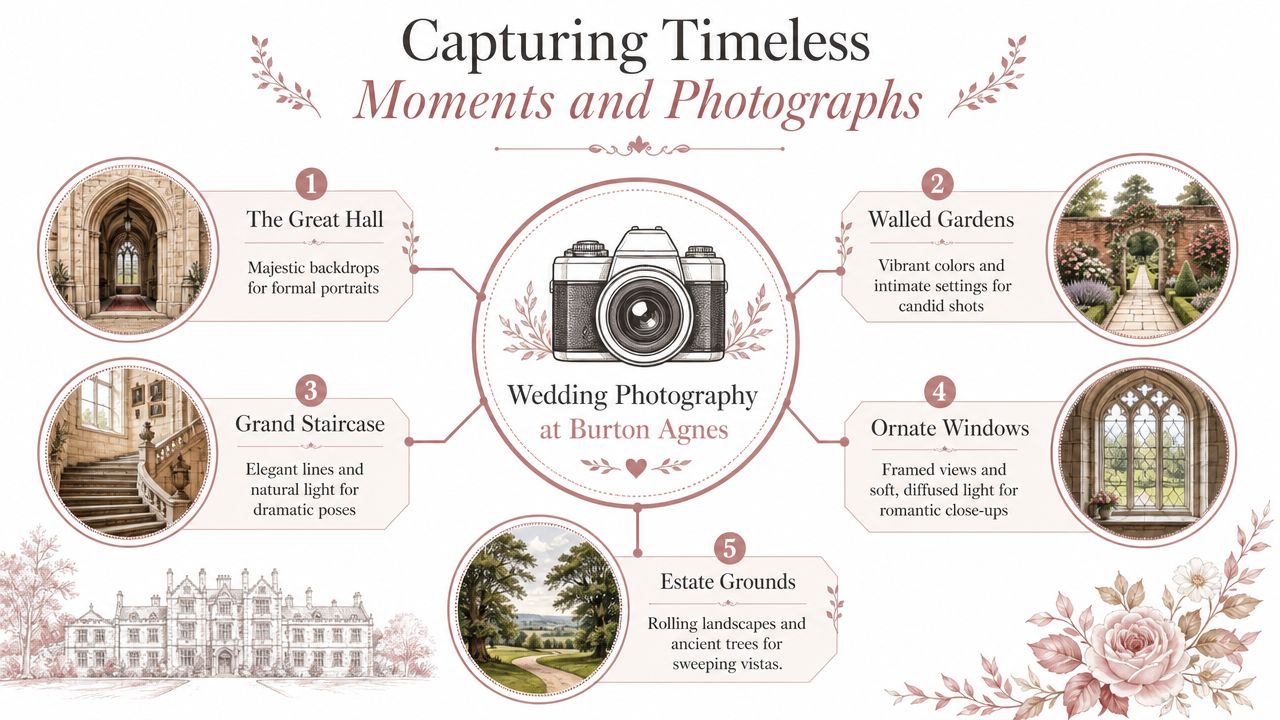
A photographer's route through the house
Try thinking about the venue in zones rather than in a single shot list.
- Historic interior details: Use them for hands, fabric, rings, and close portraits. Old surfaces make small moments feel significant.
- Openings and doorways: These are ideal for transitional images, arrivals, departures, and that slight pause before a ceremony begins.
- Exterior brickwork: It gives formal portraits structure without feeling stiff.
- Estate views: These suit looser, walking images that let the day breathe.
Soft light against old masonry often gives a wedding image more feeling than a dramatic pose ever could.
Match the photographer to the setting
Not every photographer handles heritage spaces equally well. Burton Agnes asks for someone who can work with available light, respect site restrictions, and notice atmosphere rather than chase only dramatic staging. A strong portfolio in period properties matters more here than a portfolio built entirely around modern barns or luxury hotels.
When you're assembling your shortlist, it helps to review specialists who already understand Yorkshire light, natural surroundings, and historic venues. This directory of North Yorkshire wedding photographers is a sensible place to start.
Ask practical questions too. How do they handle darker interiors? Do they use flash sparingly? Can they create formal family images quickly enough to preserve time for couple portraits? The house will reward subtlety, but the schedule still needs discipline.
Essential Logistics for Planners and Couples
A heritage wedding often reveals itself in the small practical moments. A florist pauses at a doorway and switches from hanging installations to freestanding urns. A caterer shortens a trolley route to protect a tight corner. A planner leaves ten extra minutes between drinks and dinner because guests will slow down in a house with this much age in its walls.
At Burton Agnes, logistics are part of the atmosphere. The building asks for care, and that care shapes the day. As noted earlier, the house preserves much older fabric beneath later surfaces, so every decision about setup, access, and movement benefits from restraint rather than excess. Couples feel that difference even if they never name it. The day runs more gracefully because the house has set the terms.
What the building asks of suppliers
The strongest supplier teams treat the manor as a historic interior first and an event space second. That usually changes their methods in clear, visible ways:
- Installation choices: Freestanding flowers, candles, and signage tend to suit the rooms better than anything fixed to walls or older surfaces.
- Load-in plans: Setup works best with a slower schedule and fewer last-minute changes.
- Furniture discipline: Chairs, welcome tables, and decorative pieces need to support guest flow rather than crowd it.
- Power use: Compact lighting and discreet equipment usually sit more comfortably within the character of the house.
Good judgement shows. A room feels calm instead of overfilled. Guests move easily. Nothing fights with the house for attention.
Guest travel and accommodation thinking
The romance of arriving at a manor house fades quickly if half the guests are calling from country lanes asking whether they are in the right place. Clear directions matter, especially for older relatives, families with children, and guests coming from outside Yorkshire.
A useful guest note usually covers three things:
| Planning layer | What guests need |
|---|---|
| Arrival | Exact destination, parking instructions, and realistic arrival times |
| Stay | A short list of nearby inns, hotels, and self-catering options |
| Departure | Taxi numbers, collection points, and next-day plans |
That simple bit of planning protects the tone of the day. Instead of confusion and late arrivals, people step out already settled, ready to notice the grounds, the brickwork, and the sense that this is a place with a long memory.
Timelines that respect the house
Burton Agnes rewards a wedding day with breathing room. Guests should have time to gather themselves after arrival, move between spaces without being hurried, and absorb the setting rather than pass through it at speed.
That does not mean a loose schedule. It means a thoughtful one. Ceremony, drinks, portraits, and meal service need enough structure to keep momentum, but enough space for the house to be felt. Couples planning from abroad, or blending different wedding traditions, sometimes find it useful to compare formats outside the UK. This guide for Australian brides offers a practical template that can be adapted well for a heritage venue where transitions between rooms need a little more care.
One principle helps more than any spreadsheet. Treat the house as part of the guest experience, more than the setting for it. When the timing allows people to arrive calmly, look around, and settle into the day, Burton Agnes gives something back.
Becoming Part of the Manor House Story
Burton Agnes Manor House stays with people because it doesn't split neatly into "history" and "visit" or "architecture" and "wedding". Those things are bound together. The age of the building shapes the mood of the rooms. The long family continuity shapes the emotional charge of being there. The practical details, booking, access, pacing, all matter because they protect the experience of encountering a place with real depth.
For couples, that makes the manor more than a backdrop. It offers a feeling that many modern venues try to imitate and can't quite manufacture. The atmosphere comes from survival, repair, and long use. That's why the photographs can feel richer, and why a ceremony there can feel less like an event being staged and more like a promise being placed into a larger story.
For visitors, the same quality makes the trip worthwhile. Even if you arrive curious, the house asks you to slow down and read its layers.
If you're turning the visit into a full wedding weekend, practical extras help. Group stays, relaxed gatherings the night before, and a separate celebration base can take pressure off the main day. For that part of the planning, a directory of hen party accommodation can be useful if your group wants a house-based stay rather than scattered hotel rooms.
The appeal of Burton Agnes Manor House is simple. You don't borrow its atmosphere for a day. You step into it, and for a brief while, your own story belongs there too.
If Burton Agnes Manor House has stirred your imagination but you need a licensed heritage venue in the South East for a ceremony and reception, Battle Abbey Weddings is worth exploring. It offers weddings within the historic Battle Abbey estate, with options for intimate celebrations and larger guest lists, all shaped by the same appeal many couples seek in places like Burton Agnes: genuine history, strong architectural character, and a setting that already knows how to hold a memorable occasion.