You’re probably somewhere between two tabs right now. One is full of grand staircases, clipped lawns, candlelit dining rooms and the sort of stone façades that make your heart skip. The other is a spreadsheet with guest numbers, travel times, budget ranges and a growing list of practical questions.
That tension is completely normal.
Country house wedding venues UK couples fall for tend to work on two levels at once. They stir emotion immediately, but they also ask you to think carefully. How private is it? Can everyone stay nearby? Does the ceremony flow naturally into drinks, dinner and dancing? Will the house feel intimate, or will it swallow a smaller guest list whole?
I’ve planned enough weddings in historic venues to know that the best choice isn’t just the prettiest one. It’s the one where the romance and the logistics support each other. That’s when a wedding feels effortless for guests and calm for you.
The Enduring Allure of a Country House Wedding
A country house wedding has a particular kind of magic. Guests arrive along a sweeping drive, pass old stone or brickwork softened by gardens, and step into rooms that already carry atmosphere before a single flower is placed. There’s a sense that the day has space to breathe.
That’s the first reason couples keep coming back to this style of venue. It feels special before you decorate it.
What makes a country house different
Country houses sit in a distinct middle ground between a hotel and a barn. A hotel can be polished and convenient, but it often still feels like a business open to the public. A barn can be warm and characterful, but it usually leans rustic and open-plan. A country house gives you history, architecture, gardens and privacy in one setting.
That combination changes the tone of the whole day. You’re not borrowing a function room. You’re stepping into a place with identity.
The house itself does some of the storytelling. Tall windows, panelled rooms, old fireplaces, terraces, libraries, dining rooms and lawns all create natural moments in the day. The ceremony can feel intimate. Drinks can feel open and relaxed. Dinner can feel formal without becoming stiff.
A strong historic venue gives you built-in atmosphere, which means your styling budget can work harder instead of compensating for a blank space.
Why the setting feels so timeless
Country house weddings tend to age well in photographs because the backdrop isn’t trend-led. Heritage architecture, garden paths, stone walls, topiary, terraces and old trees don’t date in the same way that heavily themed décor can. Even if your styling is modern, the setting lends it permanence.
That’s especially appealing if you want a wedding that feels elegant rather than performative.
It also suits a broad range of visions. You can lean formal with a black-tie dinner and layered candlelight. You can lean softer with seasonal flowers, long tables and an English garden mood. The venue can carry both.
Why privacy matters so much
The emotional pull is obvious, but privacy is the practical advantage couples often underestimate at first. In a country house, people tend to settle. Guests aren’t crossing a busy hotel lobby between moments. They’re not sharing key spaces with conference delegates or another celebration down the corridor.
That privacy changes the energy. Everyone feels more present.
If you’re still weighing venue styles more broadly, this wider guide on wedding venues is helpful for clarifying how setting affects guest experience, flow and atmosphere. It’s worth reading before you start booking viewings.
The dream only works if the bones are right
A country house can look perfect in photos and still be wrong for your wedding. Some are grand but awkward to get around. Some are beautiful yet limited on capacity. Some suit intimate gatherings better than large celebrations.
That’s why the dream needs a framework. Once you know how to judge region, guest count, hiring model and logistics, the search becomes far less overwhelming.
Navigating Your Venue Search by Region and Capacity
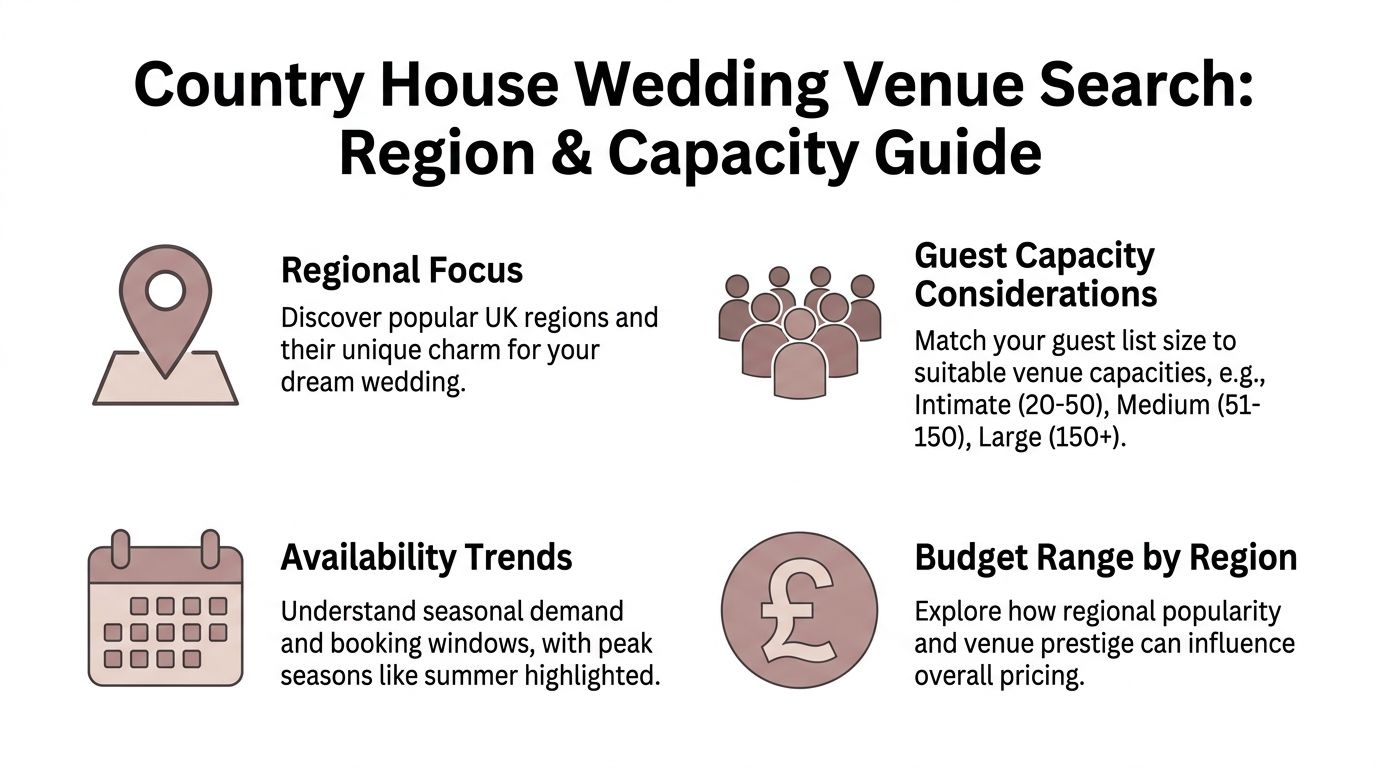
A good venue search starts with two filters. Where is it? And how many people will it hold comfortably? If you get those wrong, everything else becomes harder.
Country houses remain a popular choice across the market, with 16% of couples selecting them, and the strongest concentration is in Southeast England. Essex leads with 15,733 highly rated venues, followed by Surrey with 8,955 and Kent with 6,119, according to UK wedding venue data from Statista.
Start with the region that fits your guests
Many couples begin with aesthetics and only later think about travel. I’d reverse that. Your venue’s region affects arrival times, accommodation options, supplier access and whether guests can relax or feel rushed all day.
Southeast England draws so much attention for good reason. It gives many couples a practical balance of countryside setting and accessibility.
Think about these real-world questions before you even book a viewing:
- Guest travel: Are guests primarily driving from London, the Home Counties or further afield?
- Local stay options: Can guests find nearby hotels, inns or taxis without stress?
- Weekend feel: Do you want a destination atmosphere or a day that’s easy to attend and easy to leave?
- Supplier reach: Will your florist, band, planner and photographer travel there comfortably?
If you want an example of how couples assess a standout historic option in the Southeast, it’s useful to look at this overview of the best wedding venue criteria through a heritage setting.
Capacity shapes mood more than most couples expect
A room’s listed capacity is only the start. What matters is whether your guest count suits the proportions of the venue. A celebration of 50 can feel sumptuous in one house and lost in another. A guest list of 180 can feel lively in a well-planned estate and cramped in a property that technically fits everyone but doesn’t flow.
Often, couples get confused. They ask, “Can this venue hold our numbers?” when the better question is, “Will our numbers feel right here?”
If your ceremony room feels full in a warm, comfortable way and your drinks space allows movement without crowding, you’ve usually found the right scale.
A simple way to shortlist
Use three categories when you compare country house wedding venues UK couples often tour.
| Guest list style | What to look for | Common mistake |
|---|---|---|
| Intimate gathering | Rooms with character, not just large lawns | Booking somewhere too expansive for the numbers |
| Mid-sized celebration | Distinct spaces for ceremony, drinks and dinner | Choosing a venue where one room must work too hard |
| Large wedding | Strong circulation, terrace or lawn space, robust catering setup | Focusing on beauty and ignoring movement between spaces |
Don’t rely on brochure numbers alone
Ask how the venue uses its spaces on a real wedding day. A room might seat your guest count for dinner, but what about the ceremony? What about wet weather drinks? What about evening dancing if older guests want quieter seating nearby?
Capacity isn’t a single number. It’s a chain of moments.
That’s why I always advise couples to map the day in sequence during a viewing. Arrival. Ceremony. Confetti. Drinks. Group photos. Dinner. Speeches. Evening reception. Once you do that, the right venue shortlist becomes much clearer.
Decoding the Costs of Your Country House Venue
Country house pricing becomes much easier to understand once you stop treating “venue hire” as the whole cost. It rarely is. The full financial picture usually includes hire, catering, drinks, staffing, furniture, possible accommodation, and any extras tied to timing or setup.
The category is more flexible than many couples assume. In 2023, 60% of couples booked venues with in-house catering, and that setup can save over £1,000 compared with external suppliers. Pricing also spans a wide range, with some venues offering space for 30 to 150 guests from £1,500, while larger estates can host up to 350 guests with menus from £100 per person, according to UK wedding statistics on country house venue costs.
Understand the two cost layers
The first layer is the venue itself. This may cover exclusive access to the house or selected spaces, furniture already on site, and the basic timeline for your day.
The second layer is what the venue requires or offers around that booking. That often includes food and drink minimums, staffing, corkage terms, ceremony fees, evening extensions or overnight elements.
Such comparisons are tricky. One venue can look cheaper at first glance but end up costing more because key services are added later.
In-house catering versus external catering
In-house catering often gives couples more control than they realise. It usually means the kitchen knows the space, the timings are tested, and the service team works as one unit. Historic houses especially benefit from this because access routes, power limitations and room changes can be more delicate than in modern venues.
External catering can still be right for some weddings, especially if you want a very specific cultural menu or a dry-hire structure. But when you compare quotes, look beyond the headline cost.
Check whether external supply means you’ll also pay for:
- Kitchen setup requirements: Temporary equipment, prep spaces or generator needs
- Extra staffing: Venue stewards, service staff or coordination charges
- Longer turnaround time: More labour during room reset or clear-down
- Waste and logistics: Removal fees, glassware hire or transport costs
Ask for a like-for-like quote
A quote only helps if you can compare it properly. I tell couples to request a full breakdown in the same categories from every venue.
Use this framework:
| Cost area | What to ask |
|---|---|
| Venue hire | What spaces are included, and for how long? |
| Catering | Is service included? What menu level is priced? |
| Drinks | Are there package options, corkage fees, or minimum spends? |
| Staffing | Does the quote include bar staff, waiting staff and setup support? |
| Timing | What happens if the evening runs later? |
| Setup | Is early access included or charged separately? |
Practical rule: If two quotes look far apart, the difference usually sits in what’s included, not in whether one venue is “expensive” and the other is “cheap”.
Hidden costs are usually ordinary costs
Most so-called hidden costs aren’t hidden at all. They’re merely buried in the detail. Read carefully for late-night licensing, ceremony room fees, external supplier surcharges, furniture upgrades, security, and cleaning.
This matters even more in a listed or historic property. The venue may have sensible rules around candles, marquee placement, confetti, sound levels or supplier access. Those aren’t red flags. They’re part of protecting the building and helping the event run properly.
If you’re trying to understand how venues present themselves online and why some pricing pages feel clearer than others, this resource on SEO for Wedding Venues is surprisingly useful. It gives good context for how venue information is structured and why transparency matters.
For a concrete example of how detailed pricing can be laid out, couples often find it helpful to review dedicated pages for wedding venues and prices, then compare that format against other venues they’re considering.
Value is about smoothness, not just pounds
A well-priced country house venue does more than fit your budget. It removes friction. If catering is integrated, timings are proven and the service team knows the house, you often gain calm as much as cost control.
That calm has value. It means fewer moving parts, fewer supplier questions, and fewer opportunities for the day to feel disjointed.
Exclusive Use vs Part Hire Explained
Hiring model matters because it shapes how your wedding feels from the moment guests arrive. Some couples care most about privacy and complete control. Others want the atmosphere of a grand house without needing every room and lawn to themselves.
That’s where the choice usually comes down to exclusive use or part hire.
According to the earlier cost section’s source, 62% of venues booked in 2024 offered exclusive use, and that model is strongly associated with smoother guest experience. Some exclusive venues also report 4.9/5 satisfaction scores, linking that to the “luxurious intimacy” of a private estate. Rather than repeat the source link here, it’s enough to say the broader market clearly values privacy and flow.
What exclusive use actually means
Exclusive use means your wedding has sole access to the venue or estate areas included in the booking. There are no unrelated guests wandering through, no competing reception in the next room, and no awkward waiting while another event clears.
For many couples, that’s the emotional ideal. The house feels like it belongs to your story for the day.
It also helps with logistics. Your signage is clearer, your photography has fewer interruptions, and your timeline isn’t working around another booking’s movements.
When part hire makes more sense
Part hire sounds less glamorous, but it can be an excellent fit. In the best version of it, you still have a private, beautifully defined area of the venue. You aren’t hiring every available space.
That can suit:
- Smaller guest lists that would feel dwarfed by full-estate scale
- Daytime celebrations where fewer rooms are needed
- Couples prioritising atmosphere in one or two standout spaces
- Budgets that favour focus over breadth
The key is whether the hired section feels self-contained. If guests still feel cocooned in the experience, part hire can be every bit as elegant.
The real comparison
| Hiring model | Best for | Main advantage | Main watchout |
|---|---|---|---|
| Exclusive use | Medium to large weddings, privacy-focused couples | Full control and uninterrupted flow | You may pay for space you won’t fully use |
| Part hire | Intimate weddings, focused celebrations | Better scale for smaller numbers | Ask exactly which spaces remain private |
The right question isn’t “Which option is better?” It’s “Which option makes our guest list feel most at home?”
A practical historic venue example
Battle Abbey is a useful real-world example because the venue can be configured in more than one way. Couples planning a larger celebration can look at exclusive use wedding venues to understand how a full-site model supports broad guest movement, dramatic reception spaces and a cohesive feel for the occasion. For more intimate celebrations, an exclusive part-site approach can preserve privacy without overwhelming the day with too much space.
That’s a strong reminder that the hiring model should follow the wedding you want to host. It shouldn’t be chosen solely because one label sounds more luxurious than the other.
Bringing Your Vision to Life with Logistics and Styling
A beautiful country house wedding works because the logistics are invisible. Guests feel the rhythm of the day without seeing the machinery behind it. They move from ceremony to drinks to dinner as if the house itself is guiding them.
That’s the standard you should aim for.
Around 80% of top country house venues in the UK are licensed for civil marriages in multiple indoor and outdoor locations, which gives couples welcome flexibility. About 90% also offer in-house catering, which can cut supply chain delays by 50% compared with external caterers, and venues that offer day-before setup access can reduce preparation stress by 35%, according to country house wedding venue guidance and benchmarks.
Build the day as a sequence of spaces
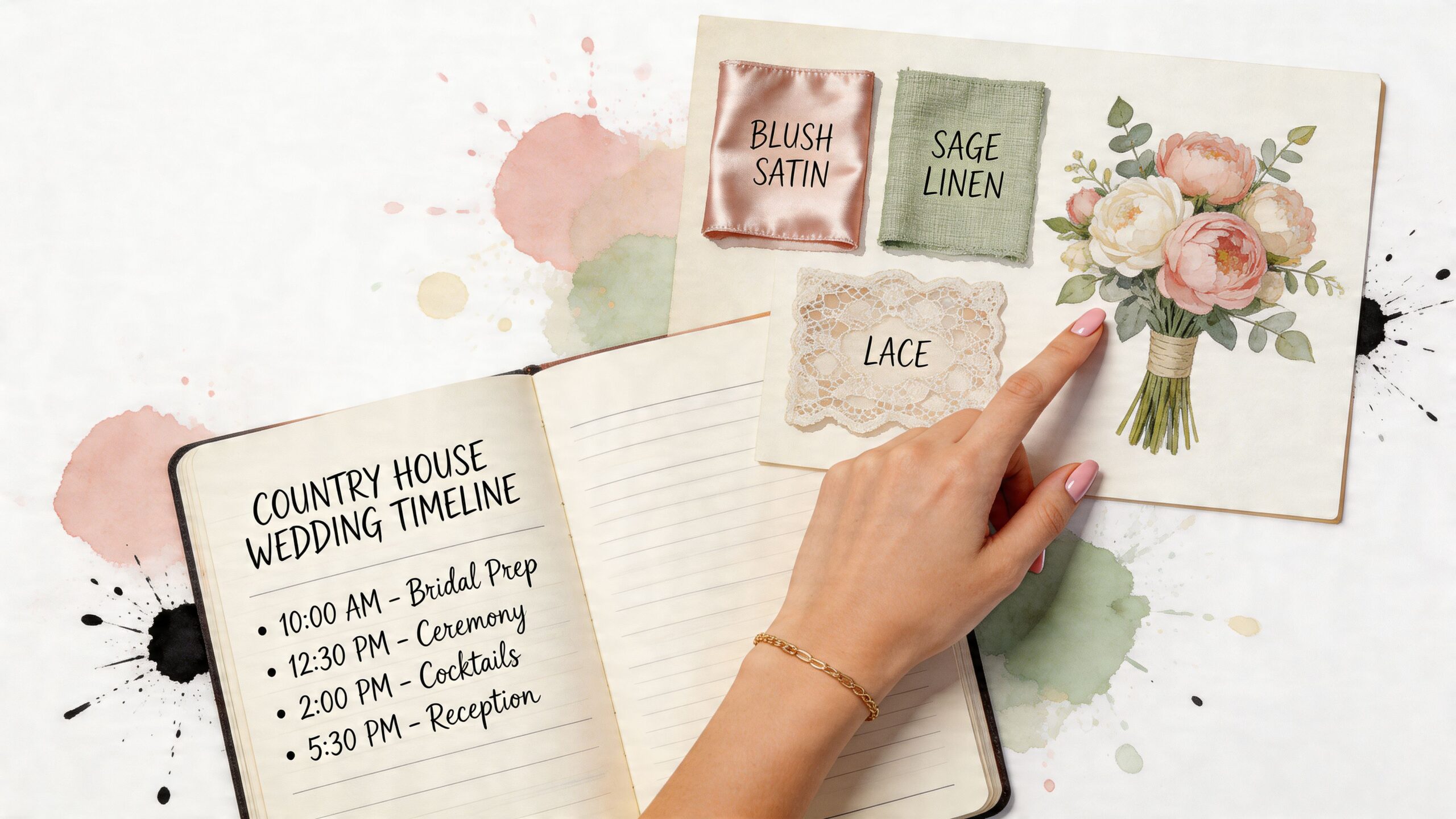
The strongest historic venues don’t ask one room to do everything. They give each part of the day a proper setting. In practical terms, that often means a licensed ceremony room, a separate area for drinks and canapés, a dining room with presence, and outdoor space that feels intentional rather than leftover.
Battle Abbey is a good example of how this thinking works in practice. Ceremonies take place in the Abbot’s Hall. Wedding breakfasts can move into the Duke’s Library or the Dining Room and Bar. Drinks and canapés can unfold on the Top Terrace or Six Penny Lawn, with the ruins creating a dramatic visual anchor.
That sequence matters because every move changes energy. A calm ceremony room focuses attention. A terrace loosens it. A dining room gathers everyone back into one emotional frame for speeches and dinner.
Indoor and outdoor licensing changes everything
Couples often ask whether outdoor ceremony options are worth prioritising in the UK. My answer is yes, but only when the indoor backup is equally attractive. The value isn’t just romance. It’s flexibility.
If the weather turns, you don’t want to feel as though you’re downgrading the day.
A venue with multiple licensed spaces allows the planner, coordinator or venue team to make a clean weather call and keep confidence high. Historic estates with substantial grounds also tend to offer better photography cover, better guest wandering space and more graceful transitions between moments.
Styling should respond to the building
A country house doesn’t need to be smothered in décor. It needs styling that listens to the architecture.
That usually means:
- Working with the room’s scale: Tall arrangements can suit grand halls, while low candlelit tables work beautifully in libraries and dining rooms
- Echoing the materials: Stone, wood, historic plaster, ironwork and lawns all suggest a softer, more layered design language
- Choosing focal points carefully: One staircase, one ceremony backdrop, one drinks terrace and one statement table plan often go further than decorating every corner
- Using the grounds well: Lawns, terraces and ruins can become part of the visual design, not just background
Historic venues already have a point of view. Your styling works best when it sharpens that point of view instead of competing with it.
Supplier access is part of the guest experience
Couples rarely get excited about access times, unloading routes and setup windows, but these details shape the day profoundly. Florists need enough time to dress ceremony and dining spaces. Caterers need workable access. Bands and DJs need realistic load-in plans. Photographers need to know where the best light falls and when.
Day-before setup is especially valuable in a country house because historic rooms often reward slower, more careful installation.
This short film gives a helpful sense of how a heritage venue can feel in motion, which is often easier to assess than through still photos alone.
Think like a planner on your viewing
When you tour a venue, walk the route your guests will take. Stand where the ceremony happens. Then walk to the drinks space. Then to dinner. Then to the evening area. If you’re constantly thinking, “Where do people go next?” that’s a sign the flow may need work.
A well-orchestrated country house wedding feels coherent because the venue team has solved those transitions before your florist arrives, before the music starts and before the first glass is poured.
That’s the difference between a venue that’s photogenic and one that’s functional.
Key Questions to Ask Before You Book
A venue visit is easy to waste. Couples often spend most of it reacting to beautiful details and forget to test whether the house can carry their wedding well.
The right questions cut through that quickly. They also help you compare venues fairly, especially when each one presents itself differently.
Venue Visit Checklist Key Questions
| Category | Essential Question |
|---|---|
| Capacity | How does our guest count feel in each part of the day, not just at dinner? |
| Ceremony | Which indoor and outdoor spaces are licensed, and which backup option is used if weather changes? |
| Privacy | Will we have exclusive use, exclusive use of selected areas, or will other guests be on site? |
| Flow | Where do guests go after the ceremony, and what happens if it rains? |
| Catering | Is food prepared in-house, and how are timings managed between canapés, dinner and evening food? |
| Drinks | Are there package options, corkage rules or bar minimums we should know about? |
| Access | Can suppliers set up the day before, and what time can they access the site on the wedding day? |
| Styling | Are there restrictions on candles, hanging installations, confetti, open flames or marquee additions? |
| Sound | Where does music happen, and are there sound or finish-time restrictions? |
| Furniture | What tables, chairs and linen are included as standard? |
| Staffing | Who runs the day on site, and who is our point of contact from booking to wedding day? |
| Accommodation | Is there on-site accommodation, or are there trusted local options for guests? |
| Photography | Which parts of the grounds are available for couple portraits and group photographs? |
| Costs | What isn’t included in the quote that couples commonly add later? |
How to ask better follow-up questions
Don’t stop at yes or no answers. If a venue says it offers a wet-weather option, ask to see it set for a real ceremony. If it says the space is flexible, ask what that looked like for a wedding similar to yours.
That’s where the truth sits. In specifics.
Use follow-ups like these:
- “Can you walk us through a wedding with our guest count?”
- “Where does the room change happen, if there is one?”
- “What tends to surprise couples after booking?”
- “Which suppliers find the venue easiest to work in?”
Good venue teams won’t be put off by detailed questions. They’ll usually answer them with clarity because they know the building well.
Watch for confidence, not just charm
A polished viewing matters, but operational confidence matters more. Notice whether the coordinator answers directly. Notice whether pricing is explained clearly. Notice whether the team understands how your day would unfold in that house.
The best country house wedding venues UK couples book don’t rely on charm alone. They pair beauty with precision. That combination is what lets you relax once the date is set.
Your Country House Wedding Story Starts Here
The right country house wedding isn’t chosen by instinct alone. It’s chosen when your vision, guest list, budget and logistics all settle into one place and feel right together.
That’s why the best decisions usually come from asking practical questions in romantic settings. You need the sweep of the drive, the beauty of the lawns and the history in the walls. You also need clear pricing, the right hiring model, sensible flow and a team who can make the day feel effortless.
When those pieces line up, a country house stops being just a venue. It becomes the setting where your families gather, your guests remember how they felt, and your photographs hold their shape for decades.
In a historic house, you aren’t only hosting an event. You’re adding your own chapter to a place that already knows how to hold meaning.
If you’re looking for a historic East Sussex setting that balances grandeur with practical planning, Battle Abbey Weddings is well worth exploring. From intimate celebrations to larger exclusive-use weddings, it offers characterful ceremony and reception spaces, experienced support, and the kind of dramatic heritage backdrop that makes a country house wedding feel unforgettable.