You've done the beautiful part already. The ceremony is mapped out, the photos are pinned down, and the venue has that long-awaited historic glow. Then the evening arrives, the pace changes, and the room either comes alive or starts to feel rushed, underfed, overheated, and badly timed.
That's the reality of an evening wedding reception at a heritage venue in East Sussex. It is not just “the party after dinner”. For many UK weddings, it is the larger social half of the day, with around 110 evening guests on average compared with about 80 day guests, and it also sits inside one of the biggest budget blocks, with the average UK wedding costing about £20,700, venue hire averaging £5,900, and catering and drinks about £4,200 (UK wedding statistics). If you treat the evening as an afterthought, the night usually tells on you.
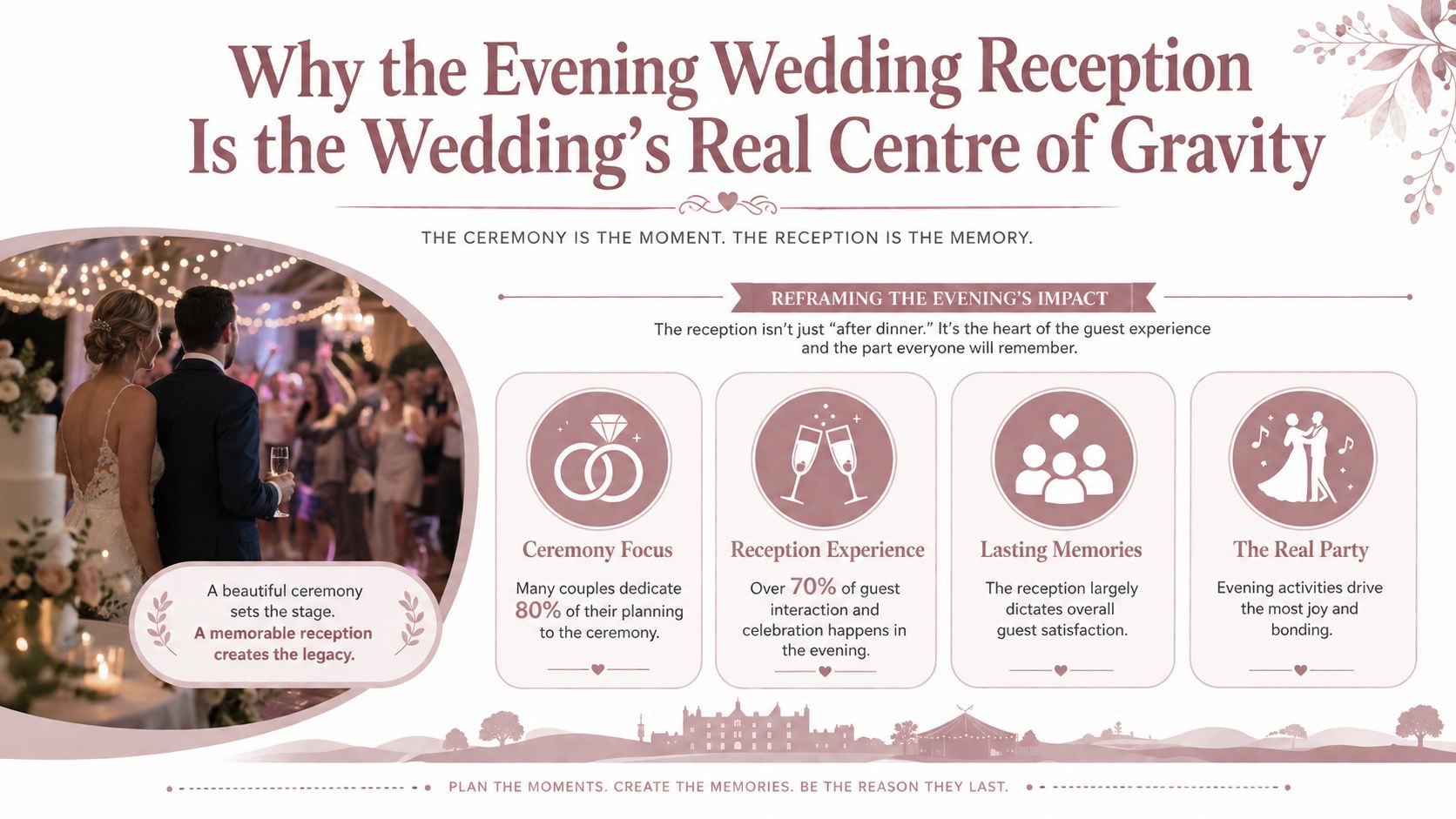
Why the Evening Wedding Reception Is the Wedding's Centre of Gravity
I've watched couples spend months perfecting the ceremony, then lose control of the evening in the first half hour after dinner. The tables look lovely, the speeches land well, and then the room starts asking practical questions the styling can't answer. Where do older guests sit? When does dancing begin? Who is fixing the music when the room goes quiet?
The evening carries so much weight because it is where the day becomes social rather than ceremonial. Guests mix more freely, the mood loosens, and the memory of the wedding usually settles here, not during the formalities. At a historic venue, that matters even more because the building has to shift from daylight ceremony mode into dinner, speeches, music, and late-night energy without feeling forced or cramped.
That pressure also shows up in the budget. UK reporting based on Bridebook and related data says the average wedding includes around 110 evening guests, compared with about 80 day guests, and that the reception is a major budget driver, especially when catering and drinks average about £4,200 and venue hire about £5,900 (UK wedding statistics). Those figures are only part of the picture. In practice, the evening is where service timing, sound limits, guest comfort, and staffing all have to hold together at once.
What changes after dark
An evening wedding reception is where atmosphere and operations meet. The abbey walls, terrace, and lawns can look cinematic, but only if the lighting, sound, service flow, and guest movement are all working together. I always plan the night before I refine the ceremony order. If the evening works, the whole wedding feels joined up. If it doesn't, guests remember the waiting, the heat, the cold, or the awkward gaps more clearly than the candles.
The move toward all-in-one wedding days makes this harder to ignore. One UK wedding-statistics source reports that up to 77% of ceremonies in 2023 were held at the same venue as the reception, and that evening receptions sit naturally alongside the most common ceremony window, with 31% of weddings taking place in the evening, versus 53% in the afternoon and 16% in the morning (wedding statistics). That means the evening block cannot be treated as what is left after the formal parts are finished.
Use this wedding day timeline template to map the evening around the venue's finish time, supplier handovers, and guest flow.
Practical rule: plan the evening first, then fit the earlier parts of the day around it. At a heritage venue, that keeps the final hours from turning into a scramble.
Building a Realistic Evening Reception Timeline for Different Guest Counts
The cleanest way to build an evening wedding reception timeline is to start from the venue's hard finish time and work backwards. At a midnight licence, every transition has to be protected with buffer time, because the room never runs at the exact speed you imagined in a spreadsheet. I build in 10 to 15 minute buffers between entrances, speeches, meal service, and the first dance, then I confirm the final run-of-show with suppliers seven days before the wedding.
A typical structure is about 5 hours total, with roughly 1 hour of cocktails and 4 hours of dinner and dancing. That leaves enough room for a proper meal, a measured speech block, and at least 2 hours of open dancing, which is where the night earns its keep (reception timeline guide). The main mistake I see is squeezing dinner and toasts so tightly that the dance floor doesn't open until the last hour. Once that happens, guests feel rushed and the room never settles.
Sample Evening Reception Timelines
| Clock Time | Intimate (up to 60 guests) | Large (75–250 guests) |
|---|---|---|
| 5:00 pm | Arrival drinks on the terrace, canapés, photos | Arrival drinks on the terrace, canapés, guests seated in waves |
| 6:00 pm | Guests move inside, brief welcome, dinner seating | Final seating call, welcome, service briefing to staff |
| 6:15 pm | Wedding breakfast begins | Wedding breakfast begins |
| 7:15 pm | Speeches, kept tight and paced | Speeches, with clear cueing between speakers |
| 7:40 pm | Dessert or coffee, room reset | Dessert or coffee, staff clear and reset floor |
| 8:00 pm | First dance, opening set, dance floor opens | First dance, opening set, dance floor opens |
| 10:30 pm | Late-night food, relaxed socialising | Late-night food, bar focus, full party rhythm |
| 12:00 am | Finish, final exit, transport check | Finish, final exit, transport check |
For a smaller part-site celebration, the evening can feel more intimate if you shorten the transitions and keep the service style simple. For a larger reception, the timeline needs firmer cues and more space between moments, because table clear-down, announcements, and dance-floor release all take longer. If you want a copyable planning structure, the wedding day timeline template is a useful place to start, then adapt it to your own finish time and guest count.
Practical rule: dinner service should never be so long that it steals the night. Keep the speech block tight, or the dance floor becomes the thing guests “get to” rather than the thing they enjoy.
Lighting and Décor for a Historic Venue After Dark
Once daylight fades, lighting stops being decoration and becomes infrastructure. That matters in a heritage venue because the evening can look romantic on a mood board while still failing in the actual world if the power supply, circuit layout, or rigging points are wrong. I've seen gorgeous plans fall over because the team assumed candles and a few festoons would be enough, then discovered the DJ, catering kit, and uplighting were all competing for the same feed.
The technical questions come first. Check whether the venue offers three-phase power or standard single-phase outlets, whether the total amperage matches the production rider, and whether audio and lighting sit on dedicated circuits. Ask for the lighting plot and DMX patch list early, not after the deposit is paid, and confirm rigging point load capacities and safety certifications before anyone promises hanging fixtures or moving heads (venue lighting and sound evaluation guidance). In plain terms, beautiful lighting is only beautiful if the building can support it.
What looks romantic and what actually works
The romantic choices are easy to picture. Uplighting on the abbey walls gives depth after dark. Festoons across the Top Terrace make the outdoor drinks hour feel warm. Lanterns on the Six Penny Lawn soften the transition from dinner to dancing. Those elements can all work, but only if the electrical plan is matched to the design rather than added as an afterthought.
The failure modes are usually boring, which is why they surprise couples. A hairdryer or catering appliance shares a feed with LED fixtures and the circuit trips. A rigging point looks fine on paper, but can't take the weight of a moving head or a heavier plot than expected. Sound and lighting are put on the same line, and the room hums or cuts out at the worst moment. The answer is to audit the documented electrical and rigging limits line by line against the production rider before signing anything.
For couples sketching a wider décor plan, evening reception decorations are worth thinking about only after the infrastructure is settled. That order matters far more than most styling guides admit.
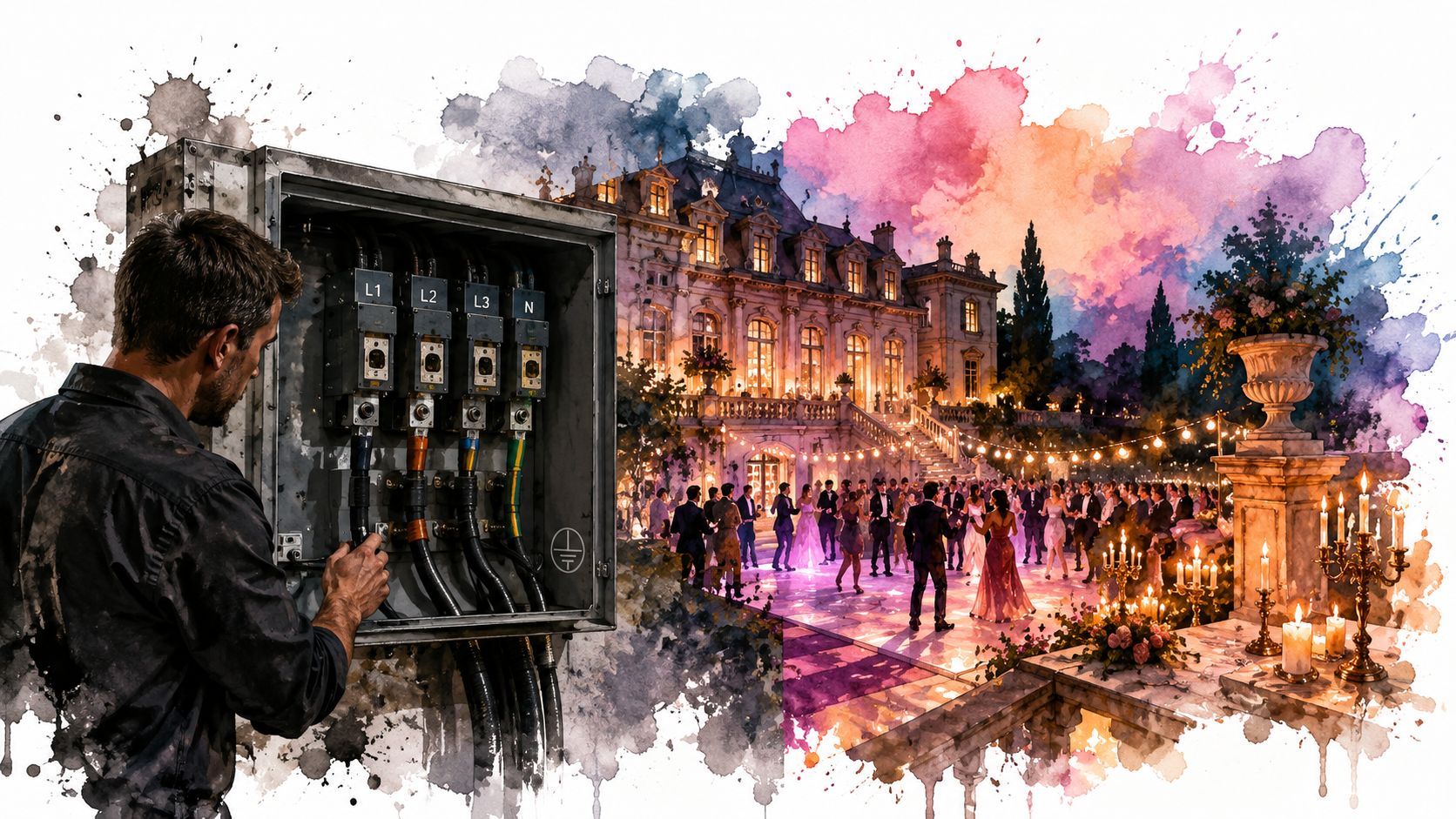
If the power plan is vague, the décor plan is already at risk.
Catering, Late-Night Food, and the Drinks Pacing Question
Food and drink timing shapes the mood of the whole evening. At a heritage venue, in-house catering usually keeps service calmer because the team already knows the kitchen access, service routes, and pace of the building. For many couples, that also reduces the number of moving parts on a night that is already carrying speeches, dancing, and a full guest list.
External catering can still work well, but it has to be judged on logistics first and menu ideas second. In-house teams are often better placed for East Sussex ingredients, three-course banquets, BBQs, and hog roasts, and they usually create fewer handover risks to a historic site. If you are comparing menu styles against the way the building works, the wedding food menu is a useful reference point because it keeps the decision tied to service flow as well as flavour.
How to pace the night
Start with reception drinks on the terrace, then move into wine service with the wedding breakfast, and hand the bar over cleanly for the evening party phase. That handover matters because guests can end up queueing for drinks if the service rhythm is unclear. Once the couple is waiting at the bar with everyone else, the night has already lost some of its polish.
Late-night food should arrive after the dance floor is established, not before. Mini bacon baps, pie stations, and loaded fries work because they reset energy without feeling like a second dinner. Served too early, they interrupt the party. Served too late, they become a queue rather than a comfort point.
The best approach is straightforward. Keep the first meal phase composed, let the bar and dancing run as separate rhythms, then drop in late-night food as a recovery point once the room is fully moving. At a venue that finishes at midnight, that sequence helps guests stay longer without feeling drained halfway through the evening.
Designing the Evening for Every Generation in the Room
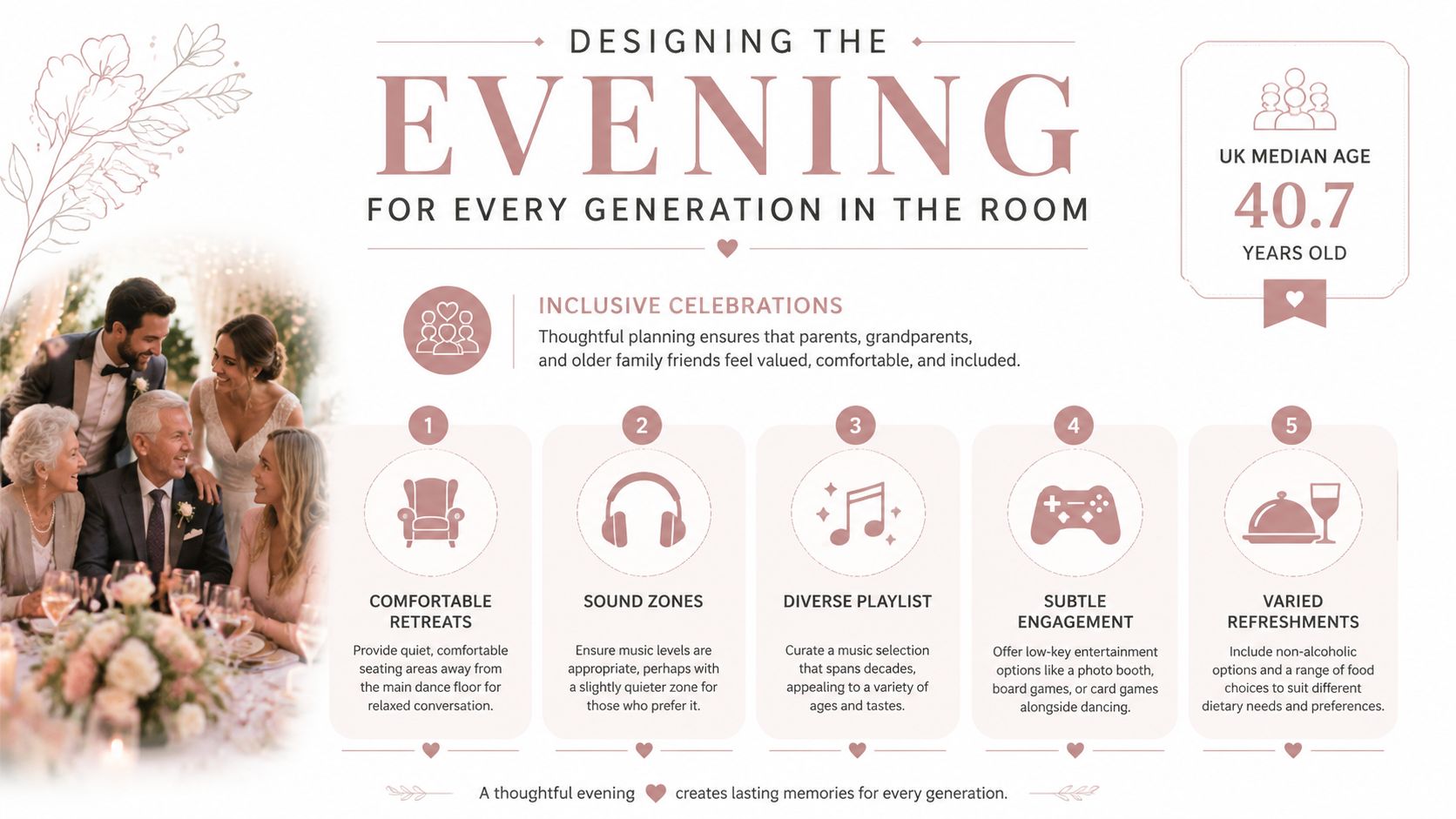
An evening wedding reception is usually planned around the dance floor, but the room is rarely made up of dancers only. The UK's median age reached 40.7 years in 2024, up from 34.9 in 1974, so multigenerational guest lists are the norm, not the exception (ONS median age data). That matters because grandparents, older family friends, and less mobile guests want to celebrate too, they just don't all want to stand in front of speakers for three hours.
The answer is to design the night in phases. Early dinner and speeches should feel inclusive for everyone. Then the room can shift into a high-energy dance block for those who want it. After that, the late social phase can be more relaxed, giving older guests a natural break without making them feel ejected from the celebration. A venue licensed until midnight has a real advantage here because the structure of the night can be clear rather than chaotic.
Details that make the room usable
Comfort beats cleverness here. A quiet-zone seating area away from the speakers gives people a place to talk without shouting. Proper chairs are better than stools if you expect older guests to stay for several hours. Surfaces on the terrace should be easy to move across in dress shoes or flats, because nobody wants to balance on uneven ground after dark.
A small wind-down window before taxis arrive also helps. It gives guests time to gather coats, say goodbye, and leave without being rushed out of a still-loud room. That is especially useful when the evening has been deliberately broken into distinct phases, because it lets the celebration end gracefully rather than all at once.
Design choice: accessibility isn't a separate feature at night, it's part of whether guests feel invited to stay.
Entertainment Sequencing and Working Within Sound Restrictions
Good entertainment at a historic venue is mostly about timing and control. If the music is too big too soon, dinner gets swallowed by noise. If the energy climbs too late, the dance floor never gets enough time to breathe. The strongest receptions sequence the music like a deliberate arc, not a single volume level.
Start with a background playlist during arrival drinks on the terrace, then use an acoustic set or softer live music during dinner. Once speeches are finished and the room has reset, move into a full band or DJ for the main dance block. The final hour should be managed wind-down, not dead air, so guests leave with the feeling that the night peaked properly rather than just stopped.
Sound restrictions need to be read before anyone books the act. Heritage venues near residential streets, including places like Battle, often have noise clauses that make the limiter settings and closing times just as important as the set list. Ask the supplier how they handle limiter changes, what they need for sound check, and whether they've worked inside buildings with strict acoustic boundaries before.
Keep the room under control
A coordinated sound check earlier in the day prevents the late-night panic where a venue manager has to cut power because the volume has crept past the agreed limit. The entertainment team should know exactly when the dance block starts, when the late-night food arrives, and when the room shifts into its final phase. That way the volume can be matched to the timeline instead of fighting it.
There's also a small but useful detail couples often overlook. Personalised glassware, name-matched drinks, or keepsake pieces can make the bar feel considered without adding visual clutter. ROCKS personalized wedding glassware is a practical example of the kind of small finishing touch that works best when the wider sound and service plan is already under control.
The point is not to make the evening quieter. It's to make the loud parts land when they should, and only then.
Transport, Staffing, Contingencies, and Printable Checklists
The night only feels complete when the end is planned as carefully as the start. In rural East Sussex, that means being realistic about how guests get home at midnight, because taxis thin out and public transport won't always serve the last stretch of the evening. Publish transport cut-off times, pre-book minibuses where needed, and schedule key moments so the last big memory happens before late-night travel becomes difficult.
Staffing has the same logic. A 75 to 250 guest evening needs clear front-of-house cover, a bar team that can keep pace with the party, cloakroom support if bags and coats are piling up, and security where the venue or supplier advises it. Weather contingencies matter too, especially on terrace-heavy schedules. If the drinks reception is meant to live outdoors, a gazebo or indoor fallback layout should already be in the plan, not improvised when rain starts.
For a useful external benchmark on event readiness and safety planning, safe event preparation at Northcourt LIVE shows the kind of checklist discipline that carries over well to weddings. The principle is the same, every supplier, movement, and risk point should be known before the doors open.
Couples and Planners Evening Reception Checklist
| When | Couples Action | Planner Action |
|---|---|---|
| 12 weeks out | Confirm guest mix, transport needs, and any mobility concerns | Draft the evening structure, staffing needs, and fallback plan |
| 4 weeks out | Finalise late-night food choice and bar expectations | Recheck supplier timings, access routes, and sound restrictions |
| 1 week out | Share transport notes and finish time with guests who need them | Lock the run-of-show with every vendor and venue manager |
| Day before | Pack evening essentials, including footwear changes and contact numbers | Confirm weather plan, delivery times, and emergency contacts |
A simple Plan B clock helps if the wedding breakfast overruns. Protect speeches first, then protect dancing, then compress the least important pieces before you touch the big moments. That way the night still feels intentional even when the day has run long.
If you're planning an evening wedding reception at a historic East Sussex venue, Battle Abbey Weddings is set up for the essentials that matter most after dark, licensed hours, terrace flow, in-house catering, and a layout that works for both intimate and full-site celebrations. Visit Battle Abbey Weddings to talk through a reception plan that keeps the romance and the logistics in the same room.