Most UK wedding ceremonies last between 20 and 45 minutes. For many couples, that means a civil ceremony of around 25 minutes or a religious service that sits closer to the longer end of the range, but the true aim isn’t to chase a number. It’s to shape a ceremony that tells your story and gives the rest of the day the right rhythm.
If you’re planning right now, you’re probably balancing two feelings at once. You want the ceremony to feel heartfelt and memorable, yet you also don’t want the day to become rushed, overstuffed, or oddly flat because one part ran too long. That tension is completely normal.
Couples often search how long is wedding ceremony because they want a simple answer. The simple answer helps, but it’s only the beginning. In a historic setting, timing affects everything that follows. Guest arrival, music cues, photography, drinks on the terrace, dinner service, and the moment the evening begins to soften into celebration all depend on those first minutes being well judged.
A shorter modern ceremony doesn’t mean a less meaningful one. In the UK, 82% of marriages are civil ceremonies which average around 25 minutes, and 68% of couples in a 2023 survey of over 5,000 UK couples chose ceremonies under 30 minutes according to UK wedding ceremony timing data. That tells us something important. Many couples now want warmth, clarity, and intention rather than length for its own sake.
Your Wedding Day Timeline Starts Here
The ceremony is the hinge of the whole day. If it begins calmly and ends on time, everything after it feels effortless. If it runs longer than expected, the pressure spreads quickly. Photographers lose the best light. Guests start wondering where to go next. Caterers wait. The reception mood arrives later than it should.
That’s why I always encourage couples to think about ceremony timing as an experience choice, not just a scheduling task. A beautifully paced ceremony gives your guests time to settle, listen, feel, and celebrate with you without fatigue creeping in.
What most couples are really asking
When couples ask how long a wedding ceremony should be, they’re usually asking three different questions at once:
- What’s typical: They want to know what most UK weddings do.
- What’s realistic: They want to avoid building a plan that won’t fit into the day.
- What feels right: They want a ceremony that sounds like them, not like a template.
Those are sensible questions. And they often come up alongside style decisions such as flowers, stationery, and crafting your custom wedding look, because the ceremony sits at the centre of how the whole celebration feels.
Practical rule: If your ceremony timing supports the atmosphere you want afterwards, you’ve chosen well.
Why modern weddings often feel different
UK ceremonies have become more concise over time, and that shift has changed expectations. Couples are less interested in padding out the formalities and more interested in creating an emotional moment with shape and flow. A short ceremony can still feel grand. A longer ceremony can still feel light. The difference is usually in the structure.
In a historic venue, that structure matters even more. Old buildings carry ceremony beautifully, but they also reward precision. Entrances feel more dramatic. Readings echo. Guest movement takes longer. A confetti exit or a receiving line can expand quickly if no one has planned the handover into the next part of the day.
Think of your ceremony as the opening movement of a piece of music. It doesn’t need to be the longest part to be the most powerful. It just needs to begin and end exactly where it should.
Ceremony Length by Type Civil Religious and Humanist
Different ceremony styles create different timings because they ask different things of the couple, the officiant, and the guests. That’s why one wedding may feel complete in 20 minutes while another needs much longer to feel balanced.
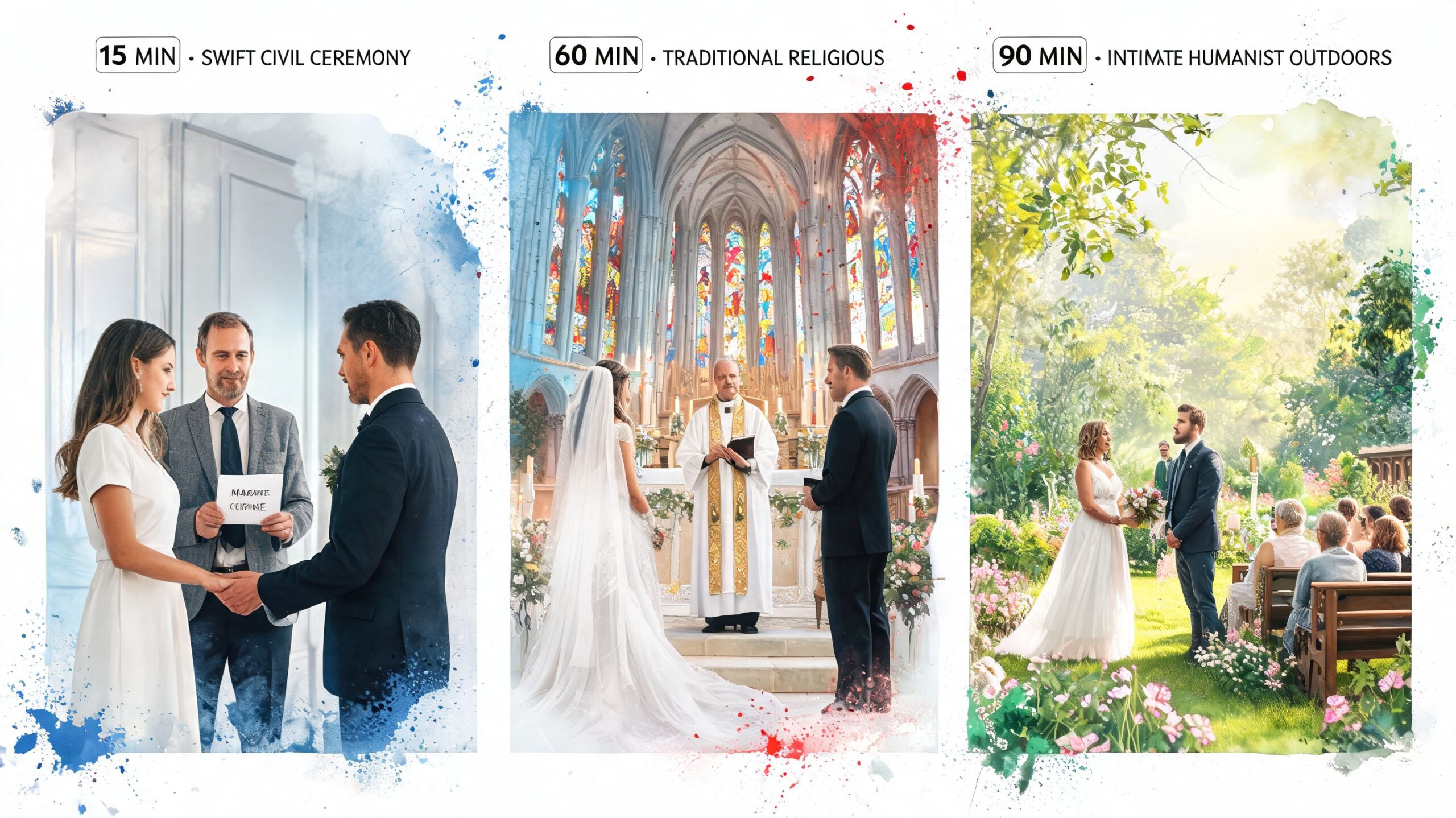
According to UK wedding ceremony trend data, UK wedding ceremonies have shortened from an average of 45 minutes in the 1970s to 22 minutes today, and civil ceremonies now make up 85% of all marriages, up from 5% in 1970. That broad shift explains why many couples today picture a ceremony that is polished, meaningful, and quite brisk.
Civil ceremonies
A civil ceremony is usually the most straightforward option. It often works well for couples who want legal clarity, elegant simplicity, and space elsewhere in the day for speeches, dining, and photographs.
Civil ceremonies tend to be shorter because they follow a tighter legal format. There’s less room for extended liturgy, and the pacing is usually firm because registrars often work to a set schedule. If you’re considering this route, it helps to look at the practicalities of a registry office wedding guide, especially if you want a simple legal format before adding more personal celebration around it.
Common features include:
- Legal wording: This must be included, so it anchors the structure.
- Brief welcome: Usually concise and formal.
- Vows and rings: The emotional centre, but not usually lengthy.
- Optional reading or music: These can personalise the ceremony without making it feel heavy.
Religious ceremonies
Religious services often take longer because they carry more ritual. A Church of England ceremony may include hymns, readings, a homily or sermon, prayers, and a more deliberate liturgical sequence. Even when the tone is warm and intimate, the structure naturally asks for more time.
That extra time can be beautiful. It creates a stronger sense of procession and solemnity. Guests often feel that they have witnessed not only a legal marriage but also a spiritual event with a fuller arc.
Humanist and celebrant-led ceremonies
These can be the trickiest to estimate because they’re the most flexible. Some are spare and poetic. Others are rich with stories, rituals, music, and personal vows. The freedom is lovely, but it also means the length can expand before couples notice it.
A celebrant-led ceremony usually grows longer when couples include family contributions, symbolic rituals, or extended storytelling. That isn’t a problem in itself. It only becomes one when no one edits with the guest experience in mind.
The best ceremony type isn’t the one with the longest script. It’s the one whose pace matches the tone of your day.
The Anatomy of a Wedding Ceremony Timings for Each Moment
Once you break a ceremony into parts, the timing starts to make sense. Couples often feel calmer as soon as they can see where the minutes go.
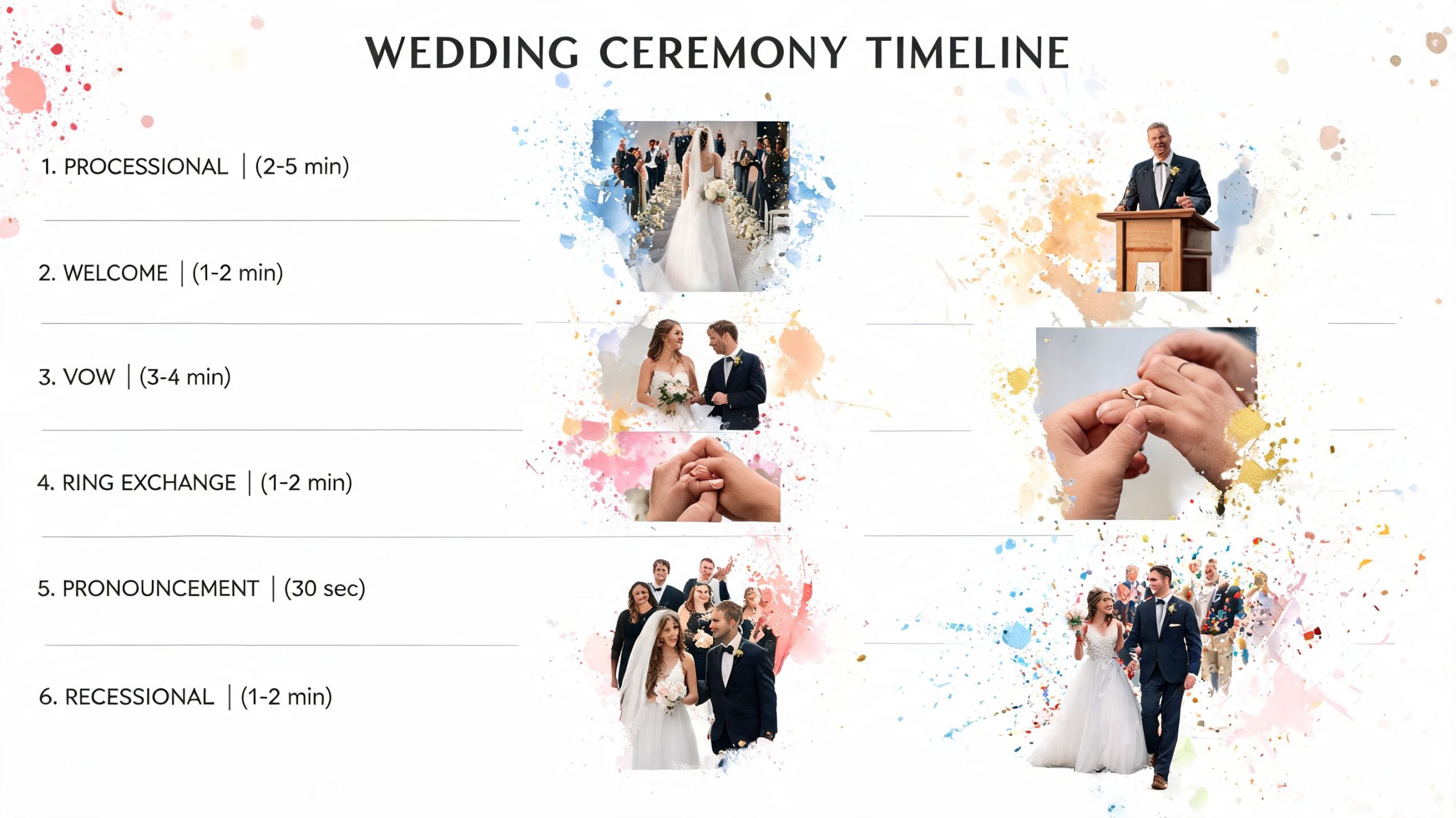
For church ceremonies in the UK, this wedding ceremony component guide notes these common timings: the processional takes 2 to 5 minutes, readings often run 5 to 10 minutes each, hymns 3 to 5 minutes each, vows 5 minutes, and register signing 5 to 10 minutes. It also notes that omitting a full Mass often keeps the service under 45 minutes.
The entrance and settling moment
The processional is usually the first place where couples underestimate time. Walking slowly, adjusting dresses, seating the last few guests, and allowing everyone to breathe before the first words are spoken all add texture.
If you rush this moment, the ceremony can feel as though it started before anyone was emotionally present. If you linger too long, the energy drops. A measured entrance tends to work best.
Welcome readings and music
This middle section is where personality enters. A short welcome creates context. A reading can add wit, tenderness, or family meaning. Music can create a pause between one stage and the next.
Here’s where ceremonies often expand unexpectedly:
- Multiple readings: Each one needs an introduction, a walk to the front, the reading itself, and a pause afterwards.
- Live music: Beautiful, but it changes pace more than couples expect.
- Long introductions: These often feel longer in the room than they did on paper.
For couples shaping the order carefully, a helpful starting point is a wedding order of service example, especially if you want to see how sequence affects flow.
Vows rings and the legal core
This is the heart of the ceremony. The exchange of vows and rings rarely needs much time to feel profound. In fact, this section is often strongest when it’s spoken clearly and without too much surrounding clutter.
If you’re writing personal vows, read them aloud together in advance. What seems short on the page can feel much longer when spoken slowly and emotionally.
Keep the legal centre of the ceremony clean. Then place personal touches around it with intention.
A short visual guide can help if you’re trying to picture the sequence in motion:
Signing and the exit
The register signing, or its modern equivalent in the practical flow of the ceremony day, is often treated as an afterthought. It shouldn’t be. It creates a natural breathing space. Guests relax. Music has room to land. Photographers capture quieter expressions.
The recessional then lifts the room. It should feel like a release, not a scramble. That means building in a little space for applause, movement, and any instructions guests need before heading outside.
A simple way to estimate your ceremony is to add up your chosen elements like this:
| Ceremony element | Typical effect on timing |
|---|---|
| Entrance | Sets the pace and creates anticipation |
| Welcome | Adds context without much length |
| Each reading | Adds noticeable time and a change of rhythm |
| Hymn or live music | Deepens atmosphere but extends flow |
| Vows and rings | Emotional centre, usually concise |
| Signing and exit | Creates closure and transition |
Sample Wedding Ceremony Timelines
Examples make this easier. Most couples don’t need a theoretical answer. They need to see what a real timeline might look like when the pieces are assembled.
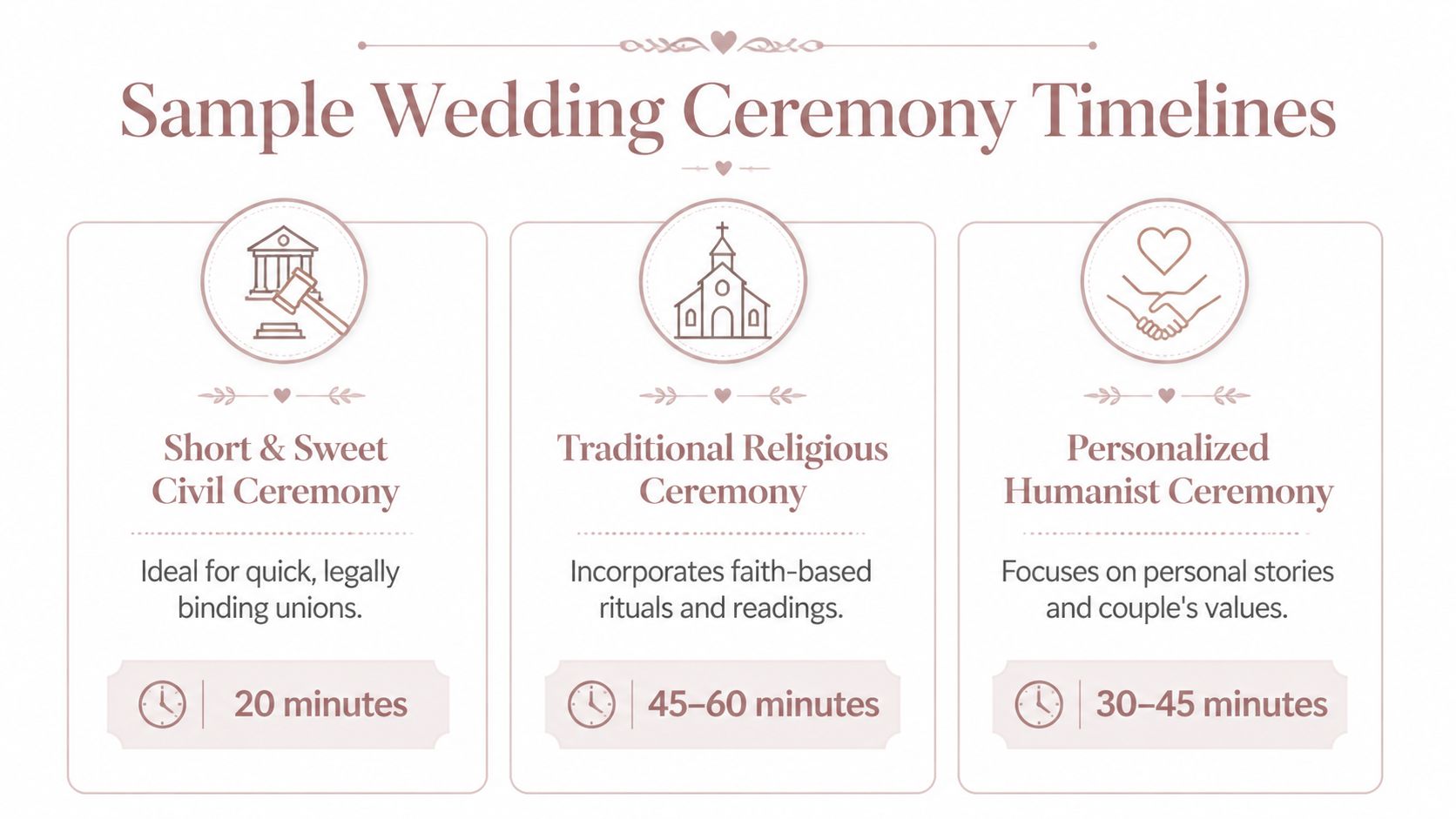
Three ways the same moment can feel different
A 20-minute civil ceremony can feel crisp and elegant. A 35-minute personalised ceremony often gives room for a reading and more individual language. A 45 to 60 minute religious ceremony usually allows for faith-based elements and a fuller ritual structure.
If you’re mapping the whole day alongside the ceremony, a wedding day timeline template can help you place each version in context.
Sample UK Wedding Ceremony Timelines
| Event | Short & Sweet (20 Mins) | Standard & Personal (35 Mins) | Extended & Traditional (50 Mins) |
|---|---|---|---|
| Guest settling and entrance | Brief entrance | Entrance with fuller pause | Formal entrance with extra processional weight |
| Welcome | Short legal welcome | Warm welcome with personal framing | Formal welcome within a traditional service |
| Reading or music | Usually omitted or kept very brief | One reading or short music interlude | Multiple readings and hymns |
| Vows and rings | Core legal vows and ring exchange | Legal vows plus personal element | Traditional vows within a longer liturgy |
| Signing | Brief and practical | Included with music | Included with music and more ceremony around it |
| Exit | Immediate recessional | Recessional with a little breathing space | More formal closing and recessional |
How to choose the right one
The shortest option suits couples who want the ceremony to feel elegant and uncluttered. It also works well when the venue setting itself provides much of the atmosphere.
The middle option often feels the most balanced. There’s room for personality without asking too much of guests’ attention. For many couples, this is the sweet spot.
The longest format works beautifully when faith and tradition are central to the day. It asks more of the schedule, but it can also give the ceremony a richness that shorter formats don’t try to achieve.
If you’re torn, choose the structure you’ll still love when you read it aloud, not just the one that looks attractive in a planning document.
How Personal Choices and Legal Rules Shape Your Timeline
Two forces shape ceremony length more than anything else. The first is what you choose to include. The second is what the law and venue logistics require.
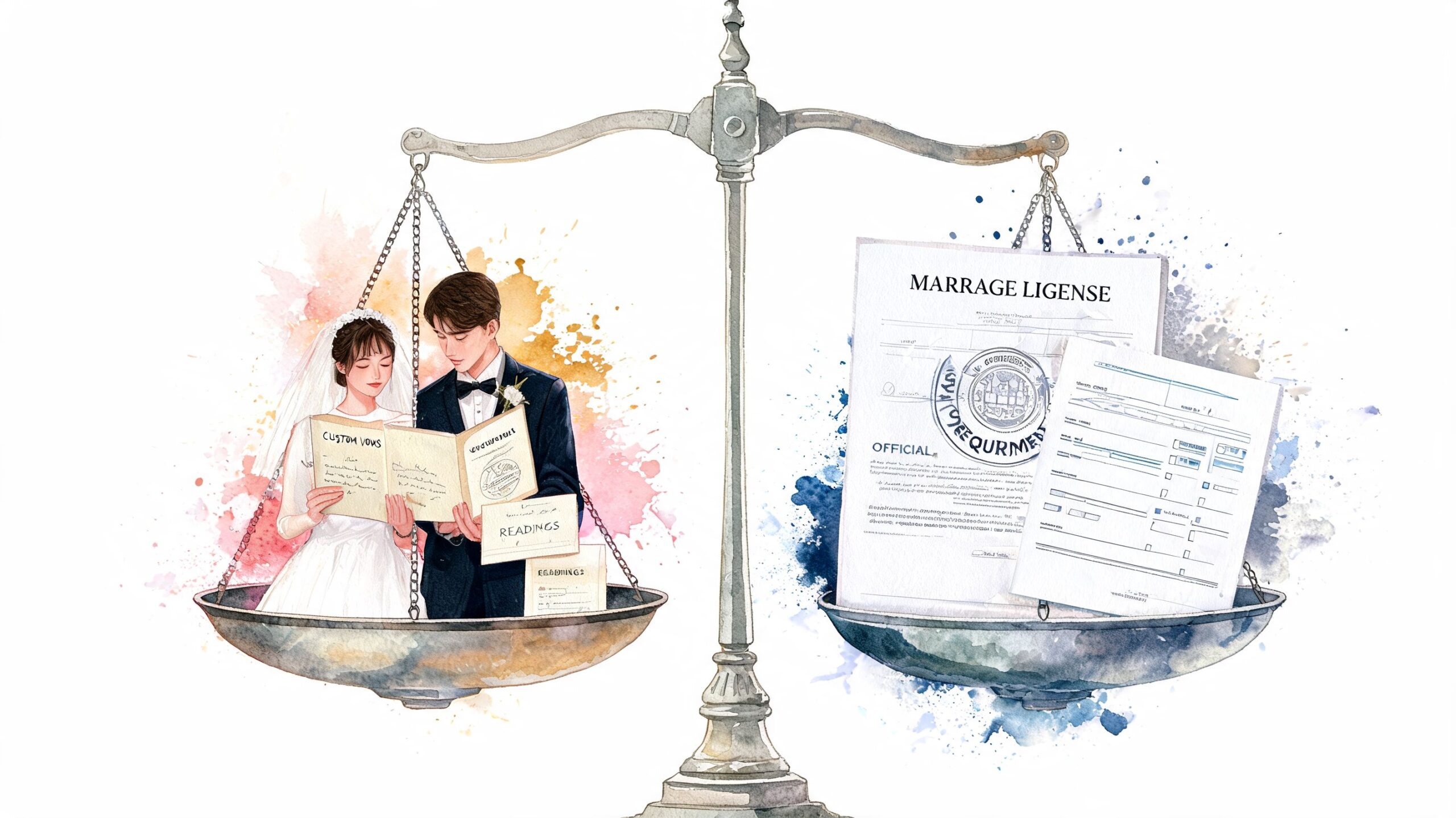
Under the UK civil ceremony time guidance, civil ceremonies in approved premises should not exceed 60 minutes under the Marriage Act 2022, and 42% of couples at heritage venues in 2025 planner surveys said they felt rushed. That doesn’t mean couples are doing anything wrong. It usually means no one has translated personal wishes into realistic minutes early enough.
Personal choices that lengthen a ceremony
The additions that most often stretch timing are usually lovely things:
- Personal vows: These add intimacy, but long vows can change the pace more than expected.
- Readings from friends or family: They create warmth, though they also require movement and pauses.
- Live music between segments: This can be magical, especially in historic spaces, but it needs proper cueing.
- Symbolic rituals: Handfasting or similar elements can add depth when they’re integrated cleanly.
None of these are bad choices. The question is whether they belong in the ceremony itself or would work better later in the reception, speech, or drinks period.
Rules practicalities and venue realities
Legal wording cannot be improvised away. Registrar availability also matters. In heritage settings, access routes, acoustic quirks, and guest movement can subtly add time around the edges.
That’s why the paper version of a ceremony and the lived version are never quite the same. A reading that takes a minute to read may take several minutes once you include introduction, walking, and settling. A confetti line can take longer than expected if there are many guests or a narrow exit route.
A simple decision filter
When you’re choosing ceremony elements, ask three questions:
- Is this essential to the meaning of our marriage?
- Will guests feel more connected because it’s included?
- Does it belong in the ceremony, or just somewhere on the day?
If an element answers yes to the first two, keep it. If it only answers the third because it sounds nice in theory, it may be better elsewhere.
Timing Your Ceremony Perfectly at Battle Abbey
Historic venues ask for a little more choreography, and they reward it beautifully. The ceremony doesn’t sit alone. It opens the doors to the entire guest experience.
At heritage venues, this ceremony pacing guidance suggests that a 28-minute ceremony is optimal. It notes that this length can accommodate a grand entrance, vows, and a reading, while helping prevent 10 to 15 minute delays for canapés and reducing post-ceremony photo overruns by 25%.
Why a well judged ceremony unlocks the rest of the day
In a place like Battle Abbey, the setting does a great deal of emotional work for you. The architecture, the grounds, and the sense of history already create atmosphere. That means the ceremony often doesn’t need to be long to feel important.
A carefully paced ceremony allows the day to breathe in the right places:
- Guests arrive and settle without confusion
- The ceremony lands emotionally without dragging
- The exit feels celebratory rather than congested
- Photography begins while energy is still high
- Drinks and canapés start when guests expect them to
That sequence matters. When the ceremony ends at the right moment, the whole celebration gathers confidence.
Practical timing in a historic setting
Historic spaces often involve stone floors, older routes, and outdoor transitions. All of those details are part of the charm, but they also mean that moving a group from one moment to another is never instant.
A sensible ceremony plan in this kind of venue usually keeps the formal part focused, then lets the grandeur expand afterwards through the setting itself. The emotional memory for guests doesn’t come only from how long they sat during the vows. It comes from the entire arc. The entrance, the words, the applause, the light outside, the first drinks, and the sense that everything is unfolding exactly as it should.
A historic venue gives you drama for free. You don’t need to manufacture it by overloading the ceremony.
For many couples, that means choosing a concise core ceremony and allowing the venue to carry the romance into the next chapter of the day.
Your Ceremony Timing Questions Answered
Even after couples settle on a rough length, a few worries tend to linger. These are the questions I hear most often.
Can a ceremony be too short for a grand venue
Not at all. A short ceremony can feel wonderfully elegant in a dramatic setting. Grandeur comes from confidence, not duration. If the entrance is well paced, the vows are clear, and the exit flows smoothly, guests will remember the feeling of the moment rather than wishing it had gone on longer.
How do we keep guests engaged during a longer service
Edit with intention. Choose readings that sound good aloud. Keep music purposeful. Ask readers to practise. If a service includes more traditional elements, vary the rhythm so guests aren’t listening to the same tone for too long.
A longer ceremony works best when every part earns its place.
What if the ceremony starts running late on the day
Build calm into the plan before anyone arrives. Keep one or two elements flexible, usually music or a reading, so you have room to adjust if needed. The best protection against lateness is a ceremony script that has already been timed realistically in advance.
Guests are very forgiving when the atmosphere feels composed. They become uneasy when suppliers and family members appear unsure.
Does timing change for a micro wedding
Yes, often quite noticeably. According to East Sussex micro wedding timing data, a 2026 ONS report showed a 35% rise in micro-weddings under 50 guests in East Sussex, and for these intimate celebrations, ceremonies often shorten to 15 to 25 minutes. The same source notes that 62% of couples reported higher satisfaction when they paired a shorter indoor rite with extended outdoor mingling and photographs.
That makes sense. Smaller weddings usually need less time for seating, movement, and formal transitions. They often feel most special when the ceremony stays simple and the intimacy unfolds afterwards in conversation, portraits, and shared time together.
The smaller the guest list, the more powerful a brief ceremony can be. Intimacy does a great deal of the work.
If you’re planning your own day and want a historic setting that’s as memorable as the ceremony itself, Battle Abbey Weddings offers a remarkable backdrop for both intimate celebrations and larger gatherings, with characterful ceremony spaces, beautiful reception settings, and the kind of atmosphere that makes every minute feel well spent.