You're probably here because your original wedding no longer tells the whole story.
For some couples, that first day was perfect but far too fast. For others, it happened under pressure, with a tiny guest list, a tight budget, family absences, or circumstances that never quite matched the significance of the commitment itself. And for many, the idea of renewing vows in the UK isn't about recreating a wedding at all. It's about marking what came after it. The years, the changes, the family you built, the hard patches you survived, and the version of love that feels deeper now than it did then.
That's where good planning matters. A vow renewal can be beautifully simple, or it can become a richly layered celebration in a historic setting with exceptional food, meaningful ceremony design, and the kind of atmosphere people remember for years. The difference usually comes down to clarity. Know what this day is for, who it's for, and what kind of experience you want to create.
Why Renew Your Vows and What You Need to Know
Some couples renew their vows on a milestone anniversary. Others do it after illness, loss, a major move, retirement, or the arrival of children and grandchildren. I also see couples choose it because their first wedding was ruled by logistics, not personality. They want this one to sound like them, feel like them, and unfold at a pace they can enjoy.
That shift matters. A vow renewal is often less performative than a wedding and more emotionally precise. The room tends to be calmer. The words matter more. Guests aren't watching two people step into the unknown. They're witnessing two people choose each other again, with full knowledge of what that means.
The legal point most couples need first
If you're searching for renew vows UK advice, the first thing to get clear is the legal status. In the UK, renewing wedding vows is a symbolic ceremony with “no legal effect”, and a registrar conducting it is not acting in an official capacity, according to Leeds City Council's reaffirmation of marriage vows guidance.
That single point changes everything. You aren't entering a new marriage. You aren't repeating the legal process. You're marking an existing marriage in a way that reflects your life now.
Practical rule: Once couples understand that the ceremony is symbolic, their planning decisions usually become clearer and more personal.
Why that freedom is useful
Because the ceremony isn't tied to the legal structure of a wedding, you can build a day around meaning rather than paperwork. That opens the door to venues with character, private spaces, family-led ceremonies, and timings that suit your guests instead of a formal legal slot.
In practice, that means you can choose the tone first. Quiet and intimate. Formal and elegant. Family-centred. Black tie. Garden lunch. Candlelit dinner in a historic room. The vow renewal works best when the format follows the story, not the other way round.
A few common reasons couples move forward with it:
- A milestone deserves more than dinner out: Anniversaries often spark the idea, especially when a couple wants a shared experience rather than a gift.
- The first wedding felt unfinished: Perhaps key people couldn't attend, or the day was organised quickly and never felt fully yours.
- Family is part of the story now: Children can read, witness, escort, or even help lead parts of the ceremony.
- You want a destination feel without legal stress: For couples considering a trip as part of the occasion, Max's Luxury Rides anniversary guide is a useful source of travel inspiration for shaping the celebration around the wider experience.
The strongest vow renewals have emotional focus and practical simplicity. When those two are balanced well, the day feels generous rather than overcomplicated.
Choosing Your Venue Date and Guest List
The first three decisions shape everything else. Venue, date, and guest list are not separate admin tasks. They determine the atmosphere, the budget direction, the ceremony format, and the kind of hospitality that makes the day feel coherent.
Start with the kind of room you want to stand in
A registry-office style renewal suits couples who want a short, straightforward moment and perhaps a meal afterwards. A bespoke venue renewal suits couples who want the ceremony to sit inside a fuller event. That might mean arrival drinks, photography across the grounds, a private dining experience, speeches, live music, or a weekend away with family.
Because UK vow renewals have no legal framework, they can take place “pretty much anywhere” with permission, from the day after the wedding to 50 years later, and a basic registry office renewal is typically around £300, while celebrant-led bespoke ceremonies usually range from £600 to £1,000 for the celebrant alone, according to Hitched's guide to renewing your wedding vows.
That doesn't mean one route is better. It means they solve different problems.
Vow Renewal Styles Compared
| Feature | Registry Office Renewal | Bespoke Venue Renewal (e.g., Historic Estate) |
|---|---|---|
| Atmosphere | Formal, simple, brief | Layered, immersive, tailored |
| Planning effort | Lower | Higher |
| Ceremony format | More standard | Flexible and personal |
| Guest experience | Often ceremony plus meal elsewhere | Full hosted event in one location |
| Visual backdrop | Civic setting | Architecture, gardens, heritage spaces |
| Celebrant role | May be limited in style | Can shape a narrative around your story |
| Best for | Couples wanting ease and restraint | Couples wanting occasion, design, and hospitality |
Date first, but choose it with purpose
The strongest dates carry emotional weight. An anniversary is the obvious choice, but it's not the only one. Some couples choose the date they met, the season they love most, or a weekend that works for a wider family gathering.
In historic venues especially, season changes the feel of the day more than people expect. Spring and summer can favour terraces and lawns. Autumn suits candlelight, richer florals, and long-table dining. Winter works beautifully if the venue has warmth, texture, and rooms with presence.
A practical way to decide is to ask what memory you want guests to leave with. A sunlit drinks reception feels different from a fireside dinner.
Guest list size changes the entire event
A vow renewal often works best when the guest list is intentional. This isn't always the moment for obligation invites. It's often the moment for the people who have actively witnessed the marriage.
If you need help sorting that balance, a structured planning tool like this wedding guest list template can make decisions less emotional and more manageable.
What usually works well:
- Small gathering: Best when the priority is intimacy, conversation, and a ceremony where every person present feels essential.
- Mid-sized celebration: Ideal for couples who want warmth without losing the ability to host properly.
- Larger event: Works when the venue has clear flow, enough privacy, and hospitality that can still feel personal.
The guest list shouldn't be built around who might be offended. It should be built around who belongs in the memory.
In a historic venue, guest count also affects whether the celebration feels elegant or diluted. A magnificent hall with too few people can feel sparse. A private dining room with too many can feel compressed. Match the scale of the room to the scale of the emotion you want.
Crafting a Personal Vow Renewal Ceremony
The ceremony is where a vow renewal either becomes moving or stays decorative.
I've seen beautifully styled events fall flat because the words were generic and the structure felt borrowed from a wedding template. I've also seen very simple ceremonies hold an entire room because the couple spoke with honesty and the officiant understood the rhythm of their story.
Who should lead the ceremony
One of the most useful freedoms in a UK vow renewal is that you don't need to use an authorised celebrant. Humanists UK highlights that vow renewals are symbolic, which gives couples far more creative control over who leads and how the ceremony is designed in their vow renewal tips.
That leaves you with two strong options.
A professional celebrant usually brings shape, confidence, and pacing. They know how to gather the room, cue transitions, and keep sentiment from becoming awkward. A friend or family member can be wonderful too, but only if they're calm, articulate, and comfortable holding attention.
What the vows should sound like
New vows don't need to be long. They do need to be specific.
The best ones don't try to summarise an entire marriage. They pick out the truths that matter now. Gratitude. Endurance. Humour. Changed priorities. The promises you understand more fully because you've already lived them.
A strong structure often looks like this:
- Begin with recognition: Name the journey rather than retelling every chapter.
- Add one or two lived details: Small specifics carry more feeling than grand statements.
- Make present-tense promises: Focus on the marriage you're continuing, not the one you began years ago.
- End plainly: A clean closing lands better than a dramatic flourish.
A ceremony that feels like your own
For most couples, a good vow renewal ceremony lasts somewhere between brief and comfortably substantial. It needs shape, but not bloat. A typical order might include a welcome, a short story about the couple, readings, the vows, an exchange of rings if wanted, and a closing blessing or toast.
If you'd like a practical starting point, this wedding order of service guide is helpful for mapping the flow.
Elements that often work especially well in a vow renewal:
- Readings by children or close friends: These bring family history into the room.
- Music with shared meaning: Not just what sounds romantic, but what belongs to your life together.
- A symbolic gesture: Handfasting, a candle-lighting moment, or a shared drink can add texture without making the ceremony feel theatrical.
Keep the ceremony shorter than your emotions suggest and more personal than any template offers.
What doesn't work is imitation. A vow renewal shouldn't feel like a second attempt at a first wedding. It should feel like a confident ceremony for the marriage you already have.
Styling Your Day Food Photography and Attire
Once the ceremony is set, the rest of the celebration needs to support it. Styling isn't just about colour or décor. It's about making sure the room, the food, the clothing, and the photography all belong to the same story.
In historic venues, this matters even more. The architecture already carries mood. Good styling works with that character instead of fighting it.
Dress for the setting and for yourselves
There are no rules here, which is liberating and occasionally unhelpful. Some couples want black tie because the day feels significant enough to warrant formality. Others want soft tailoring, a modern dress, or something they can wear again for dinner on the terrace.
The useful question isn't “what should we wear?” It's “what level of occasion do we want to create?”
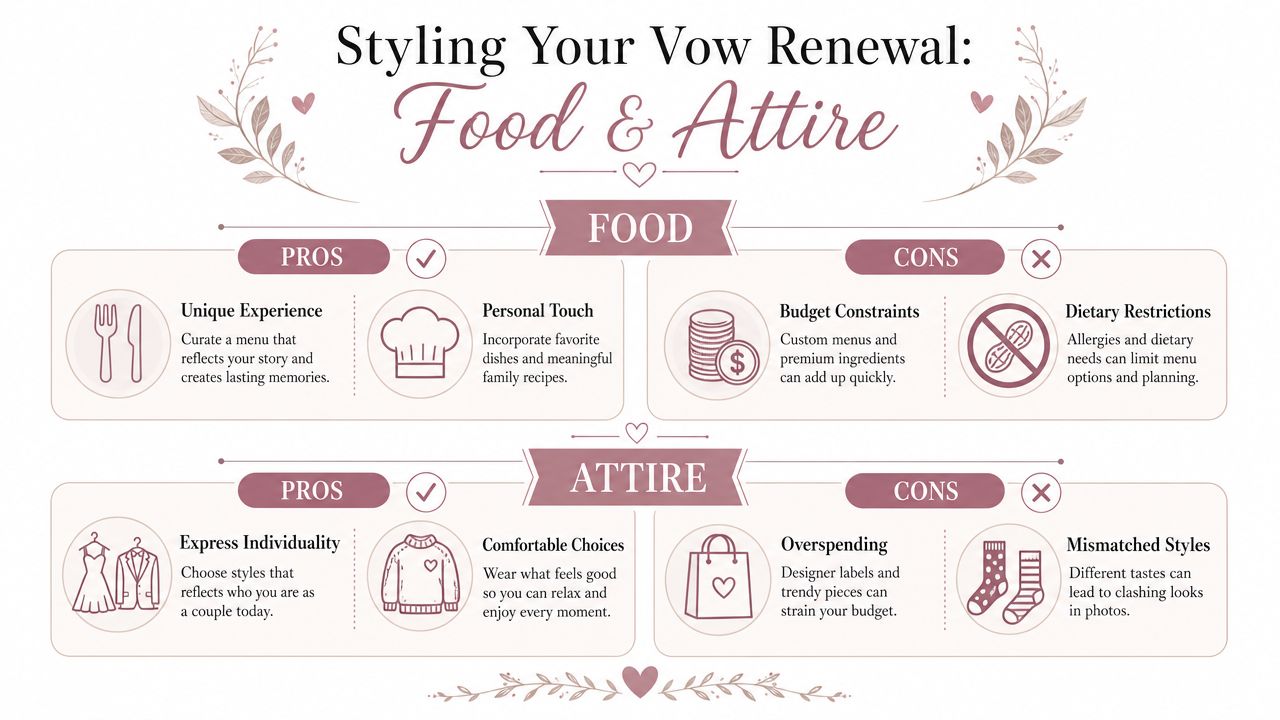
A few principles usually hold up well:
- For heritage interiors: Structured tailoring, silk, crepe, velvet, and polished shoes sit naturally in the space.
- For outdoor terraces or lawns: Lighter fabrics and easier silhouettes tend to move better and photograph well.
- For comfort: If you'll be standing, walking grounds, or greeting guests for a long stretch, comfort needs to be designed in from the start.
For décor direction, seasonal florals and statement installations can help define the space without overloading it. If you're looking at current visual ideas, Amazing Giant Flowers' 2026 trends offers useful inspiration for couples who want a stronger styling concept.
Food should match the pace of the day
Food can either support a vow renewal beautifully or interrupt it completely. The mistake I see most often is choosing catering that doesn't fit the event rhythm.
A seated meal works well after a formal ceremony when guests are dressed for occasion and the venue has strong dining rooms. A BBQ, sharing menu, or relaxed feast works well when the tone is family-led and the day spills naturally across indoor and outdoor spaces.
Venue operations matter here. Because a UK vow renewal doesn't require legal notice or a marriage schedule, the main technical constraint becomes the venue itself. If you're using a heritage site or private property, hire agreements and event permissions are often the planning detail that matters most, as noted in The Wedding Travel Company's guide to renewing vows.
Photography needs a different brief
A vow renewal isn't photographed like a first wedding. The emotional centre is different.
The photographer should understand that the day is less about staged anticipation and more about connection, history, family dynamics, and quieter reactions. Ask to see galleries with mature couples, mixed-generation groups, speeches, and candid moments in architectural spaces.
When the brief is right, the photographs hold the feeling of the day rather than cataloging what everyone wore.
Budgeting and Planning Your Vow Renewal Timeline
Vow renewals look effortless when they're planned in the right order.
They become stressful when couples assume that symbolic means simple. It doesn't. The legal side may be light, but the event side still needs sequencing, supplier management, guest communication, and enough margin for decisions to evolve.
The order matters more than people expect
A sensible planning sequence is to lock in the date first, then the venue, then invitations, and then the ceremony content, including the vows. That order is recommended in The Celebrant Directory's vow renewal checklist, which also notes that many couples choose anniversaries or major milestones and that vow renewals are more commonly held at least one year after the original wedding.
That sequence works because every later decision depends on the first two. Stationery, food style, travel plans, attire, timing, and ceremony tone all sit more neatly once the setting and date are fixed.
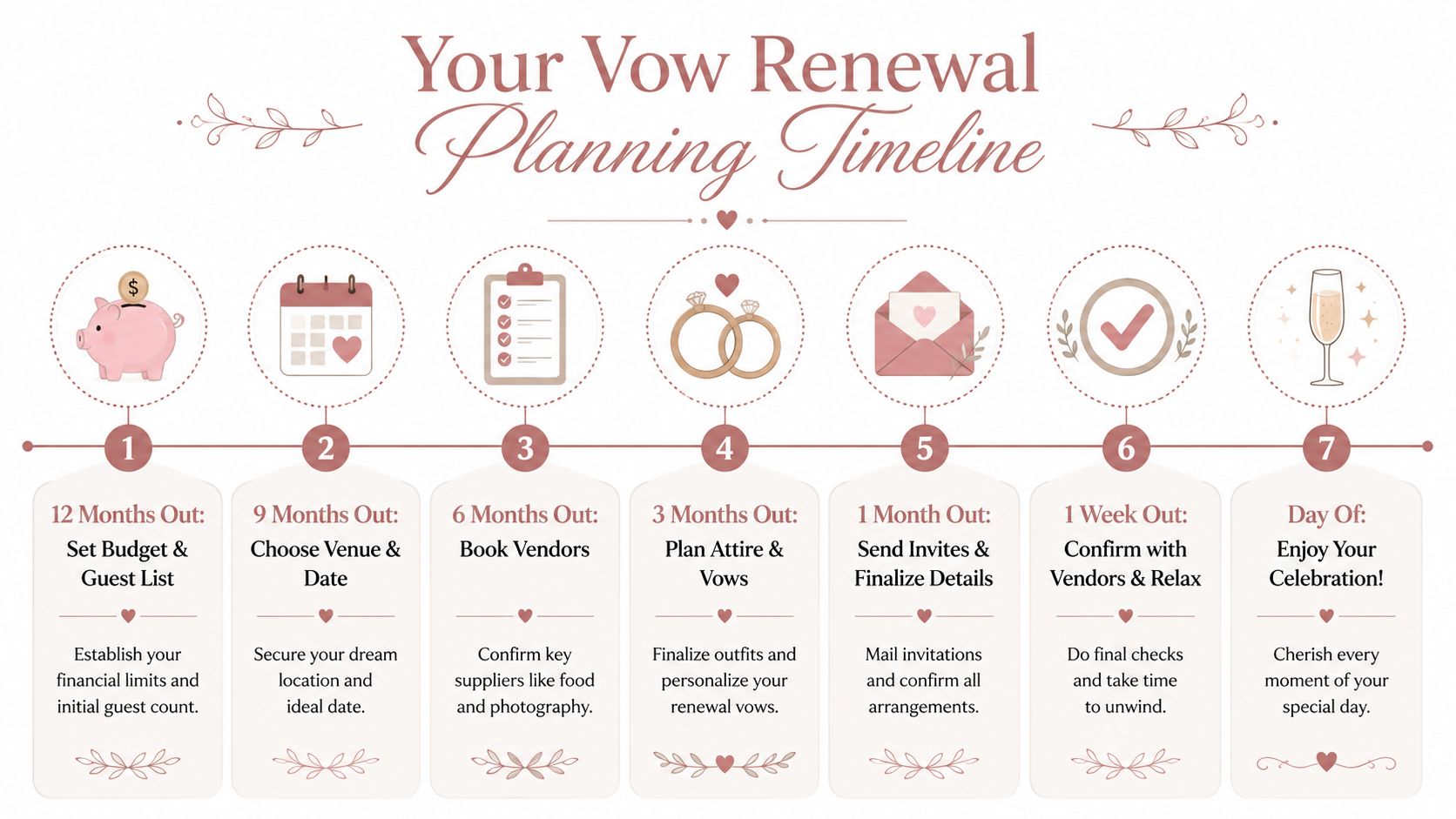
A planning rhythm that works in practice
Rather than treating it as a wedding or a dinner party, treat it as a hosted milestone event.
Define the brief early
Decide whether this is intimate, formal, family-centred, or destination in feel. If you skip this, every supplier conversation becomes harder.Set a spending limit before viewing too much
It's easy to drift upward once you start seeing venues, florals, and photography. A grounded benchmark helps. If you want broader context around celebration spending, this average cost of a wedding guide is useful as a reference point, even though a vow renewal may be structured differently.Book the essential elements first
Venue, photographer, and the person leading the ceremony usually shape the whole day.Write the vows earlier than feels necessary
Couples often leave this too late. Then the most meaningful part of the event gets squeezed into the final week.
A strong timeline protects the emotional parts of the day. It gives the vows, the food, and the guest experience room to be considered rather than rushed.
Where the budget usually goes
Budgeting works best when couples separate the ceremony itself from the celebration around it.
For a simple renewal, the spend may centre on the officiant-style experience, photography, flowers, and a meal. For a larger event, venue hire, catering, drinks, styling, and entertainment often become the dominant costs. Historic venues can be excellent value when they provide atmosphere, ceremony space, photo locations, and dining rooms in one place, because that reduces the need to build character through décor alone.
A practical checklist for the final stretch:
- Guest communication: Include date, location, timings, dress code, and travel notes.
- Supplier confirmations: Reconfirm access times, set-up windows, menus, and wet-weather options.
- Ceremony pack: Print vows, readings, music cues, and the final running order.
- Personal details: Rings, outfits, transport, overnight bags, and any family contributions should be gathered in one place.
The planning sweet spot is ambition with restraint. Enough detail to feel special, enough discipline to keep the day calm.
Finding a Vow Renewal Venue with History and Heart
For a celebration about endurance, memory, and legacy, historic venues make emotional sense.
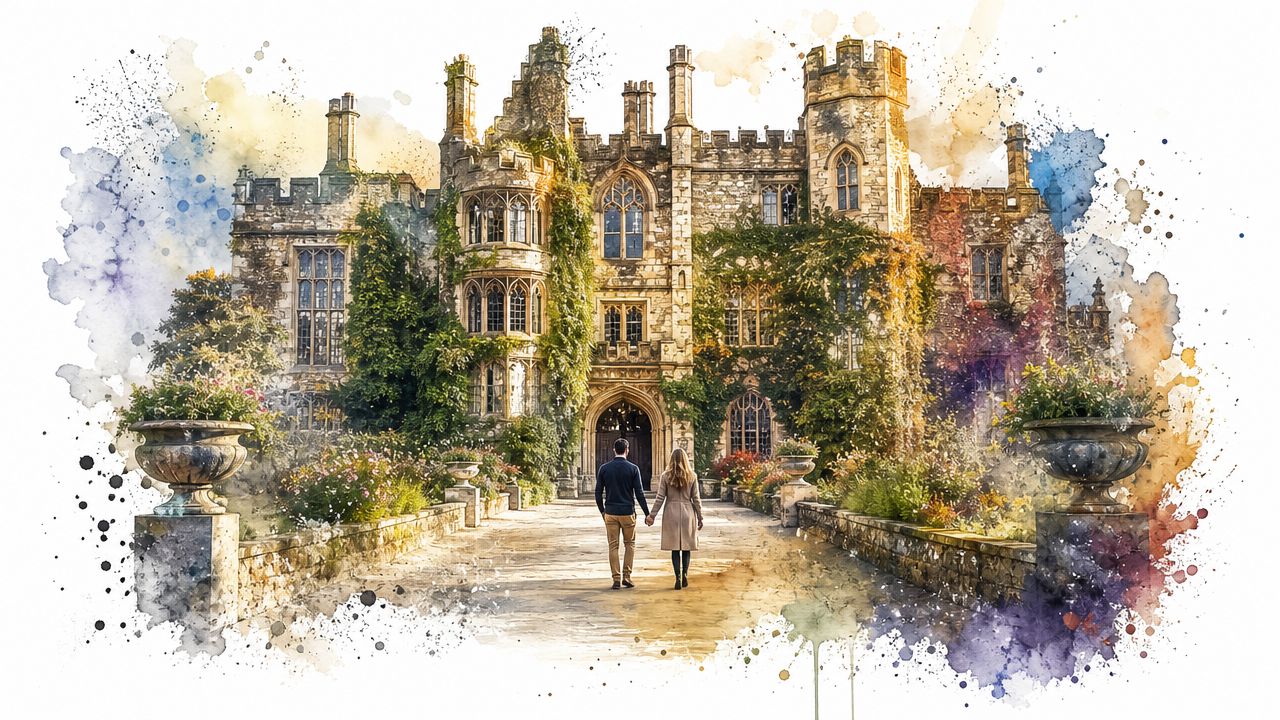
They bring scale without artificiality. They give the day texture before a single flower is placed. Stone walls, old libraries, abbey ruins, terraces, and long views do part of the storytelling for you. That's especially valuable with vow renewals, because the occasion usually carries more reflection than a first wedding. The setting should be able to hold that depth.
What a heritage venue gets right
A good historic venue doesn't just look beautiful in photographs. It solves practical and emotional problems at the same time.
Emotionally, it gives significance to the moment. Practically, it can offer distinct spaces for each part of the day. Ceremony in one room, drinks outdoors, dinner in another, portraits on the grounds, and a natural shift into evening celebration.
What to look for when choosing one:
- Rooms with purpose: You want spaces that feel right for vows, dining, and gathering. Not one room trying to do everything.
- A sense of privacy: A vow renewal can feel exposed if the venue is too public or interrupted by other visitors.
- Catering that suits the setting: Historic spaces pair best with food that feels considered rather than generic.
- An experienced planner on site: Heritage venues often have operational quirks. You want someone who already knows them.
One factual option in this category is Battle Abbey Weddings, which offers ceremony and reception spaces within the historic Battle Abbey estate in East Sussex, including options for intimate celebrations and larger exclusive-use events, with in-house catering and planning support.
Why the backdrop changes the atmosphere
In modern blank-canvas venues, couples often need to build atmosphere from scratch. In an abbey, estate, or historic hall, the architecture does the first layer of that work. The styling can then become more restrained and more elegant.
That's why heritage settings suit vow renewals so well. They don't force the day to perform. They allow it to feel rooted. For couples marking decades together, that grounding can be far more moving than a trend-led venue with little sense of permanence.
This gives a sense of how a historic setting can frame the day on film as well as in person.
The feeling you're really choosing
When couples say they want a meaningful venue, they usually mean something more specific. They want guests to arrive and understand, almost immediately, that this isn't a casual party attached to a few sentimental words. They want the setting to signal importance.
A historic venue can do that without becoming stiff. It can still hold a relaxed lunch, a family-centred ceremony, or a candlelit dinner full of laughter. The history doesn't dictate the tone. It gives the tone depth.
That's a key appeal of renewing vows in a place with heritage. Your marriage already has a past. The right venue honours that, rather than pretending the story starts today.
If you're considering a vow renewal in a historic East Sussex setting, Battle Abbey Weddings is worth exploring for couples who want a symbolic ceremony and celebration in one characterful location, with spaces for intimate gatherings or larger hosted events.