You're probably staring at a guest list that looked perfectly manageable a fortnight ago and now feels impossible. One side of the family doesn't speak to the other. Your university friends will adore each other if they meet, but only if they aren't stranded beside Great-Uncle Peter for the entire wedding breakfast. Someone needs step-free access. Someone else can't hear well if they're near the speakers. Suddenly, table seating plans stop feeling like stationery and start feeling like diplomacy.
At Battle Abbey, that's completely normal. A seating plan isn't the least romantic part of the wedding. It's one of the clearest expressions of care you'll create. In a venue with this much history in its walls, thoughtful placement matters even more, because the room itself already carries atmosphere. Your job is to make sure every guest feels that atmosphere as welcome, not overwhelm.
Crafting Your Wedding Story Through Seating
Couples often arrive at this stage expecting a puzzle. What they're building is a social map for the room. The right table seating plan doesn't just tell people where to sit. It shapes who relaxes quickly, who starts talking, who feels included, and how naturally the wedding breakfast begins.
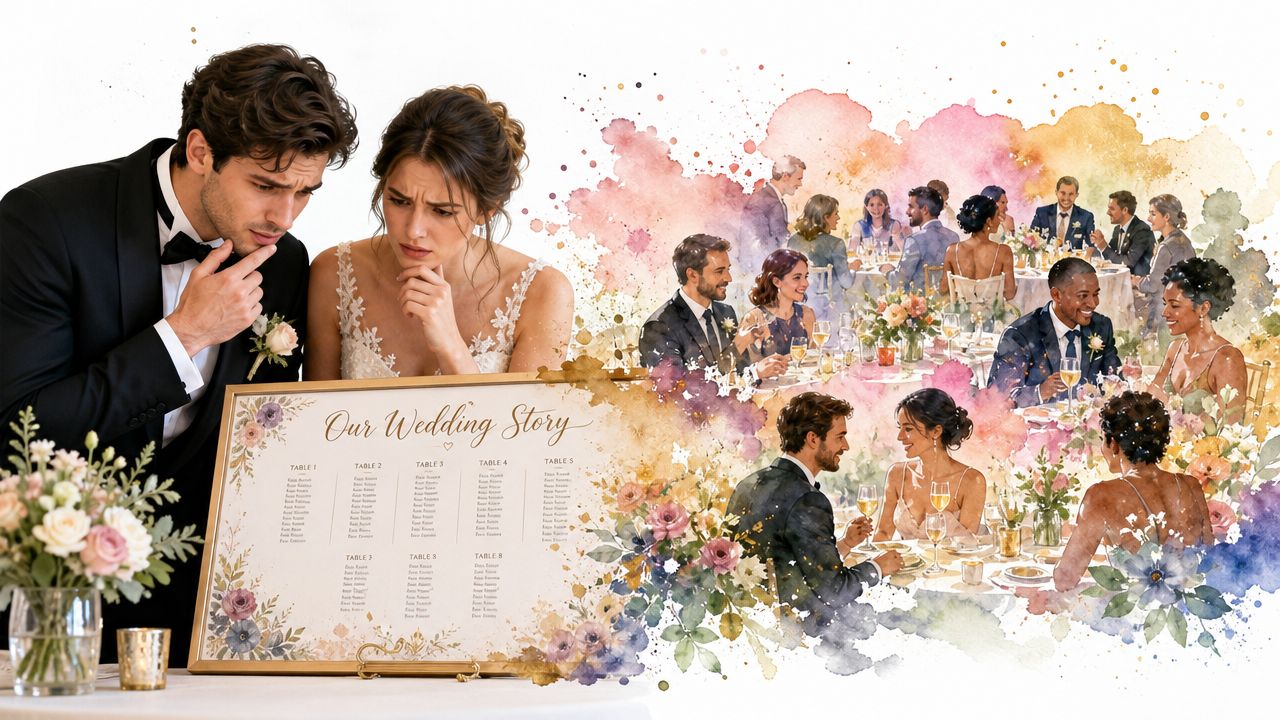
That idea has deep roots in British dining culture. By the late 1700s, British aristocratic dining increasingly adopted service à la russe, with dishes served to guests individually, course by course, and that changed how tables were arranged and how people interacted at meals, helping establish the modern expectation that a wedding table plan should balance status, conversation, and service flow, as outlined in this history of British table settings.
At Battle Abbey, that history doesn't feel abstract. It feels present. When guests move from the ruins and terraces into the wedding breakfast, the room already asks for a little ceremony. A thoughtful plan answers that beautifully. It says, “We've considered your comfort. We've thought about who you'll enjoy. We've made space for you.”
Hospitality, not just logistics
The strongest seating plans usually do three things well:
- They settle nerves early. Guests know where they belong the moment they enter the room.
- They start conversation naturally. People meet across shared humour, age, family ties, or interests.
- They support the service team. Clear layouts help the meal feel calm rather than chaotic.
A good seating plan should feel invisible once everyone is sitting down. Guests simply feel at ease.
That's especially true in a heritage setting. If you're choosing Battle Abbey for its romance, its English character, and its sense of occasion, your layout should carry that same intention. The venue already gives you a memorable backdrop. Your seating plan gives that backdrop warmth. If you're still deciding what draws couples to this setting in the first place, what makes Battle Abbey such a distinctive historic wedding venue is worth a look.
Mapping Your Space Inside Battle Abbey
At Battle Abbey, table seating plans work best when they begin with the room rather than the guest list. Couples often do the reverse. They start assigning people first, then try to squeeze that plan into the space. That usually creates awkward aisles, pinched corners, and a top table that feels as though it has been placed wherever there was room left.
For intimate celebrations up to 60 guests, the reception spaces lend themselves to a close, atmospheric feel. For larger celebrations from 75 to 250 guests, exclusive full-site hire gives much more freedom to think about movement as well as seating. The room you use for the wedding breakfast sets the whole tone.
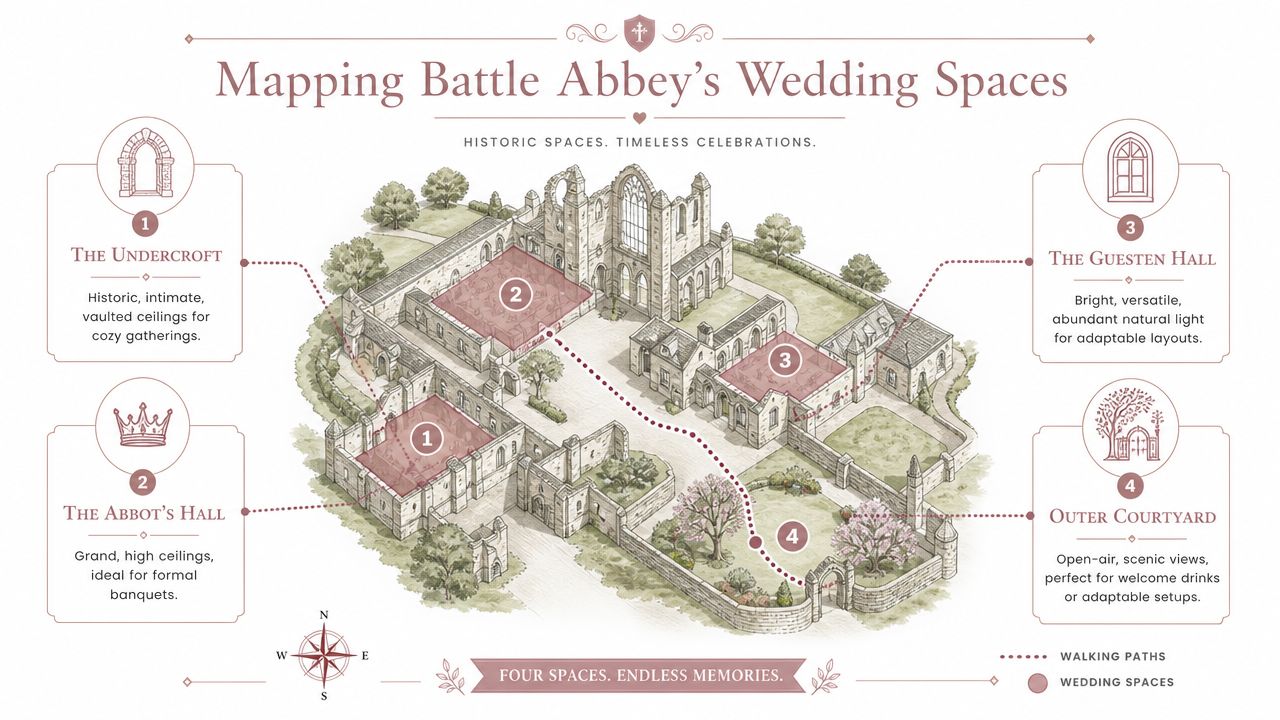
The Duke's Library
The Duke's Library suits couples who want the wedding breakfast to feel intimate, cultivated, and subtly dramatic. It has a natural sense of enclosure, which is useful if you want conversation to carry without the room feeling sparse.
This sort of space tends to reward restraint. Fewer, better-positioned tables nearly always work better than trying to fill every possible corner. Guests should be able to admire the room and still move easily between chairs, service routes, and the route out to later parts of the celebration.
A practical rule in a room with strong architectural character is simple. Let the room breathe.
The Dining Room and Bar
The Dining Room and Bar give a more classic reception feel. They can support a larger social energy and make it easier to create a strong focal point for the couple, whether that is a top table, a sweetheart table, or a central long-table arrangement with family nearby.
This style of room is often easier for mixed-age guest lists because you can create clearer zones. Older relatives can sit where the route in and out is straightforward. Friendship groups can anchor one side of the room. Immediate family can stay close to the couple without every table feeling tightly packed around the centre.
Match the room to the feeling you want
When couples are choosing between spaces and layouts, I usually ask them to decide what they want guests to feel during the meal. The answer tends to make the room choice clearer.
| Reception priority | Space quality that helps |
|---|---|
| Quiet, intimate conversation | A room with natural enclosure and softer social scale |
| Formal banquet energy | A room with stronger central focus and clear symmetry |
| Flexible guest grouping | A room that allows distinct social zones |
| Easy movement for mixed-age guests | Wide routes and obvious circulation paths |
Practical rule: If a chair has to be pulled out into an aisle for someone to sit down, the layout is too tight.
Battle Abbey's historic character is part of the joy, but it also means your seating plan should respect sightlines, furniture flow, and how guests enter the room. A lovely plan on paper can still feel awkward if everyone bottlenecks at one point or if service staff have to weave around decorative decisions.
Choosing Your Table Shapes and Layouts
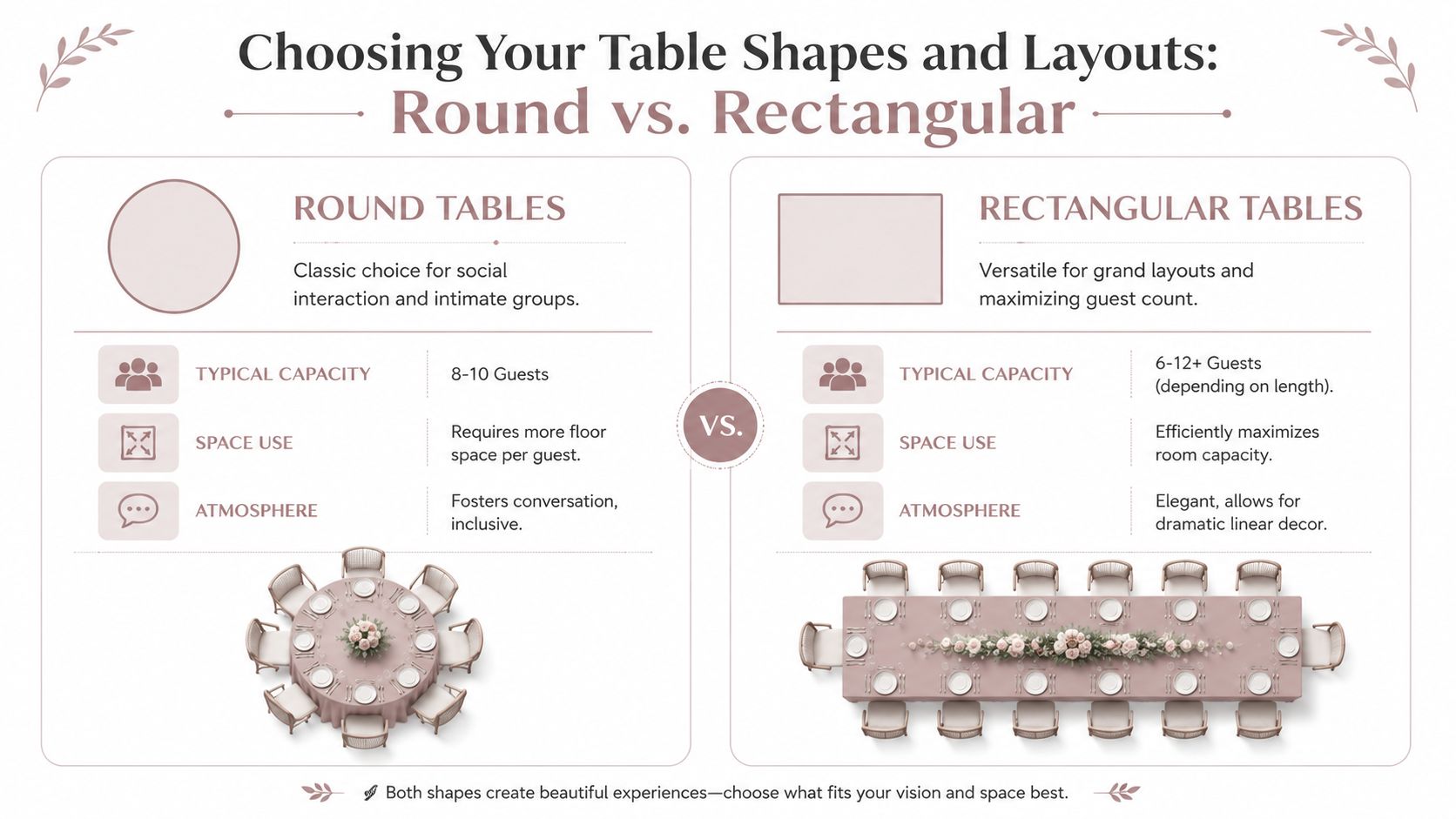
Table shape changes the whole social rhythm of the wedding breakfast. Two couples can host in the same room at Battle Abbey with the same guest count and create completely different experiences by selecting rounds or long tables.
Round tables
Round tables are still the easiest choice for conversation. Guests can make eye contact with nearly everyone around them, which softens introductions and helps mixed groups settle quickly. If you're blending school friends, cousins, colleagues, and family friends, rounds often do the heaviest lifting socially.
They also suit rooms where you want the look to feel romantic rather than rigid. In heritage interiors, that softness can be a real advantage.
What works well with rounds at Battle Abbey
- Mixed social tables: Rounds make it easier to combine guests from different parts of your life without forcing a single line of conversation.
- Older relatives: Guests who prefer ease and visibility often feel more comfortable on a round.
- Traditional styling: Florals, candlelight, and layered place settings tend to sit beautifully on round tables.
What doesn't work so well
- Very long guest lists in tighter floor plans: Rounds take up more floor area per guest.
- Couples who want a dramatic banquet look: They create a softer visual pattern, not a strong processional line.
Long tables
Long trestle-style tables bring shape and theatre into the room. They work especially well if you want the wedding breakfast to feel immersive and communal, with guests sharing one visual story down the centre of the room.
They're also useful when you need your table seating plans to make the room work harder. In many spaces, long tables can create cleaner lines and more efficient use of floor area than multiple rounds.
Here's a quick visual explainer before the finer points of layout:
A side-by-side view
| Table style | Best for | Watch out for |
|---|---|---|
| Round | Easy conversation, mixed groups, classic romance | Can consume more floor space |
| Long rectangular | Banquet feel, visual impact, efficient lines | Guests may talk mainly to those beside or opposite |
There's also a lovely historical echo here. In the early 1900s, etiquette for a wedding of 60 guests described a formal arrangement of one central table of 20 with four corner tables of 10, showing just how structured intimate dining could be in Britain, as described in this historical guide to formal wedding seating plans. That doesn't mean you should recreate Edwardian formality, but it does remind us that small weddings benefit from deliberate structure rather than improvised placement.
Good fits for intimate and larger weddings
For a smaller Battle Abbey celebration, a central statement table with supporting guest tables can feel wonderfully grounded in the venue's period atmosphere. It gives the room a focal point without losing intimacy.
For larger receptions, I'd choose based on the room's strongest axis. If the architecture draws the eye lengthwise, long tables can look magnificent. If the room needs social clusters and softer movement, rounds usually perform better.
If you're weighing where the couple and immediate family should sit within that layout, this guide to top table layout options is useful alongside the broader floor plan.
The most elegant layout is rarely the one with the most symmetry. It's the one that still feels generous once every chair is occupied.
The Art of Grouping Your Guests
Table seating plans' success or failure hinges on key elements. The furniture matters, but guest grouping matters more. A beautiful room can't rescue a table where nobody has anything to say, where one person feels stranded, or where simmering family tension gets a front-row seat.
Modern guidance reflects that shift. Expert advice increasingly warns that a beautiful seating chart can fail if it ignores social friction or accessibility, and it points couples toward conflict-aware planning, including cooler-down spaces and placing older guests away from speakers, as noted in this expert article on seating chart strategy.
Start with comfort, not symmetry
Couples often chase visual neatness. They want each table to look balanced on paper. The problem is that people don't experience a floor plan from above. They experience it seat by seat.
That means your first question shouldn't be, “Does this room look even?” It should be, “Will this guest feel comfortable here for the whole meal?”
Guest-first rule: If you must choose between a prettier layout and a kinder one, choose the kinder one.
The groups that usually work best
Some combinations are dependable because they give guests a natural starting point for conversation. Others sound tidy but create dead air.
The strongest groupings usually include:
- Family clusters with breathing room: Keep immediate relatives near one another, but don't force every branch of the family onto the same table if relationships are strained.
- Friendship pods: University friends, school friends, and work friends usually settle faster when they have at least a few familiar faces around them.
- Bridging guests: One sociable cousin, one warm friend, or one easygoing sibling can connect two circles better than any seating software can.
- Solo guests with anchors: Never seat a person who knows almost no one at a table full of established pairs who will naturally turn inward.
Tricky dynamics need seat-level thinking
Managing seating plans often highlights a planner's value. “They can be in the same room” doesn't always mean “they should be at neighbouring seats.” Divorced parents may manage beautifully with a table or two between them. Two guests who bicker might be completely fine if they don't share a direct sightline all evening. A difficult relative can be softened by surrounding them with calm, socially capable people rather than placing them in the emotional centre of the family table.
When conflict is possible, think in layers:
- Distance matters. Separate high-friction guests enough that they don't feel forced into each other's orbit.
- Sightlines matter. Direct facing seats can intensify discomfort.
- Routes matter. Consider who passes whom on the way to speeches, the bar, or the lavatories.
- Recovery matters. A guest who feels overwhelmed should have an easy route to step away for a moment.
Accessibility is part of good hosting
Accessibility shouldn't be bolted on at the end. It belongs in the first draft. At Battle Abbey, this is especially important because historic venues are beautiful precisely because they have character, and character needs practical planning.
Think through the meal from the guest's point of view.
- Wheelchair users or guests with mobility needs: Leave proper clearance so they can approach, turn, and sit comfortably without feeling parked at the edge of the room.
- Older relatives: Seat them away from speakers and on an easy route in and out.
- Guests with hearing challenges: Don't place them where room noise, music equipment, or busy service routes will drown out conversation.
- Parents with young children: Keep them where stepping out briefly won't create disruption.
- Anyone anxious or overstimulated: Avoid placing them in the loudest, busiest social pinch point.
A spreadsheet helps enormously here, especially if you tag guests by relationship group, accessibility note, and social note before you start moving names around. If you need a clean starting point, a practical wedding guest list template makes those decisions much easier to manage.
What usually goes wrong
The most common mistake isn't malice. It's overconfidence. Couples assume guests will “sort themselves out” once they're in the room. Sometimes they do. More often, they sit where they're placed and make the best of it.
That's why the kindest table seating plans are rarely accidental. They are edited, tested, and adjusted with real human behaviour in mind.
Your Seating Plan Timeline and Tools
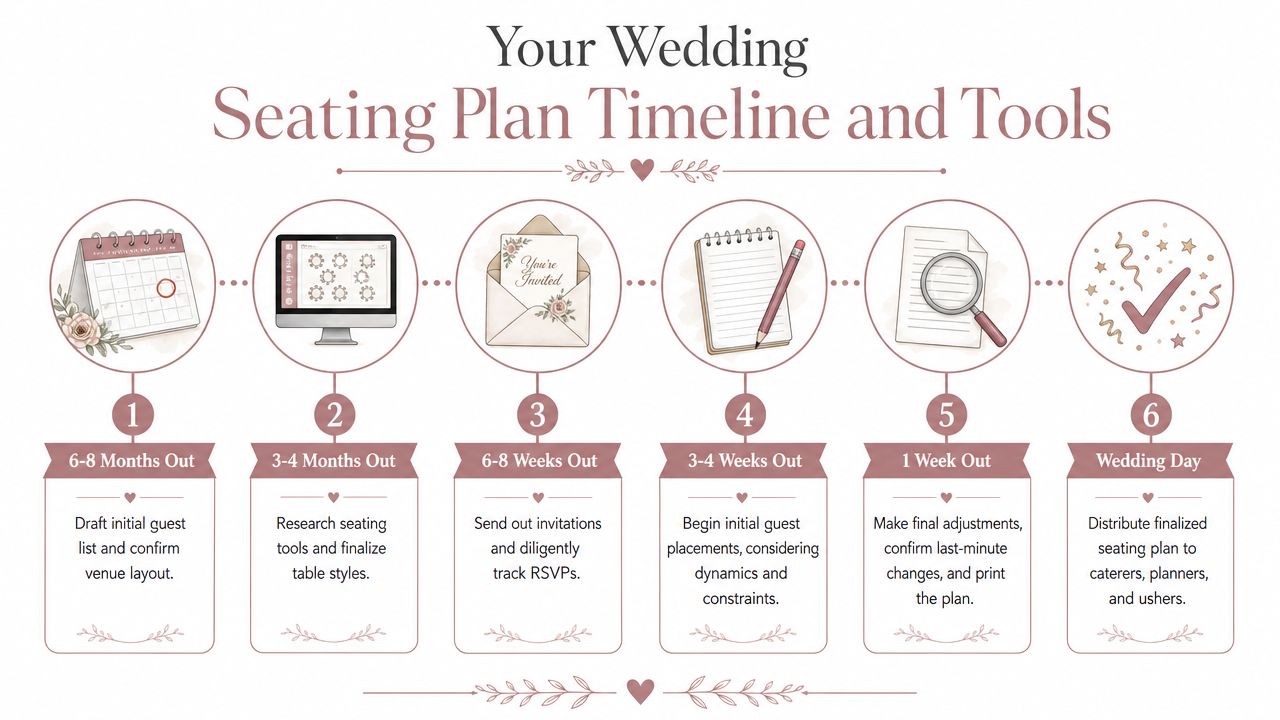
A seating plan usually feels hardest in the final fortnight, when RSVPs are still shifting and everyone wants certainty at once. The couples who find it easiest at Battle Abbey are not the couples with perfect guest lists. They are the ones who make the big decisions early, then leave themselves room for careful adjustments.
At this stage, timing matters more than clever software. In a historic venue, late changes can affect far more than name cards. A revised table count may alter service routes in the Dining Room, spacing in the Duke's Library, or how easily guests move between the drinks reception and the wedding breakfast. Keep the room layout steady as early as you reasonably can, then work on the guest placements within it.
A calm working rhythm
A practical timeline usually works like this:
- Set the room layout first: Confirm table sizes, top table position, and access routes before you start fine-tuning individual seats.
- Keep one master guest file: Include names, RSVP status, relationship groups, dietary notes, and any details that affect comfort or service.
- Draft the seating plan before every reply is in: If the shape of the guest list is clear, start placing tables and groups early.
- Review the plan with the venue team close to the date: They can spot issues such as tight gaps for service, awkward furniture placement, or a table that looks right on paper but feels cramped in the room.
- Send out one final version only: Everyone setting up the room should work from the same plan, with the same guest spellings and table numbers.
I always advise couples to separate structural decisions from emotional ones. Decide where the tables go first. Decide who sits together after that. It prevents the entire plan from being rebuilt because one guest changed their RSVP.
Tools that actually help
A good seating plan does not require specialist software. Google Sheets and Microsoft Excel are often the most useful starting points because they let you sort quickly by family, friendship group, dietary requirement, or attendance status. Once those categories are clear, a visual drag-and-drop planner can help you test spacing and balance.
The tool matters less than the discipline behind it.
Use one file. Use one naming system. Keep one final version.
Print too early and every late reply becomes a nuisance. Print too late and your planner, caterer, or setup team ends up working under avoidable pressure.
Battle Abbey Weddings also provides planning and setup coordination, which helps when your seating plan has to fit the character of a historic room as well as the practical realities of service.
Keep the final briefing practical
Your last version should answer operational questions quickly. Include table names or numbers, the top table arrangement if you are having one, correct guest spellings, children's places, supplier meals if relevant, and any notes that affect access or service.
At Battle Abbey, that final document often does more work than couples expect. It helps the room be set accurately, helps the catering team serve confidently, and helps the whole wedding breakfast begin with the calm, well-coordinated feeling you want guests to remember.
On-the-Day Details and Final Touches
A seating plan isn't finished when the spreadsheet is done. It's finished when a guest can walk into the room, find their place without fuss, and sit down feeling expected.
That's where your on-the-day stationery earns its place. A large seating chart at the entrance works well when you want one clear focal point before guests enter the wedding breakfast. Escort cards add a little movement and can feel charmingly personal in a historic venue. Place cards at each setting bring the most precision, especially where seat-level assignments matter because of family dynamics or accessibility.
Choose the format that matches the complexity
If your guests only need a table assignment, a single chart is often enough. If specific seats matter, escort cards plus place cards create far less confusion. At Battle Abbey, where rooms have such strong character, the stationery should feel part of the setting rather than an afterthought.
A few design directions suit the venue beautifully:
- Calligraphy or serif-led stationery: Formal enough for the architecture without feeling stiff.
- Textured card, ribbon, or wax-seal details: These sit naturally in a historic setting when used with restraint.
- Freestanding displays: Useful where you want guests to read the chart comfortably before moving into the room.
- Thoughtful table names: Places, books, gardens, family references, or East Sussex touches can all work if they are easy to recognise.
Legibility matters more than flourish
This is one place where practicality should win. Guests shouldn't have to queue, squint, or ask an usher to decode a romantic script font. If older relatives are attending, larger type and strong contrast make a real difference. If there are many guests, alphabetical listing by surname is usually the quickest way for people to find themselves.
The final touch is emotional rather than visual. Good table seating plans make the room feel settled from the start. They reduce awkwardness, ease service, and let the conversation build naturally. In a place as atmospheric as Battle Abbey, that calm beginning allows the beauty of the setting to do what it does best.
If you're planning your wedding breakfast in one of England's most evocative historic settings and want a reception layout that feels graceful, practical, and true to your guest list, Battle Abbey Weddings offers the setting, planning support, and flexible spaces to help bring it all together.