The average UK wedding venue costs £6,040 to hire without catering, and most couples land somewhere between £3,000 and £10,000. Once catering is included, that average rises to £9,695, which is why the first quote you receive often feels lower than the final bill you'll pay.
That moment catches almost every couple off guard. You open a venue brochure, see a number that seems possible, then start spotting phrases like “exclusive of VAT”, “dry hire”, “minimum guest numbers”, or “preferred suppliers only”. Suddenly, a quote that looked straightforward doesn't feel straightforward at all.
I've seen this confusion many times. Couples aren't bad at budgeting. They're usually reacting to a pricing system that hides important costs in plain sight. The headline fee tells you where the conversation starts. It rarely tells you what the day will really cost.
A calm, informed approach helps. If you understand what a hire fee covers, what usually sits outside it, and why some venues charge far more than others, you can compare options properly instead of chasing misleading bargain prices. For a wider look at how venue costs sit within the full wedding budget, this guide to the average cost of a wedding is a useful companion.
Your Guide to Understanding Venue Hire Prices
Your venue will shape more than the setting. It affects your catering costs, staffing needs, timing, transport, décor, and how much flexibility you'll have on the day. That's why venue hire prices can feel confusing. You're not only paying for a building. You're often paying for access, logistics, support, and limitations as well.
A simple example makes this easier to grasp. Two venues can both quote a similar hire fee, yet one may include furniture, staffing support, and a smoother setup window, while the other gives you only the keys and a list of restrictions. On paper, they can look close. In practice, they can be miles apart on total cost and stress.
Why the headline price misleads
The first number couples see is often a partial price, not a complete one. Some venues present a hire fee alone. Others lead with a package that wraps in food and drink. Some include VAT in every figure. Others don't.
That's why comparing venue hire prices without context can lead to poor decisions. A lower starting quote can still become the more expensive option once all the extras are added.
Practical rule: Never compare venues using only the first number in the brochure. Compare the final payable figure, the access hours, and the list of compulsory extras.
What couples usually want to know
Instead of asking, “What is the theoretical market rate for a venue?” individuals typically pose more practical questions:
- Can we afford this place once everything is included?
- Are we paying for quality, or just prestige?
- What costs are still missing from this quote?
- Could a cheaper-looking venue end up costing more overall?
Those are the right questions. The rest of this guide is built around them, because fair pricing isn't just about finding the lowest figure. It's about understanding value clearly enough to avoid unpleasant surprises.
Decoding the Quote What Venue Hire Includes and Excludes
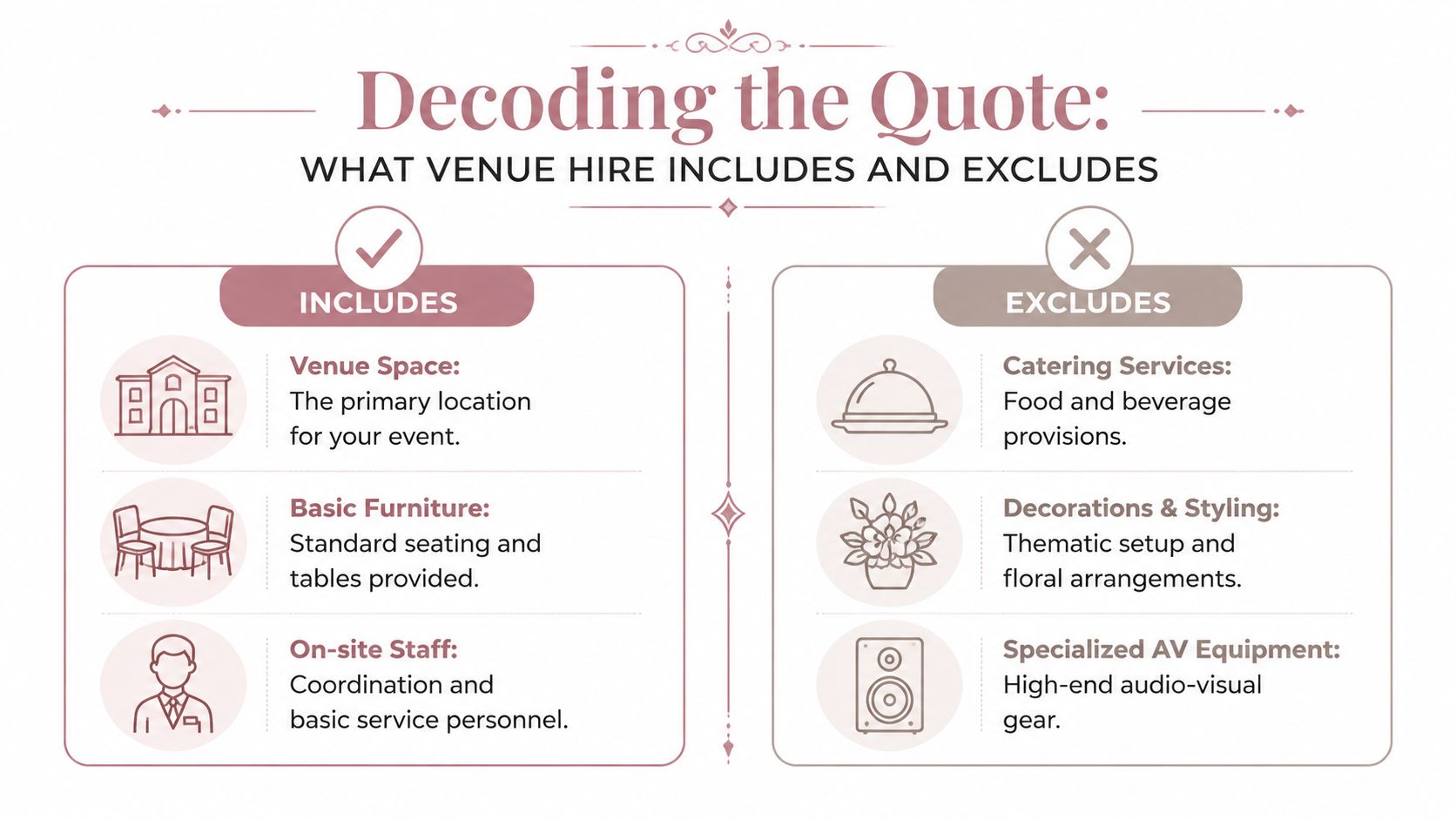
A venue quote becomes much less intimidating once you separate it into two categories. First, what the hire fee buys. Second, what you'll still need to pay for elsewhere.
Many couples assume “venue hire” means the whole hosting cost. It often doesn't. Sometimes it means the physical space only. Sometimes it includes a bundle of essentials. The wording matters.
Dry hire versus packaged hire
Dry hire usually means you're hiring the venue space with limited built-in services. That may suit couples who want full control, but it also means more separate supplier decisions, more coordination, and more chances for extra costs to creep in. If you want a plain-English breakdown, this explanation of dry hire meaning is worth reading.
A package venue usually combines the space with some practical items such as furniture, staffing support, or catering options. These quotes can look higher at first, but they're often easier to budget because fewer costs are left floating outside the package.
What is often included
This varies by venue, but a hire fee commonly covers some mix of the following:
- Exclusive use of the space: You and your guests aren't sharing the venue with another event.
- Access windows: Time for arrival, ceremony, reception, and clearing down.
- Basic furniture: Tables, chairs, and sometimes linen.
- Core staffing: A venue coordinator, duty manager, or operations team.
- Standard facilities: Heating, lighting, toilets, parking, and routine cleaning.
That list sounds basic, but each item has value. Extended setup time alone can save a couple from paying suppliers extra labour or rushed delivery charges.
What is often excluded
The more important part of the quote is usually what sits outside it. Common exclusions include:
- Catering and drinks
- Bar service
- Floristry and styling
- Entertainment and DJ equipment
- Specialist lighting or sound
- Ceremony fees
- Extra staff for service
- Late finish extensions
- Accommodation
- Security or stewarding where required
In South East England, Tagvenue's June 2026 dataset puts the median venue hire fee for venues accommodating 160 to 200 guests at £2,472 per day, with a benchmark range of £1,000 to £4,920. The same dataset notes that bare-hire models typically need additional spending of £49 to £90 per person for catering and drinks, while all-inclusive packages can reduce planning overhead by consolidating suppliers through one venue arrangement according to Tagvenue's South East wedding venue data.
The VAT shock couples miss
One of the biggest traps is VAT. Many venue guides still lead with figures that don't make clear whether tax has been added.
Battle Abbey Weddings points out that many UK guides obscure the 20% VAT issue, even though it can turn a £10k quote into £12k, which they describe as a major shock for couples comparing prices in this pricing guide on wedding venues and prices.
Before you react to a quote, ask one sentence: “Is this figure inclusive or exclusive of VAT, and what compulsory charges are still to be added?”
That one question can save a lot of budget panic later.
The Main Factors That Influence Venue Hire Prices
You get a quote that looks manageable. Then the full scope of the price starts to appear. The venue is not only charging for a room, but for a date with high demand, a certain level of privacy, a building with its own running costs, and sometimes a business model that makes up for lower margins elsewhere.
Location and regional demand
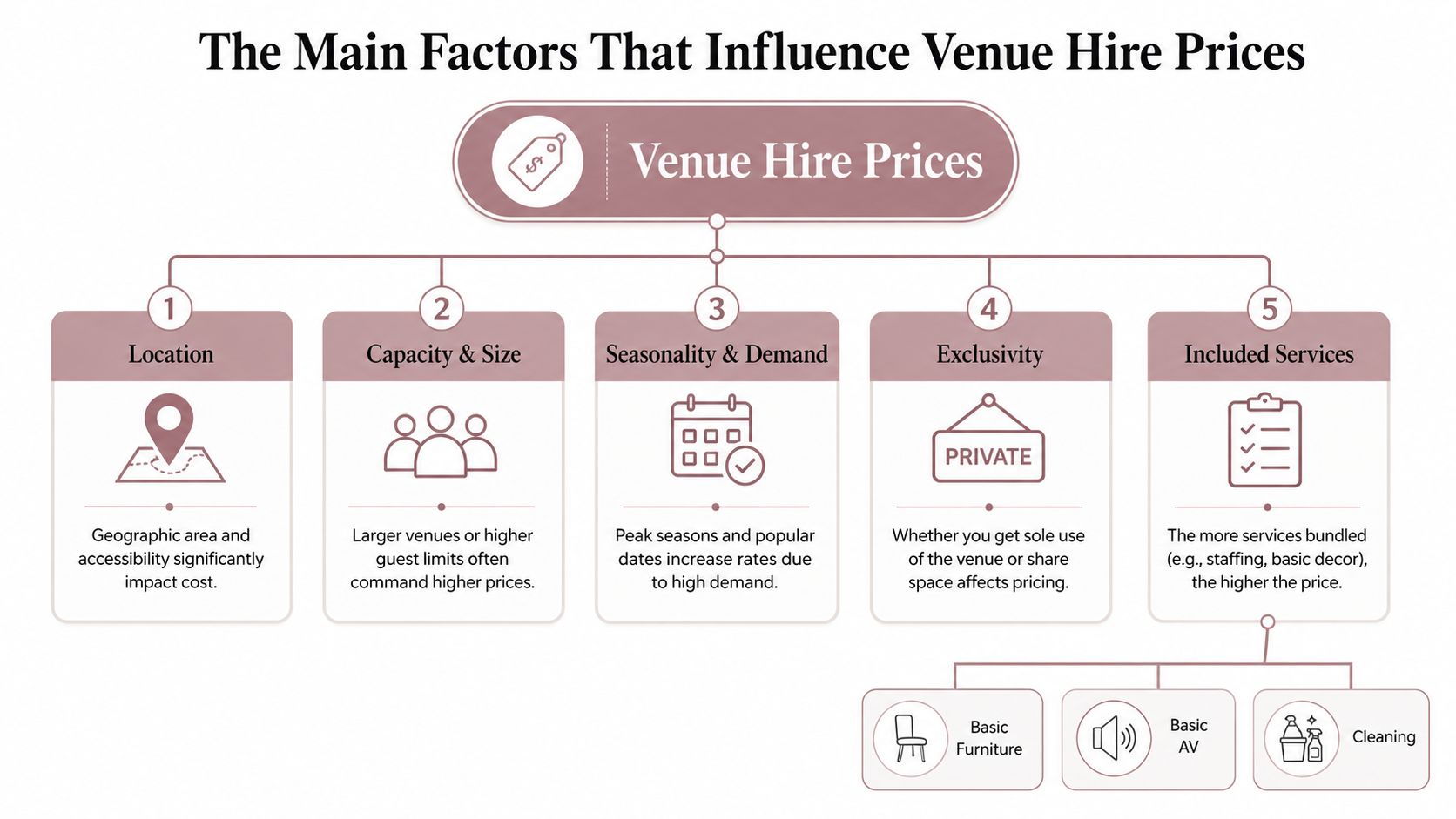
Location is one of the strongest price drivers for venue hire. A popular county, a well-known city, or an easy-to-reach tourist area often costs more because the venue is paying more for land, wages, utilities, insurance, and maintenance before your wedding is even in the diary.
That is why two beautiful venues with similar styling can be priced very differently. One may sit in a high-cost area where couples expect exclusive use, premium staffing, and polished facilities. The other may be in a region with lower overheads and less pressure on Saturdays in peak season.
This is also where couples can get caught by the headline figure. A venue in an expensive area may keep the hire fee looking competitive, then recover profit through higher minimum spend requirements, approved supplier mark-ups, corkage, service charges, or drinks packages. In practice, the cheaper-looking quote can become the dearer one.
Size, exclusivity, and how the day works
Guest count affects far more than chair numbers. Bigger weddings put pressure on parking, toilets, power supply, staffing, turnaround time, glassware, kitchens, and contingency planning. Even if the hire fee looks fixed, the cost of delivering the day often rises in the background.
Exclusivity changes the maths too. If a venue gives you sole use, it cannot sell bedrooms, restaurant tables, or smaller event spaces to other guests in the same way. Part of your fee is paying for the income the venue is choosing not to take elsewhere.
That is why exclusive-use pricing often feels disproportionate at first glance. You are not just hiring square footage. You are reserving attention, privacy, timing, and operational flexibility.
For readers who like to understand the business logic behind this, the same pricing principles appear in hospitality articles about optimizing hotel profitability. Hotels and wedding venues both price around demand, capacity, staffing, and the value of inventory they can only sell once.
A quick visual summary helps here:
Venue type and the hidden cost base
Venue type matters because each building comes with its own cost structure. A village hall can be straightforward to run. A country house, heritage property, or converted barn may need specialist repairs, stricter compliance, more setup labour, limited access times, and extra insurance.
Some venues also operate on a commercial cross-subsidy model. In plain English, one part of the business helps support another. A venue might price hire relatively low, then make its margin on catering, bar spend, accommodation, or required staffing. Others do the reverse and charge a higher hire fee because they allow more freedom elsewhere.
Neither model is automatically unfair. The problem starts when couples compare only the first number on the quote. A fair comparison means asking where the venue earns its money, and which charges are fixed, conditional, or likely to rise with guest count.
The clearest way to judge value is to view the venue as a small business with a specific cost base, not as an empty backdrop. The building, the team, the downtime between events, the cleaning, the licenses, and the risk all sit inside the price, whether they are visible or not.
UK Wedding Venue Price Ranges in 2026
You open a venue brochure and see a hire fee that looks manageable. Then the quote arrives with VAT, staffing, minimum spend, and timing rules tucked into the small print. That is why national benchmarks help only as a starting point. They tell you where the market broadly sits, but they do not tell you how a venue has built its price.
Bridebook's 2026 figures put the average UK wedding venue at £6,040 excluding catering and £9,695 including catering, with many couples spending between £3,000 and £10,000. The same guide also places purpose-built wedding venues, historic estates, and luxury country houses toward the top of the market, with high-end venues starting from £10,000 and often rising beyond £25,000 in Bridebook's UK wedding prices guide.
That wide spread is normal.
A village hall, a barn, and an exclusive-use country house may all host weddings, but they are priced like completely different businesses. One may earn mainly from room hire. Another may keep the hire fee lower and recover margin through catering, bar sales, accommodation, or required staff. This is the commercial cross-subsidy point many couples miss, and it is one reason the cheapest headline fee is not always the cheapest venue overall.
A simple way to read the market
A tiered view is more useful than one national average because it helps you compare like with like.
| Venue Tier | Typical Price Range (Hire Only) | Common Venue Types |
|---|---|---|
| Budget-friendly | Under the lower end of the usual national spend | Village halls, pubs, community spaces, simple function rooms |
| Mid-range | £3,000 to £10,000 | Barns, smaller hotels, purpose-built wedding venues, some private estates |
| Luxury and exclusive-use | From £10,000, often exceeding £25,000 | Historic estates, luxury country houses, premium exclusive-use venues |
Use this table as a filter, not a verdict. A £7,000 venue may be good value if it includes furniture, setup time, ceremony space, and experienced coordination. A £4,000 venue can become more expensive once VAT and compulsory add-ons are layered in.
That is especially true if you are drawn to historic wedding venues with exclusive-use character and heritage appeal. Their prices often reflect access limits, conservation requirements, and the extra labour needed to run weddings in protected buildings.
Why smaller weddings can feel pricier
Couples often expect a lower guest count to produce a sharply lower venue bill. Sometimes it does. Often it does not.
Hire pricing works a bit like booking a whole cottage rather than a hotel room. You are paying for access to the place itself, not only for each person inside it. Bridebook's example shows the effect clearly. At 80 guests, an average hire cost of £6,040 is roughly £75 per head. At 50 guests, that same hire cost becomes about £121 per head.
So a smaller wedding is not automatically cheaper in venue terms. It can be worse value unless the venue offers an intimate-wedding package or a scaled pricing model.
Regional price ranges matter more than couples expect
The national average smooths out huge regional differences. South East pricing often sits above the UK midpoint because demand is stronger and many venues are selling more than a room. They are selling grounds, exclusivity, accommodation, longer access, or a setting that is hard to replicate.
The fairest question to ask is simple. Does this quote make sense for this venue type, in this location, with these inclusions, before and after VAT?
That last part matters. A venue priced at the lower end of a range can jump quickly once tax and service charges are applied. A venue priced higher at first glance may prove better value if the quote is transparent and the extras are limited. In practice, the actual price range couples need is not just the hire band on a website. It is the final figure on the contract.
A Real World Example Battle Abbey Weddings
The easiest way to understand premium pricing is to look at a venue that publishes clear numbers and a clear offer. Historic East Sussex venues provide a good example because they sit at the point where setting, heritage, and logistics all shape the fee.
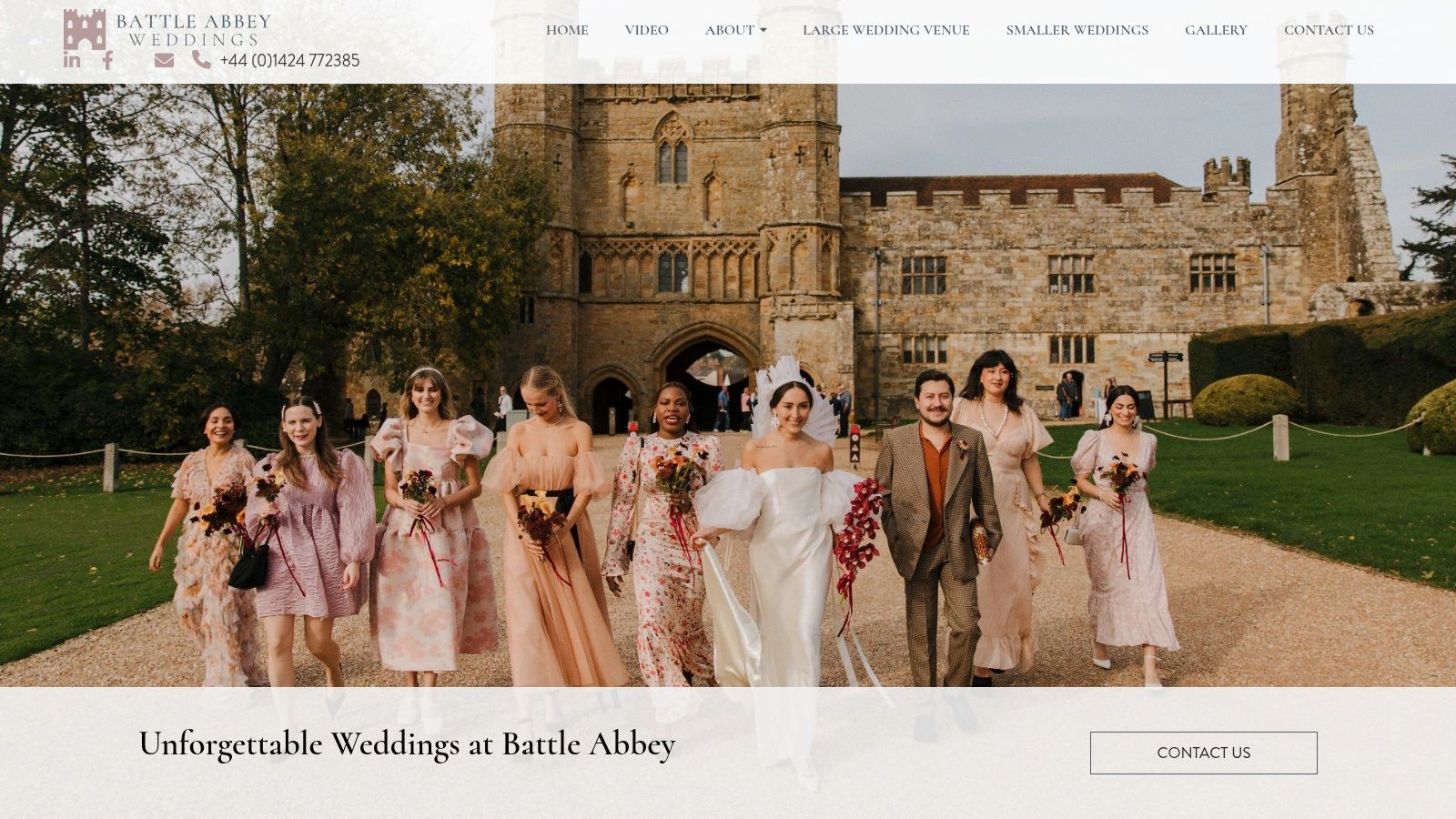
According to Battle Abbey Weddings' 2026 guide, historic heritage venues such as this publish transparent full-site exclusive hire rates from £3,500 to £5,900 plus 20% VAT for 75 to 250 guests, with part-site options for up to 60 guests in this guide to local wedding venues.
Why a heritage venue costs more than a simple hall
That price sits above the South East median benchmark discussed earlier, but the reason isn't mysterious. The venue combines sacred interiors, English Heritage ruins, and exclusive-use access in a setting that isn't interchangeable with a standard event space.
The guide also ties that premium to practical realities. Heritage status brings logistical constraints such as limited vendor access, restricted setup conditions, and the need for dedicated in-house planning support. In other words, some of the cost is paying for the complexity of delivering a wedding in a protected historic environment, not just for the romance of the backdrop.
What value looks like in practice
Many couples get tripped up. They compare a heritage venue's fee to a blank-canvas hall and assume one must be overpriced. But the comparison only works if the experiences are similar.
A premium historic venue may offer benefits such as:
- A distinctive ceremony setting: Characterful interiors remove the need to spend heavily on transformation.
- Exclusive atmosphere: You aren't sharing the site with unrelated events.
- Better photography opportunities: Grounds, architecture, and built-in visual drama do a lot of work for you.
- Planning support: More experienced venue teams often reduce decision fatigue and supplier friction.
- Extended access: Day-before setup availability can make the whole wedding feel calmer.
One of the clearest indicators of value is transparency. If a venue explains its rates, capacity bands, and style of hire openly, couples can make a much cleaner comparison. That's far more useful than a low teaser price followed by layers of extras later.
For couples drawn to history-rich settings, this overview of what makes Battle Abbey the perfect historic wedding venue shows the kind of details that usually sit behind premium heritage pricing.
Premium doesn't always mean inflated. Sometimes it means the venue has already absorbed complexity that would otherwise land on the couple.
Smart Budgeting and Negotiation Tips for Your Venue
Good budgeting starts with honesty about priorities. If the venue is the heart of the day for you, protect that line in your budget early. If food, music, or guest accommodation matters more, don't let a beautiful building swallow every spare pound before you've priced the rest.
A practical budgeting method is to build from the final payable number, not the brochure rate. Work backwards from the fully costed quote, including tax and mandatory extras, then decide whether the venue still leaves room for everything else that matters.
Questions that protect your budget
Bring these into every venue conversation:
- Is VAT included in every figure?
- What charges are compulsory rather than optional?
- Do we have to use your caterers or bar package?
- What access do suppliers get for setup and clear-down?
- Are there different rates for smaller guest counts or quieter dates?
- What happens if our numbers change?
These questions don't make you difficult. They make you organised.
The cross-subsidy model couples rarely hear about
One of the least discussed pricing dynamics is the commercial cross-subsidy model. Plinth's UK guide explains that some venues charge commercial hirers, including wedding parties, at a premium in order to offer lower rates to charities or community groups. In that context, a private venue quote of £8k may partly reflect a pricing structure designed to fund discounted access elsewhere in Plinth's guide to room hire pricing strategies.
That doesn't automatically make the quote unfair. But it does give couples a smarter lens for asking about value. If a venue is charging a premium, what are you receiving in return? Better access, stronger support, exclusive use, more flexibility, a stronger setting? Those are fair questions.
If you want a broader planning worksheet to help map costs around the venue itself, this GroupOS event budgeting guide is a handy reference.
Frequently Asked Questions About Venue Hire
Is a package venue always better value than dry hire
Not always. A package venue can be better value when it reduces supplier duplication, admin, and hidden extras. Dry hire can work well if you already know your suppliers and want full control. The better option is the one with the clearer total cost and fewer unpleasant surprises.
Why does one venue seem cheap until we ask for details
Because some venues lead with the most attractive number rather than the most useful one. The gap usually appears when you ask about tax, catering, furniture, staffing, setup time, and mandatory supplier rules.
Are historic venues overpriced
Sometimes they're priced for a more complex operation. Protected buildings often need tighter coordination, specialist maintenance, and more careful event management. A venue can still be good value at a higher price if the experience, support, and setting match the fee.
Can we negotiate venue hire prices
Sometimes, yes. Couples often have more success asking about alternative dates, smaller packages, or added value than asking for a blunt discount. Venues may protect their headline rate but offer flexibility elsewhere.
What's the biggest mistake couples make with venue budgets
They compare brochure prices instead of final costs. A quote only becomes useful when you know what it includes, what it excludes, and what's compulsory.
How do we know if a venue is fairly priced
Compare like with like. Look at location, guest capacity, exclusivity, included services, tax position, and operating complexity. A fair venue isn't always the cheapest one. It's the one that stays transparent when you ask careful questions.
If you're looking for a historic East Sussex setting with transparent pricing, exclusive-use options, and the atmosphere many couples want from a storybook celebration, take a closer look at Battle Abbey Weddings. It's a distinctive choice for both larger weddings and more intimate gatherings, especially if you want clear information before you book.