The ring is on your finger, the messages are pouring in, and the first rush of celebration has started to settle into practical questions. How many guests? Which season? Church or civil? Grand house, ruined abbey, marquee, or something intimate? Most couples arrive at this point thrilled, slightly overloaded, and aware that every decision now seems to affect five others.
That's exactly why a wedding planner consultation matters. It isn't an extra errand to squeeze into an already busy engagement. It's the point where ideas stop floating around in separate conversations and start becoming a plan you can use.
Modern couples often come to that first meeting with strong instincts already in place. In the UK, the Office for National Statistics recorded 246,897 marriages in 2022, and reported the age at first marriage at 32.5 for men and 30.9 for women, reflecting a longer-term rise in marrying later via this ONS summary. In practice, that usually means couples arrive with formed tastes, a clearer sense of budget, and less patience for vague advice.
At a historic venue, the consultation matters even more. Romance is part of the draw, but so are access times, listed-building sensitivities, ceremony flow, supplier movement, guest comfort, and the difference between what looks beautiful online and what works smoothly on the day. A good consultation handles both. It protects the feeling of the occasion while grounding everything in reality.
Your Journey from Engagement to Planning
A familiar scene plays out after the excitement of the proposal. One of you has saved venue images for years. The other wants a straightforward day with excellent food, no fuss, and everyone in the same place. Both of you are right, and neither of you yet has the framework to join those ideas together.
That first consultation is where the noise starts to quiet down. It gives shape to the wedding you're planning, not the dozen versions suggested by social media, relatives, and group chats. If you've been collecting inspiration, practical guides, or best wedding planner resources, bring them with you. They're most useful when someone experienced can sort what is stylistic preference from what has real logistical impact.
For couples planning around work, family calendars, and venue availability, timing often becomes the first source of pressure. A clear planning schedule helps. Reviewing a realistic wedding planning timeline before your consultation can make the conversation far more productive because you'll already have a sense of what needs to happen first and what can wait.
Why the first meeting changes everything
A wedding planner consultation should leave you with fewer open loops, not more. You should come away understanding where your priorities sit, what needs immediate action, and which ideas are still flexible.
A strong consultation doesn't sell you a fantasy. It gives your wedding a structure that can hold the fantasy properly.
That matters especially for couples who are marrying later and already manage busy lives, homes, and finances. They usually don't need broad inspiration. They need accurate guidance, sharp sequencing, and someone who can spot friction before it becomes expensive.
What relief feels like in planning
Relief often arrives when a couple realises they don't have to answer every question on day one. They just need to answer the right first questions. Usually those are:
- What kind of day are we trying to create
- How many people must it work for comfortably
- What level of support do we need
- Where are the constraints
Once those are clear, planning becomes far more enjoyable. You're no longer reacting to endless options. You're making decisions within a brief that suits you.
What a Wedding Planner Consultation Actually Involves
A wedding planner consultation is not a casual chat dressed up as a service. Done properly, it's a structured working session. You're assessing the planner's judgement and communication style, and the planner is testing whether your brief is coherent, feasible, and suited to the level of support you're considering.
In the UK, the standard consultation is a 60-minute session, designed to gather key information on budget, guest count, and venue window, with a reported 92% success rate in translating vision into actionable criteria according to the UK Wedding Industry Report 2025. That fixed length exists for a reason. It gives enough room for meaningful depth without letting the conversation wander into fatigue and repetition.
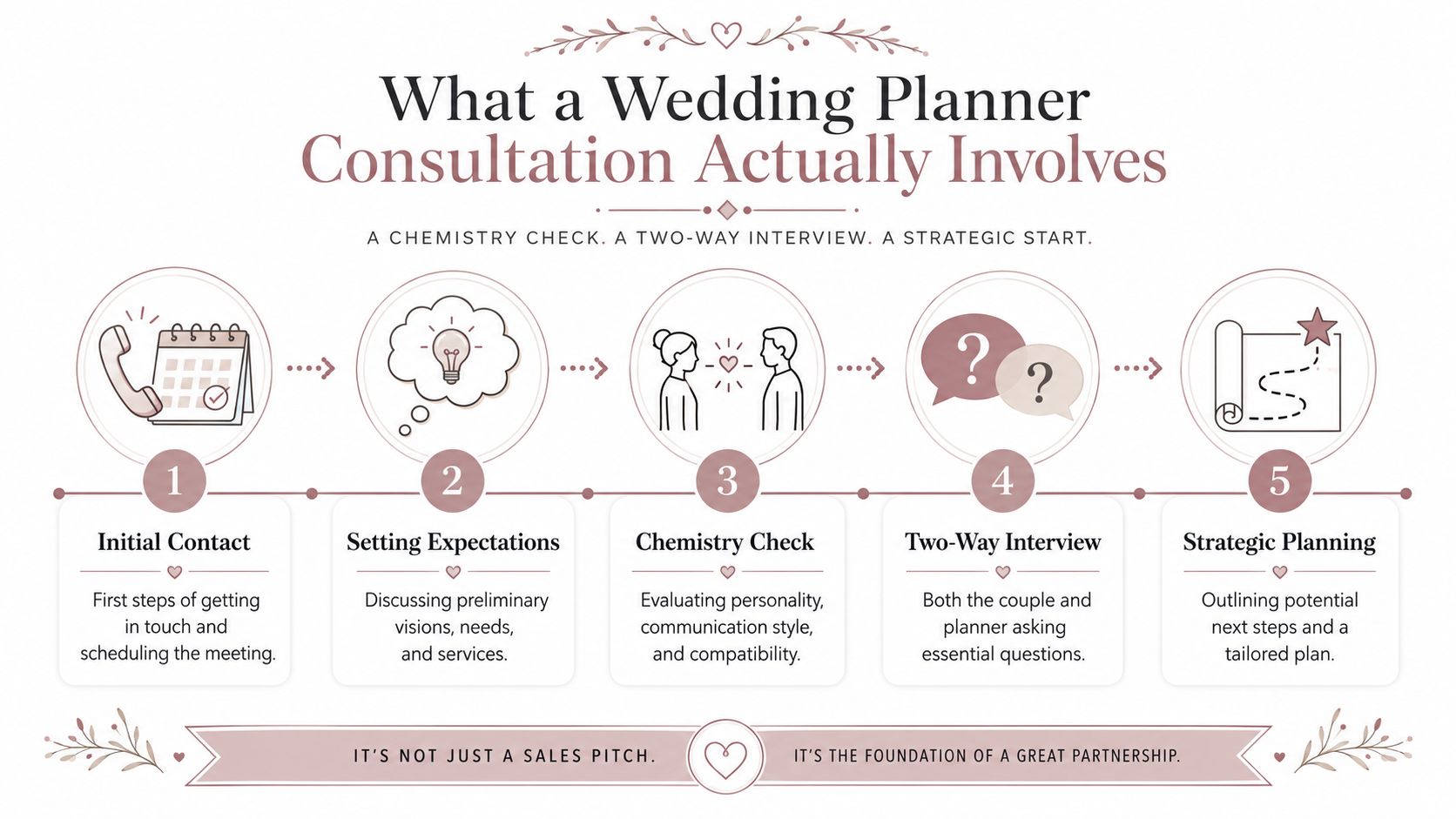
The shape of a good power hour
Most strong consultations move through five practical stages.
Initial context
You'll cover the basics first. Names, rough date range, whether you've booked a venue, and what prompted you to seek support now.Vision and atmosphere
Style references become useful. Not to copy another wedding, but to identify what you're responding to. Candlelight, formal dining, long tables, ruins at dusk, a black-tie tone, or a relaxed country-house feel all lead planning in different directions.Compatibility check
Chemistry matters. You need to know whether this planner listens well, answers directly, and understands how much guidance you want.Two-way questioning
The meeting's true value emerges here. You ask about service scope and communication. The planner asks about budget honesty, family dynamics, and priorities.Next-step strategy
By the end, you should know whether the fit is right and what the next practical move would be.
What works and what wastes time
The consultations that go well are the ones where couples arrive ready to make decisions, even if those decisions are provisional. A range is better than a shrug. A shortlist is better than endless screenshots.
What doesn't work is treating the meeting as a free brainstorm with no agreed priorities. That usually produces confusion, not clarity.
A useful comparison comes from wider hospitality operations. Teams that run strong planning sessions in venues, kitchens, and events don't rely on vague discussion. They work from service realities, staffing, timings, and delivery constraints. That's why broader hospitality advisers, such as Relief Chefs UK for hospitality consulting, focus so heavily on operational fit. Weddings need the same discipline, just expressed with more warmth and sensitivity.
Practical rule: If a consultation ends and you still can't state your likely guest range, date window, and spending comfort, the meeting hasn't gone deep enough.
Your Essential Pre-Consultation Checklist
Most couples don't need to arrive with everything solved. They do need enough prepared that the conversation can move beyond guesswork. The difference between a vague consultation and a productive one is often what happened in your kitchen the night before, not what happens in the meeting itself.
Start with a simple working brief. Nothing polished. Nothing performative. Just enough information that a planner can respond with precision rather than assumptions.
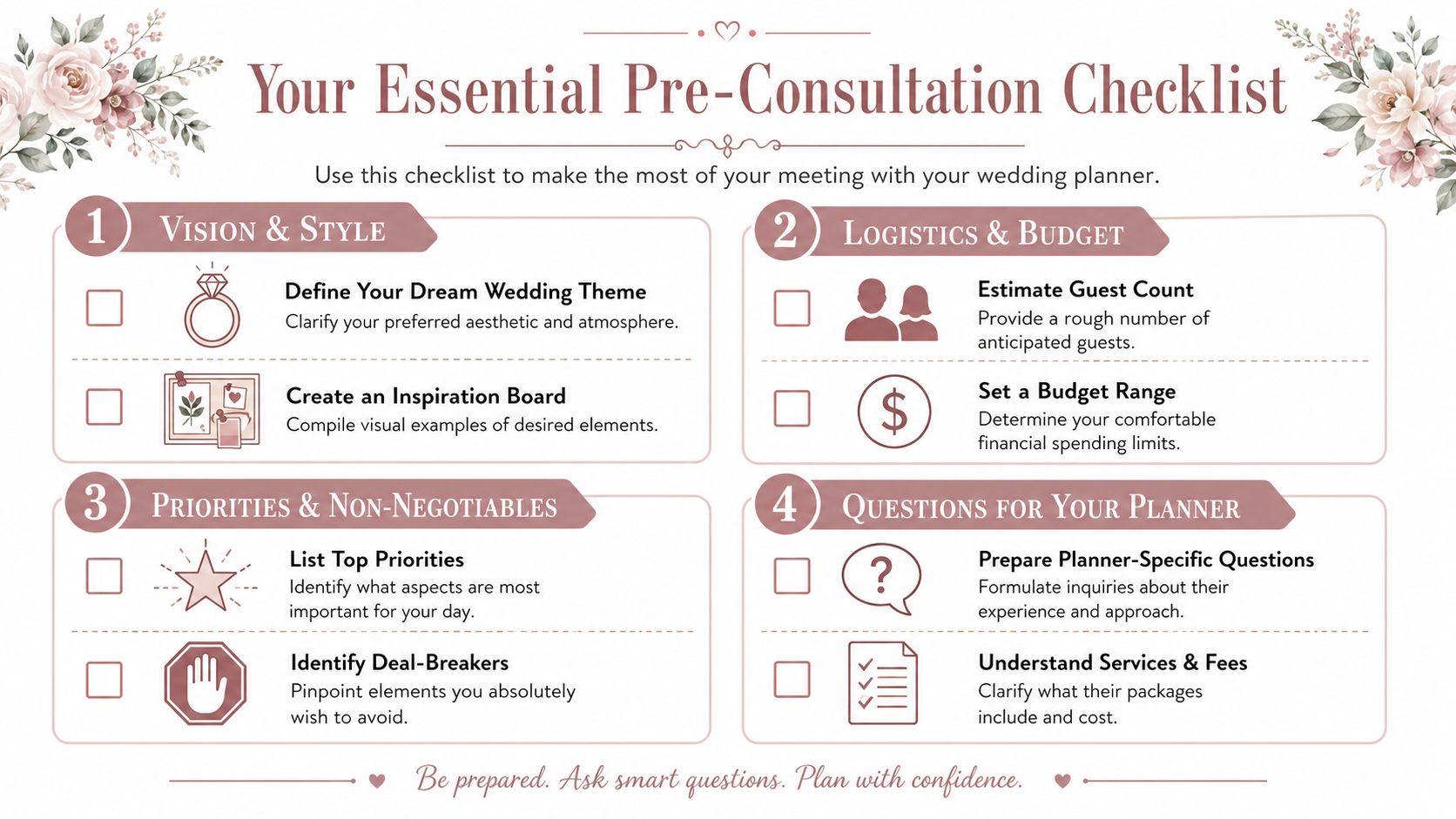
Bring a visual brief, not a visual avalanche
A mood board helps, but only if it's edited. Twenty images are useful. Two hundred are not.
Look for patterns in what you've saved. Are you leaning towards candlelit interiors, stone architecture, garden drinks receptions, statement florals, or a restrained classic look? A planner doesn't need every image explained. They need to spot your repeated preferences.
- Choose your strongest references: Save the images that feel closest to your day, not the ones that are merely pretty.
- Note what you dislike: This is often more revealing than what you love.
- Separate fashion from venue styling: Dress inspiration and room styling influence each other, but they aren't the same decision.
A short visual brief also makes it easier to discuss whether your ideas suit a heritage venue, where scale, architecture, and existing character shape the styling choices.
A quick video can also help you organise your thoughts before the meeting:
Sort your guest numbers before your flowers
Guest count drives more than seating. It affects room choice, catering format, drinks planning, staffing, transport, and whether the day feels intimate or overstretched.
You don't need a final list yet. You do need a realistic range. For example, “about 80 to 95” is useful. “Somewhere between 60 and 150” is not.
A planner will usually want to know:
- Your must-invite core: Immediate family, closest friends, wedding party.
- Your expandable group: Colleagues, parents' friends, extended family.
- Your upper comfort limit: The number beyond which the day would stop feeling like yours.
Have the money conversation properly
This is the part many couples delay, and it always shows. If one of you is picturing a generous multi-course celebration at a heritage venue and the other is imagining a tighter spend with selective priorities, that gap must be discussed before the consultation.
What matters most is honesty. A planner can work with a modest budget and a clear brief. It is much harder to work with an ambitious brief and unclear financial boundaries.
Use this simple table before your meeting:
| Topic | Agree before the consultation |
|---|---|
| Overall comfort | The range you can spend without regret |
| Potential contributions | Who is paying, and whether that affects decisions |
| Top priorities | Food, photography, music, venue, guest experience, styling |
| Likely compromises | Guest count, day of week, format, or service level |
Decide who needs a voice
Some weddings are planned by two people. Some have parents heavily involved. Some include a sibling with logistical oversight and a couple making the final calls. None of those models is wrong. Problems start when nobody says which model applies.
If key decision-makers are missing from the consultation, decisions made in the room often unravel afterwards.
Before you book the meeting, agree on two things. First, who must attend. Second, who has the final say if opinions differ. That one conversation can prevent weeks of drift later.
The Two-Way Interview Questions You and Your Planner Will Ask
The most valuable consultations feel balanced. Couples sometimes arrive thinking they need to impress the planner or prove they're organised enough to deserve help. That isn't the point. You're looking for capability, calm judgement, and a planning style that suits how you make decisions.
At the same time, an experienced planner is listening closely for indicators that shape the entire engagement. Budget confidence, clarity between partners, tolerance for complexity, and emotional pressure from family all affect the advice you'll receive.

Questions you should ask the planner
Skip the generic “How long have you been doing this?” unless you're prepared to follow it with something sharper. Experience matters, but judgement matters more.
Ask questions that reveal how the planner thinks under pressure and how they work with venues, suppliers, and couples.
How do you handle a couple who are still deciding between two different wedding styles
This shows whether the planner can guide without steamrolling.What does communication look like once we book
You're checking responsiveness, meeting rhythm, and whether they rely too heavily on email when a call would solve matters faster.How do you build a wedding day timeline at a heritage venue
Historic sites often involve stricter setup logic, guest movement considerations, and more careful coordination.What do you need from us to make this work well
Good planners will answer this clearly. Great ones will answer it kindly.How do you deal with supplier misalignment or last-minute issues
You're looking for practical process, not dramatic stories.
Questions the planner will ask you, and why they matter
Some questions feel personal, but there's usually a strong operational reason behind them. One of the most important is budget.
In East Sussex, where average costs can reach £38,000, a planner's budget question acts as a stress test. They'll often perform a mental budget variance analysis, with 40 to 45% allocated to venue and catering, to judge whether your expectations are workable before planning goes further, as outlined in this analysis of UK wedding trends.
That's why a planner may ask:
| Planner question | What they're really assessing |
|---|---|
| What's your budget range | Whether the brief can support the format, venue type, and guest experience you want |
| How many guests are non-negotiable | Whether the day's scale is fixed or adjustable |
| What's most important to you both | Where to protect spend and where compromise is possible |
| What's worrying you most right now | Where you need support first |
| Who is involved in decisions | How approvals will work and where delays may arise |
The budget conversation is not a trap
Couples sometimes go quiet here because they fear being judged or sold to. A good planner isn't trying to corner you. They're trying to stop you making choices in the wrong order.
The budget question isn't about what you can be persuaded to spend. It's about whether the wedding you want can be built responsibly.
If your priorities and spend are misaligned, the consultation should say so early. That may mean refining the guest list, changing the service level, or adjusting the venue brief before you sign contracts that are hard to unwind.
Decoding Planner Fees and Packages in the UK
Fee structure is one of the most confusing parts of booking planning support because couples often read advice written for a different market. In the UK, consultation charges and planner packages don't always follow the American model, and that disconnect causes a lot of unnecessary uncertainty.
According to the 2025 UK wedding survey report, 72% of UK couples are confused about consultation costs, 38% of UK planners charge £50 to £150 for an initial deep-dive session, and only 12% of UK couples use percentage-based planners, with UK percentage fees typically sitting around 10 to 14%. In practice, most couples here are more likely to book a flat-fee or hourly structure than a percentage arrangement.
What you're actually paying for
A paid consultation usually means you're getting focused professional analysis rather than a brief introductory call. That can be good value if the planner uses the time well and follows up clearly.
The key is transparency. Before you book, you should know:
- Whether the first meeting is paid or complimentary
- How long the consultation lasts
- Whether any fee is later credited against a package
- What follow-up, if any, is included
If any of that remains vague, ask again before confirming. You're not being difficult. You're checking whether the business communicates cleanly.
Common UK package models
Different planners label services differently, but most offers fall into three practical categories.
Full planning
This suits couples who want support from the earliest decisions onward. Venue search, supplier sourcing, timeline management, logistics, design coordination, and final execution often sit here.
Partial planning
This works well if you've booked the venue and perhaps a few key suppliers, but now need structure and experienced oversight. It's often the right middle ground for busy couples who've made a strong start but don't want the final stretch to become chaotic.
On-the-day or coordination support
This is usually for couples who want to manage most decisions themselves but need someone to take control of supplier movement, setup flow, timings, and troubleshooting close to the date.
For couples comparing options, a venue-specific guide to wedding planner costs can help translate broad industry language into a more practical local picture.
Fee red flags worth noticing
The issue is rarely that a planner charges for their time. The issue is when costs are unclear, service boundaries are fuzzy, or package descriptions sound generous but don't define deliverables.
Watch for:
- Unclear consultation terms
- No written outline of package inclusions
- Loose wording around revisions or additional meetings
- Verbal promises that don't appear in the proposal
A strong proposal should make it easy to understand what you're buying, when support begins, and what sits outside scope.
A Consultation for Battle Abbey Weddings
A wedding planner consultation changes character when the venue is historic. At that point, you're not just asking whether a room looks beautiful. You're asking how architecture, guest flow, catering, access, and atmosphere can work together without fighting the building.
That's where heritage planning separates itself from generic advice. A modern blank-canvas venue gives you one kind of freedom. A place with centuries of history gives you another. It offers depth, ceremony, and extraordinary visual character, but it also asks for more thoughtful decisions.
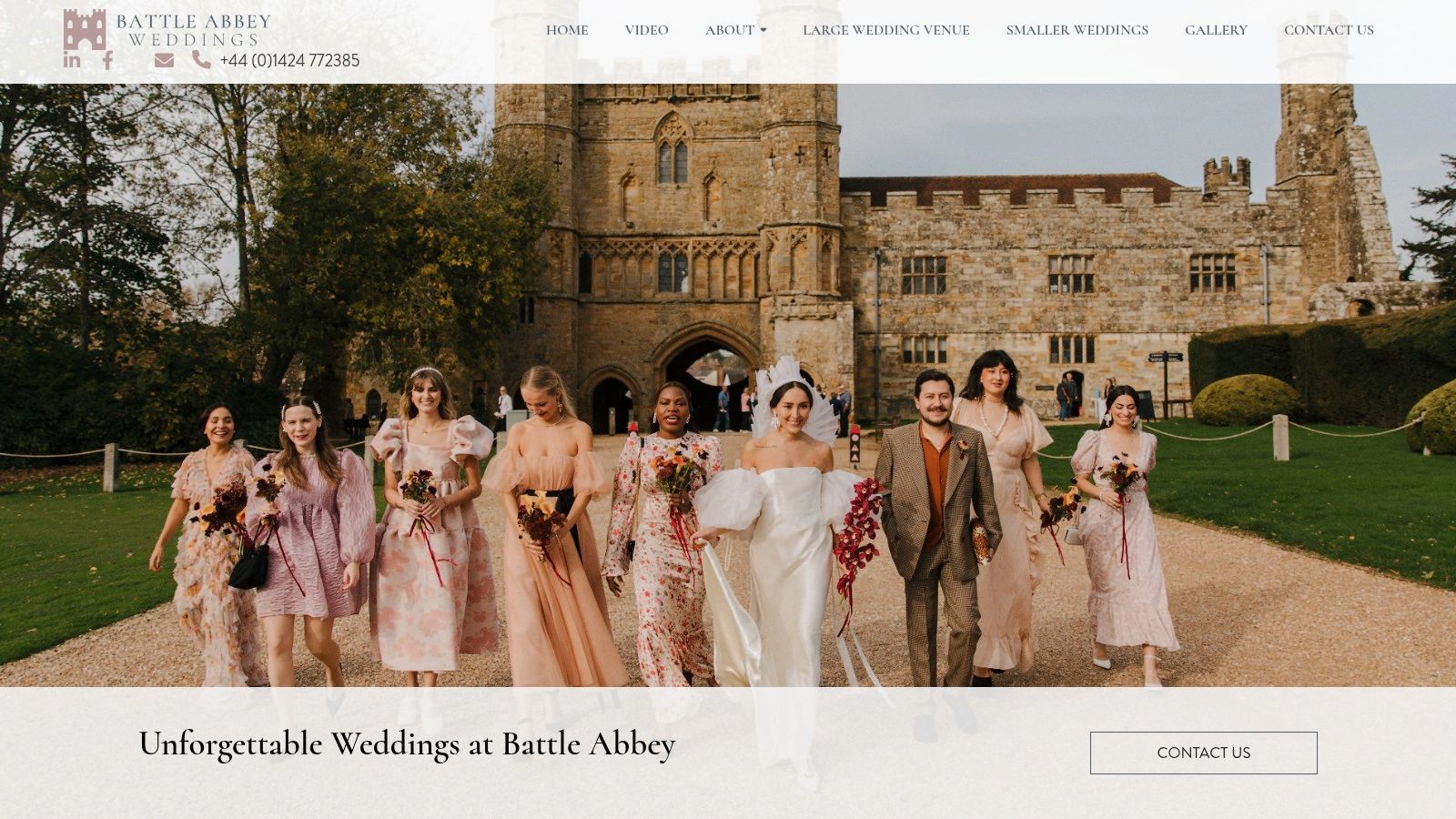
The consultation goes beyond style
At a venue such as Battle Abbey Weddings, the consultation usually needs to cover the emotional shape of the day and the practical realities that protect it. That may include whether you're planning a larger celebration or a smaller gathering, how you want guests to move through the site, and which spaces best suit your ceremony, drinks reception, wedding breakfast, and evening flow.
Historic venues often reward couples who think in sequence rather than isolated moments. The terrace may be perfect for drinks, but only if timings, weather planning, and service movement support it. A dramatic hall may suit the ceremony beautifully, but only if guest numbers, acoustic expectations, and room turnaround are considered early.
The trade-offs generic guides miss
A consultation for a high-value heritage setting should test details that ordinary checklists often ignore.
Exclusive use versus intimacy
A larger guest list can justify full-site hire, while a smaller celebration may feel better in a part-site format that keeps the atmosphere warm and intentional.Catering style versus room character
Formal dining, relaxed sharing menus, or more informal evening food each create a different rhythm. At a venue with in-house catering and local sourcing, this part of the conversation should be specific, not abstract.Photography versus guest comfort
Historic grounds offer remarkable backdrops, but your planner must balance portrait time with hospitality so guests aren't left waiting too long between moments.Romance versus restrictions
Every heritage venue has rules designed to protect the site. The right consultation translates those constraints into smart solutions rather than presenting them as obstacles.
A historic venue works best when the planning respects the building instead of trying to overpower it.
What a venue-aware planner notices early
An experienced planner will spot whether your wedding concept belongs in the space. They'll ask better questions about access the day before, supplier load-in, weather alternatives, ceremony-to-reception transitions, and how to let the architecture carry some of the visual work.
That last point matters. In a setting with genuine atmosphere, you often don't need to over-style. Thoughtful florals, well-judged lighting, and confident table design can be enough. The consultation should help you spend where the venue benefits and stop where the venue already gives you plenty.
From Consultation to Celebration Your Clear Next Steps
Once the consultation ends, the next stage should feel calmer, not murkier. A good planner or venue team will follow up with a proposal, a clear outline of services, and any next actions needed from you.
Read that proposal slowly. Check the scope, meeting structure, payment terms, and what happens if your brief changes. If anything sounds broader in conversation than it appears in writing, ask for clarification before signing.
Use a simple review lens:
- Does the service match the level of support we need
- Do the fees and inclusions make sense
- Did we feel understood during the consultation
- Can we imagine trusting this person on a pressured day
If the answer is yes, respond promptly and secure the arrangement. If the fit isn't right, decline courteously and move on. You don't need to apologise for choosing differently. You do need to choose with clarity.
The right wedding planner consultation doesn't just help organise a wedding. It changes the tone of the whole engagement. Decisions become cleaner. Priorities sharpen. The day starts to feel possible in a way that is both romantic and well-managed.
If you're planning a wedding in East Sussex and want guidance that reflects realities of a historic setting, Battle Abbey Weddings offers venue-specific support that helps couples shape the day with both atmosphere and practical clarity in mind.