You’re probably somewhere between two unhelpful options right now. One venue feels too large, where 60 guests would rattle around in a ballroom built for far more. Another feels so tight that dinner, drinks, and dancing would compete for the same few square metres. That tension is common when couples search for wedding venues for 60 guests. They want a day that feels meaningful and full, not sparse, not squeezed.
A guest count of 60 often creates the kind of wedding people remember for the right reasons. You can speak to everyone. The room still has energy. The meal can feel considered rather than mass-produced. And if you’re drawn to a historic venue in the UK, this number often suits the architecture beautifully because you can use characterful rooms and outdoor terraces in a way that feels intentional rather than scaled down.
Historic venues add another layer to the decision. They’re romantic, visually rich, and often far more nuanced than generic venue round-ups suggest. Capacity isn’t just a line on a brochure. It affects movement, ceremony sightlines, service style, weather backup, and whether the day flows naturally from one moment to the next. For 60 guests, those details matter more, not less.
The Sweet Spot Why 60 Guests is the Perfect Number
You walk into a Georgian dining room, the kind with tall windows, worn floorboards, and a fireplace that has seen two centuries of gatherings. With 60 guests, it feels alive. Every chair is used with purpose, the room has a gentle hum before dinner, and no part of the venue feels hired as an arbitrary selection.
That is why 60 is such a strong number for a historic UK wedding. It gives you enough guests for real atmosphere, but not so many that the day starts dictating the venue instead of the other way round. UK wedding planning data from Hitched places the average wedding at around 82 guests in 2023, so 60 still reads as intimate while feeling complete, as reported in the Hitched National Wedding Survey 2024.
In practice, 60 also opens doors that larger guest counts often close. Many heritage venues are at their best when you hire part of the site rather than the whole estate. A private hall for the ceremony, a terrace or courtyard for drinks, and a separate room for dinner can feel generous at this size. At 100 guests, the same plan may need overspill areas, extra furniture turns, or a larger marquee that changes the character of the setting.
The social dynamic is different too.
With 60 guests, couples usually know every person in the room well enough to spend meaningful time with them. Conversations last longer. Place names can be more thoughtful. Service feels more attentive because the schedule is not built around moving a large crowd from one point to another. That is one reason smaller celebrations continue to shape 2026 wedding trends.
There is also a budget advantage, but not in the simplistic sense of “fewer guests means cheaper.” Historic venues often come with fixed costs, staffing rules, and conservation restrictions, whether you invite 60 people or 120. The gain at 60 is choice. Couples can put more of the budget into a better menu, stronger wine, upgraded florals, live music, or an extra hour in a remarkable space. If you are comparing character-led settings built for this scale, this round-up of intimate wedding venues for smaller celebrations is a helpful place to start.
For many couples, 60 is the point where a wedding still feels full, but the day remains personal. In a historic venue, that balance is hard to beat.
Defining Your Vision Beyond the Guest List
A couple walks into a historic venue convinced they need space for 60, then books the wrong place because they never decided how those 60 people should experience the day. I see this often with abbeys, manor houses, and part-hire heritage sites in the UK. The guest count is clear. The atmosphere is not.

For a 60-guest wedding, vision matters more than pinning down decorative details too early. Historic venues already bring character, rules, and physical constraints. A ruined cloister, panelled hall, or walled garden will shape the day long before flowers and stationery do. That is why the first job is to decide what kind of gathering you want to host.
Decide what should lead the day
Start with experience, not styling. A candlelit dinner with speeches between courses needs a different setting from a ceremony-led day with garden drinks and a lively party after dark. Both suit 60 guests. They do not suit the same building.
Ask yourselves a few blunt questions:
- What do you want guests to remember first? The ceremony setting, the meal, the music, or the sense that every part of the day felt personal.
- Where do you want the emotional high point? During the vows, at dinner, or once the dancing starts.
- What would frustrate you if the venue made it difficult? Outdoor drinks cut short by access rules, a band squeezed into a corner, or portraits rushed because the grounds close early.
Those answers help you filter venues quickly. They also stop you falling for impressive architecture that does not support the way you want to celebrate.
In a historic venue, priorities need to be specific
UK heritage venues often come with details generic planning advice skips over. Some offer part-site hire rather than exclusive use. Some protect certain rooms from open flames, amplified music, or heavy furniture moves. Some have extraordinary ceremony spaces but limited wet-weather options, or beautiful grounds with strict guest access times.
At 60 guests, those details matter because the wedding is small enough for every planning decision to be felt. If drinks are in one area, dinner in another, and evening dancing in a third, the flow needs to feel deliberate rather than fragmented. If only part of a property is yours, the hired spaces must still feel private and coherent.
Use the smaller guest count to improve substance
A 60-guest wedding rewards choices guests can notice.
That might mean:
- A menu with more character. Slower service, better ingredients, or a format that fits the building, such as a formal wedding breakfast in a hall and pudding served later with dancing.
- Design that respects the venue. Fewer pieces, better placed. Historic rooms rarely need decorating in every corner.
- Clothing that fits the site. Stone steps, uneven paths, lawns, and long hours on your feet can change what feels practical. A guide to Daniella Shevel wedding shoes can help if you want something elegant that still works in a heritage setting.
Your guest list sets the scale. Your vision decides the pace, mood, and where the budget should work hardest.
Match the mood to the building, not just the photos
A medieval gatehouse creates a different atmosphere from a Georgian country house, even if both can host 60 guests beautifully. The right venue should support your priorities without constant compromise. During viewings, ask how the day would run on site. Where would guests gather after the ceremony? Which rooms are included in your hire? What changes if it rains? Are there conservation rules that affect candles, music, confetti, or late-night access?
If you want a sharper framework before you start touring venues, this guide on how to choose a wedding venue will help you compare character, practicality, and flow with clearer eyes.
Mastering Venue Capacity and Layout for 60 Guests
The hardest mistake to spot during a venue search is a room that is technically large enough but operationally wrong. A capacity figure on its own tells you almost nothing about how the day will feel.
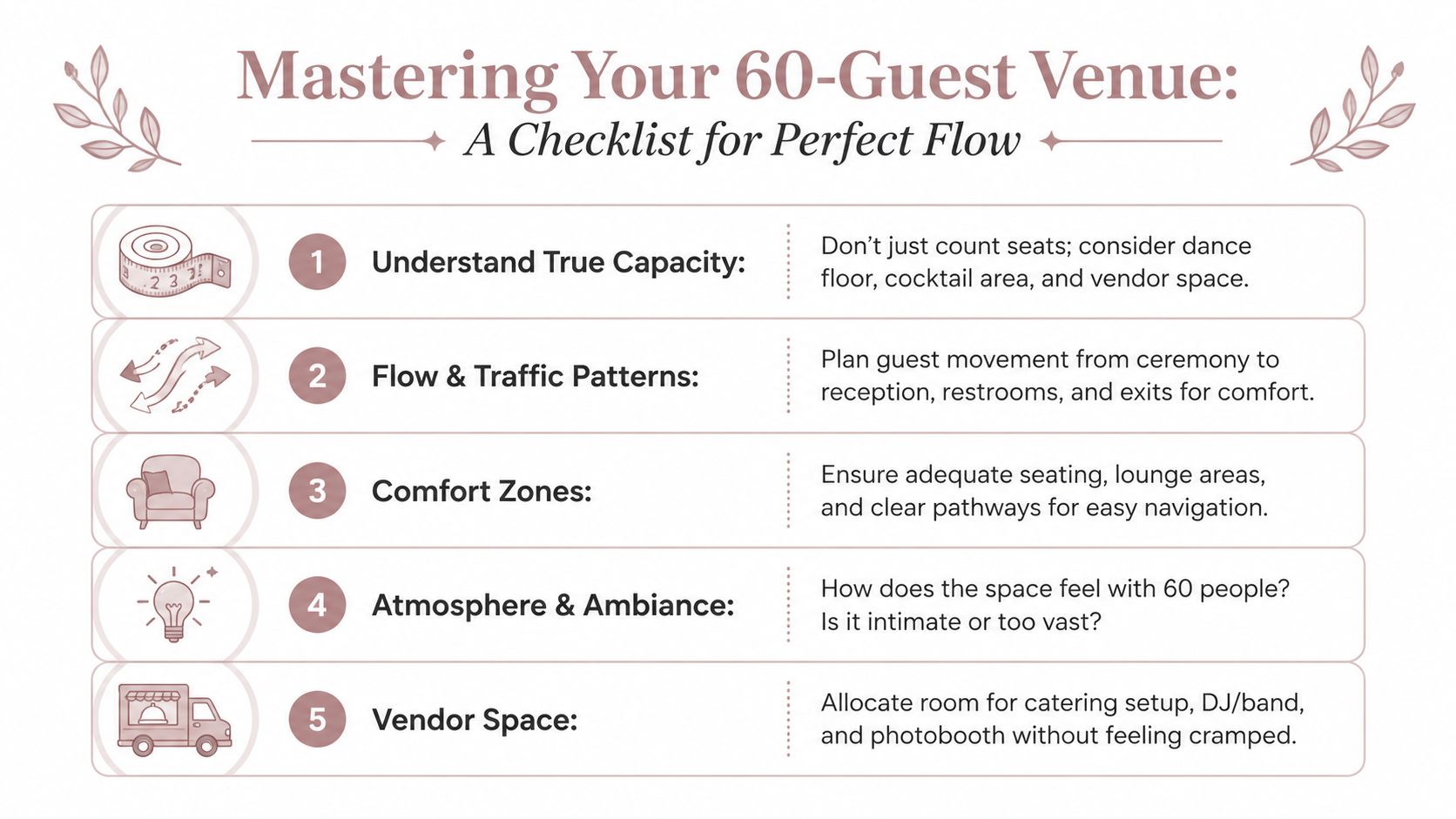
For a seated dinner, planners recommend allowing 1.5 to 2 square metres per person, so a 60-guest wedding needs 90 to 120 square metres for comfort, according to this venue sizing reference. The same source notes that overcrowding contributes to guest dissatisfaction in 25% of poorly planned small weddings. That doesn’t mean every room has to be large. It means the dining room has to work once tables, chairs, service routes, and people standing up to hug each other are all in play.
Capacity and comfort are not the same thing
A room can fit 60 chairs and still fail as a wedding space. Here’s where couples often misread a floor plan:
| Check | What to ask | What goes wrong if you skip it |
|---|---|---|
| Dining layout | Can 60 guests dine without tables being pushed tight to walls? | Service becomes awkward and conversation feels cramped |
| Transition space | Where do people gather after the ceremony or before dinner? | Guests bottleneck in doorways |
| Dance floor | Is dancing sharing space with dining or does it open naturally later? | Furniture shuffling breaks momentum |
| Vendor footprint | Where do catering staff, musicians, and equipment go? | The room feels busy before guests even arrive |
Walk the day in order
When you visit, don’t stand in the middle of the room and ask whether it’s pretty. Start at arrival and move in sequence.
Picture where guests check in, where coats go, where older relatives can sit down early, where the ceremony happens, and how people move to drinks without crossing through supplier setup. Then picture dinner. Then dancing. Then departure.
That exercise usually reveals whether a venue has been designed around intimate weddings or squeezed down to accommodate them.
A strong layout lets guests forget logistics. A weak one makes them feel every transition.
Historic venues need zoned thinking
For 60 guests, the best historic venues usually rely on distinct zones rather than one oversized room. Ceremony in one characterful space. Drinks outdoors or on a terrace. Dinner in a separate room. That sequence creates movement and makes a small wedding feel expansive.
Look for these signs during a viewing:
- Separate ceremony and dining spaces: This keeps the day unfolding rather than resetting.
- Outdoor spill-out areas: Terraces and lawns give guests breathing room during canapés and photographs.
- Quiet corners: At 60 guests, not everyone wants to stand by the bar or the speakers all night.
- Clear access routes: Staff shouldn’t need to cut through guest conversations to keep service on time.
Ask for a realistic setup, not the maximum one
Venues often show their most optimistic layout. Ask to see a plan that reflects your actual wedding, including your preferred table style, music setup, cake table, gift table, and any lounge seating.
If you’re touring a historic property, ask one more question that matters a great deal: how does the room feel with 60 people in it? Some spaces become magical at this number. Others reveal too much empty perimeter and start to feel underused. Intimacy is partly about scale, but it’s also about proportion, ceiling height, acoustics, and what guests see when they look up from the table.
Elevating the Experience with Catering and Service
A 60-guest wedding changes catering from a volume exercise into part of the storytelling. That’s one of the clearest advantages of choosing a smaller celebration.
At this size, chefs can be more flexible, service can be more attentive, and the meal can reflect the venue and the season more closely. That matters even more now because 35% of UK couples are asking for sustainable venues, and venues with flexible menus and locally sourced ingredients can reduce food waste by up to 22% compared with rigid banquet packages, according to this wedding venue sustainability reference.
Smaller numbers create better menu choices
For a large wedding, couples often choose the safest menu that can be produced at scale. For 60 guests, you can usually be more specific.
That might mean:
- Seasonal ingredients: especially if the venue works with local farms and suppliers.
- More varied service styles: plated dinner, shared feasting, a refined barbecue, or a hog roast that suits the setting.
- Better dietary handling: it’s much easier to make guests feel considered when numbers are manageable.
Venue catering matters more than many couples expect. If a venue offers in-house catering and knows the building well, timing is often smoother because kitchen, staff, and planner are already working from the same operational rhythm.
Read quotes with a planner’s eye
The cheapest per-person figure can become the most expensive option once staffing, crockery, glassware, service style, and evening food are added back in. For 60 guests, I’d rather see a clear proposal than a low starting number.
Look closely at:
- What service staff are included
- Whether drinks service is integrated or separate
- How children’s meals and dietary alternatives are handled
- What happens if the weather changes your reception plan
A strong catering quote should help you understand the day, not just the bill.
For inspiration on how food presentation and pacing shape a celebration, this short film is useful:
Good catering at 60 guests doesn’t just feed people. It changes the tempo of the entire wedding.
What works best in historic venues
Historic venues usually reward menus that feel grounded in place. Locally sourced produce, generous canapés, and a dinner style that matches the building will always feel more coherent than a menu copied from a city hotel package.
What doesn’t work as well is forcing a format that fights the venue. An overly elaborate station layout in a compact heritage room can interrupt movement. A rigid banquet package can miss the chance to use a terrace, lawn, or bar area naturally. The strongest weddings let the service style support the architecture and the guest count at the same time.
Navigating the Logistics of a Historic Venue
Historic venues are full of charm, but they aren’t simple boxes you hire and fill. They have rules, rhythms, protected features, and practical realities that generic venue lists often ignore.
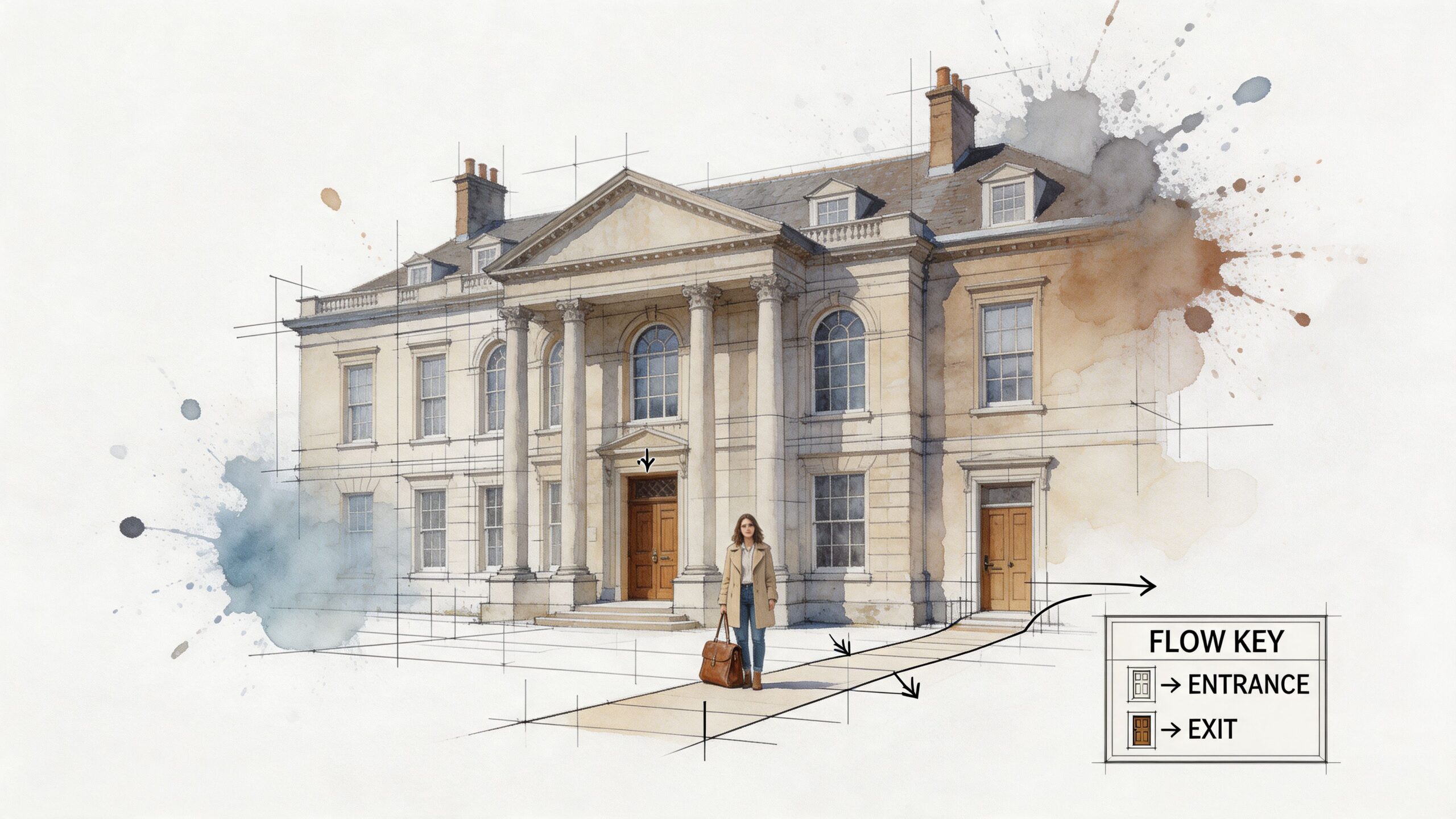
That’s one reason intimate heritage weddings have become more prominent. A UK industry report recorded a 28% increase in demand for intimate ceremonies under 75 guests at heritage sites in Southeast England from 2025 to 2026, while also noting that many couples still don’t understand weather contingency planning or licensing rules, according to this heritage wedding trend article.
Part-site hire can be the right answer
For 60 guests, full exclusive use is not always necessary. In fact, it can dilute the atmosphere if too much of the property sits empty. A part-site hire often works better because it concentrates the wedding into the rooms and terraces that suit the guest count.
This is especially effective at heritage venues with distinct ceremony and dining areas. You get the architecture, the history, and the outdoor setting, but without paying for or managing spaces you won’t use. That usually gives you better flow and a stronger sense of occasion.
The questions couples often forget to ask
Historic sites have practical constraints, and the best venues will answer these clearly.
- Licensing: Is the ceremony room licensed, and are receptions permitted until your intended finish time?
- Weather backup: If drinks are planned outdoors, where do guests go quickly if the weather turns?
- Supplier access: Can florists, musicians, and stylists set up the day before, subject to availability?
- Guest movement: Are there steps, uneven surfaces, or long walking routes between key spaces?
- Photography permissions: Which parts of the grounds can be used, and at what times?
Those questions don’t reduce the romance. They protect it.
Historic venues reward couples who plan for the building, not against it.
What works and what doesn’t
A few trade-offs are worth stating plainly.
What tends to work well
- Ceremony in a characterful indoor room, followed by outdoor drinks if the weather cooperates.
- A guest list tight enough that everyone can move comfortably between spaces.
- One planning lead who coordinates venue timing, catering, and suppliers.
What tends to cause stress
- Building the whole reception around an outdoor area without a clear indoor pivot.
- Hiring suppliers who haven’t worked in heritage settings and underestimate access restrictions.
- Assuming that “intimate” means easy. Smaller weddings still need strong timing.
Use the constraints as design prompts
Historic venues often become easier to plan once you stop treating their rules as obstacles. A protected room may limit hanging installations, but that can push you toward candles, table florals, and lighting that suits the building more naturally. Restricted setup windows make a day-before access policy more valuable. Outdoor terraces become more dramatic when they’re used for one perfect part of the day instead of everything.
In other words, the logistics are part of the design brief. The couples who enjoy historic venue planning most are usually the ones who accept that the building already has a voice. Their job is to work with it.
A Case Study Battle Abbey Weddings for 60 Guests
If you want to see how these planning principles come together in practice, a heritage venue with an intimate part-site format is a useful model. Battle Abbey Weddings as a historic wedding venue is one example of how a 60-guest wedding can be shaped around ceremony, dining, outdoor reception space, and heritage logistics without feeling either oversized or constrained.
The strongest part of this kind of setup is proportion. For historic venues of this type, in-house teams achieve 96% smooth execution for 60-guest weddings, and the spaces are often already scaled to suit intimate celebrations, with the Abbot’s Hall seating 50 to 70 and the Duke’s Library hosting 45 for a banquet with a dance floor, according to this historic venue reference. That matters because 60 guests don’t need one room to do everything. They need a sequence of spaces that each serve a purpose well.
Why the format works
A ceremony in a room such as the Abbot’s Hall gives the vows gravity and atmosphere. After that, drinks and canapés on a terrace or lawn create a natural release. Guests move, talk, and take in the setting while photographs happen without the day stalling.
Dinner then feels like its own chapter rather than an extension of the ceremony setup. That’s a common strength in historic part-site hires. They create progression.
The practical advantages
This kind of arrangement also answers several of the issues couples worry about most:
- Guest count fit: the rooms feel inhabited and warm rather than underfilled.
- Planning continuity: an in-house team can coordinate timings across ceremony, catering, and room turns more tightly.
- Photo opportunities: heritage grounds and ruins reduce the need to travel off-site for portraits.
- Menu flexibility: locally sourced catering can be matched to the scale and tone of the day.
The right 60-guest venue doesn’t shrink a big-wedding template. It builds a different kind of wedding from the ground up.
For couples drawn to a fairy-tale setting but wary of heritage complexity, this is often the sweet spot. You get the drama of history, a manageable footprint, and a guest experience that feels personal from arrival to last dance.
Your Story in a Timeless Setting
A 60-guest wedding has a particular kind of beauty. It isn’t trying to impress by size. It creates meaning through shape, attention, and atmosphere.
That’s why the venue matters so much. The right historic setting doesn’t just hold your wedding. It helps organise it. It gives the ceremony weight, the drinks reception a view, the meal a sense of occasion, and the photographs a feeling that doesn’t need much styling to become memorable.
If you’re still narrowing your ideas, it can help to look at destination planning through a broader lens too. Even a guide on choosing a wedding destination in wine country can sharpen your thinking about the surroundings, guest experience, and what kind of setting feels most like you.
The best wedding venues for 60 guests don’t make the day feel smaller. They make it feel closer. More deliberate. More alive. When a venue, a guest count, and a clear vision all line up, the result is the kind of wedding that feels effortless to your guests, even though every choice behind it was thoughtful.
If you’re looking for a historic East Sussex setting for an intimate celebration, Battle Abbey Weddings offers ceremony and reception spaces designed for weddings of up to 60 guests, with part-site hire, locally sourced catering, and planning support within the Battle Abbey estate.