You're probably in the phase where the big picture feels romantic, but the decisions feel oddly technical. You've found the venue with the old stone, the candlelit rooms, the terrace view, and that sense of history you can't fake. Then someone asks about the menu, and suddenly the mood shifts from dreaming to spreadsheets.
That's where many couples get stuck. They know they don't want a generic wedding breakfast, but they also don't want something so trend-led that it feels dated in a year's time. They want food that feels gracious, British, celebratory, and right for a historic setting.
That's exactly why the idea of a white swan menu is so useful. Not as a single pub menu copied onto wedding stationery, but as a culinary style. Think refined British classics, seasonal produce, confident simplicity, and dishes that feel generous rather than fussy. It's a way of feeding people that suits a grand room, an old estate, and a day meant to be remembered for warmth as much as spectacle.
Crafting the Story of Your Wedding Breakfast
A wedding breakfast should feel like part of the story, not an interruption between the ceremony and the dancing. I often think of the couple who have chosen a historic setting because they want the day to feel rooted, personal, and timeless. For them, the meal isn't just catering. It's the chapter where guests settle into the celebration and feel looked after.
A white swan menu works beautifully in that role because it suggests a certain kind of hospitality. It brings to mind crisp linen, polished glassware, silver service where appropriate, and food that feels unmistakably British without becoming stiff or predictable. The appeal lies in familiarity refined by care.

The phrase itself is helpful because it gives couples a direction. Instead of asking, “What should we serve?” you can ask, “What kind of feeling should the meal create?” That changes everything. Suddenly the menu becomes about atmosphere, heritage, and the experience of being gathered together in a place with history in its walls.
For some couples, that might mean a graceful plated meal with roast meats and a classic pudding. For others, it may mean canapés on a terrace, a seasonal banquet, then something relaxed later in the evening. Even the table details matter. If you're choosing between textures and finishes, it can help to compare sustainable napkins at Afida, especially if you want the tablescape to feel as considered as the food itself.
A memorable wedding meal doesn't have to be experimental. It has to feel right for the room, the season, and the people you love.
That's the heart of this style. A white swan menu doesn't chase novelty. It creates confidence, comfort, and elegance.
Deconstructing the Classic White Swan Menu
The easiest way to understand a white swan menu is to picture it as four parts of one gracious meal. There is an opening note, a signature main event, the supporting seasonal elements, and a finish that feels warm rather than theatrical. This is why the style translates so well from beloved British dining traditions into weddings.
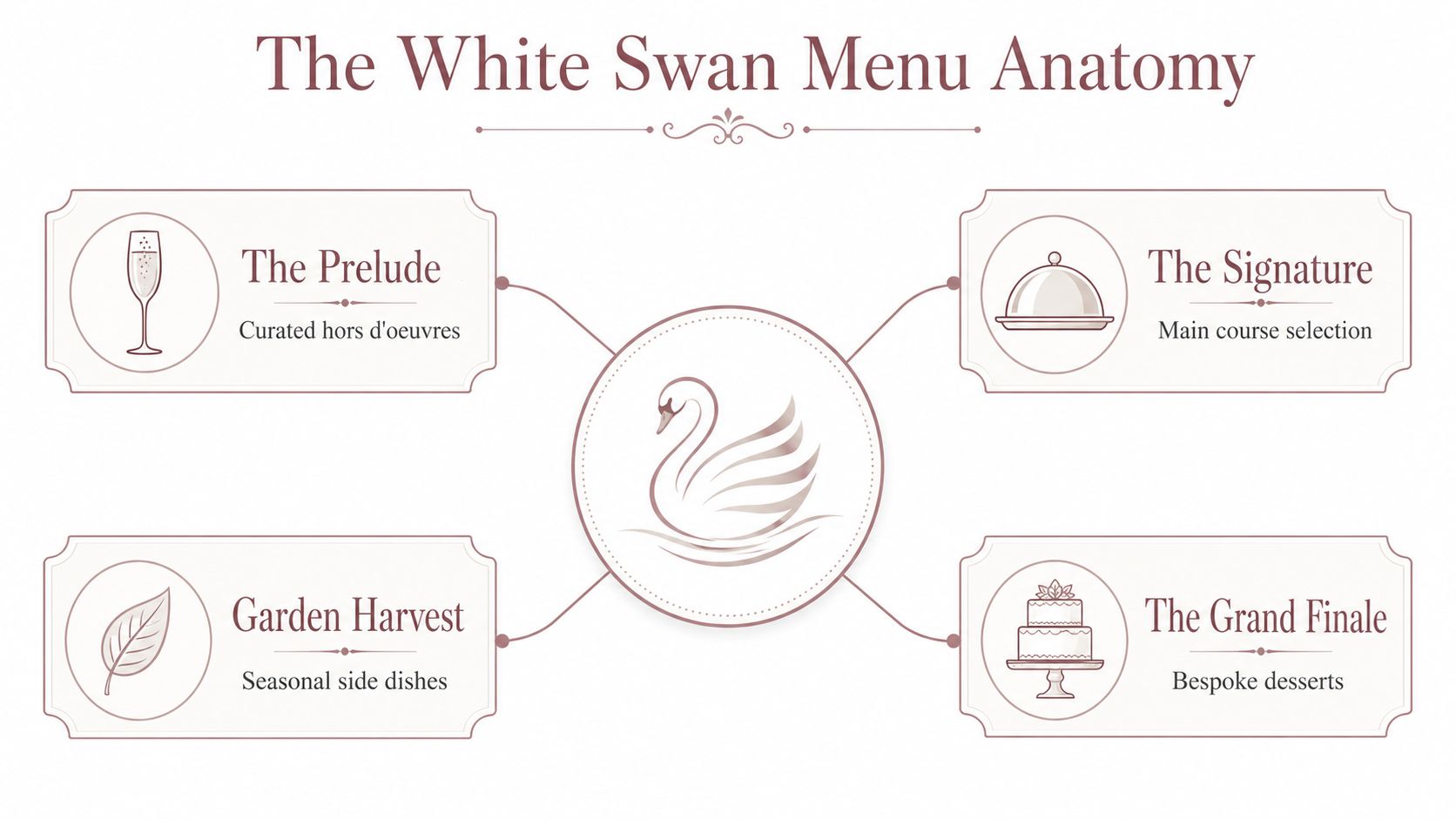
The heritage matters here. Industry data shows 28% of UK pub-goers cite “traditional British food” as their primary draw, a preference that naturally carries into weddings when couples want refined classics rather than passing trends, as noted by the British Beer and Pub Association.
The opening course
The starter in this style should set a calm, polished tone. It's not there to overwhelm. It's there to sharpen the appetite and signal the standard of the meal to come.
Good examples include:
- Smoked salmon with pickled cucumber. Elegant, recognisable, and particularly suited to formal service.
- A seasonal soup such as roasted tomato, celeriac, or wild mushroom. This works especially well for autumn and winter celebrations.
- Pressed ham hock or a light chicken terrine with chutney and leaves. This suits couples who want a more traditional country-house feeling.
- A composed vegetarian starter built around beetroot, goat's cheese, heritage carrots, or garden herbs.
If you're unsure whether a dish is formal enough, ask a simple question. Would it feel at home on fine china in a historic dining room? If the answer is yes, it's likely on the right track.
The central course
The white swan menu earns its reputation through its execution. The main course should feel generous and composed, with British character at the centre of the plate.
A few strong options are easy to picture:
| Style | Example | Why it works |
|---|---|---|
| Roast-led | Roast lamb with seasonal vegetables | Traditional, celebratory, and ideal for spring or early autumn |
| Coastal classic | Pan-seared sea bass with a delicate sauce | Lighter, elegant, and useful for summer receptions |
| Signature showpiece | Beef Wellington or a beef-based centrepiece | Best for a grand, formal wedding breakfast |
| Vegetarian centrepiece | Mushroom or squash wellington | Keeps the same classic silhouette for non-meat guests |
The supporting elements matter just as much as the protein. A white swan menu often relies on proper sides rather than decorative garnish. Buttered greens, roast potatoes, glazed roots, braised cabbage, cauliflower purée, or a seasonal gratin all make sense. Guests remember whether the whole plate felt complete.
Practical rule: if the main course sounds grand but the sides sound vague, the menu isn't finished yet.
The pudding course
Dessert in this style should land with warmth and certainty. It's usually better to serve one excellent British classic than a complicated plate that looks impressive and eats poorly.
Consider these directions:
- Sticky toffee pudding for comfort and familiarity.
- Seasonal fruit crumble when you want the meal to feel tied to the local environment and time of year.
- Lemon tart or a custard-based pudding for a cleaner finish after a rich main.
- A local cheese course if you want a more grown-up, lingering end to the meal.
A good pudding also helps shape the mood of the room. Warm desserts encourage a sense of ease. Sharper fruit-led desserts feel brisker and lighter. Cheese slows the tempo and often suits evening transitions.
The style in one sentence
A white swan menu is classic British hospitality made wedding-worthy. It is orderly without being rigid, generous without excess, and polished without losing its heart.
Sourcing Ingredients and Catering to Every Guest
The quickest way for a beautiful menu to become stressful is when guests start asking about allergens and no one can answer clearly. This happens more often than couples expect, especially when sample menus look lovely on paper but don't explain how dishes can be adapted.
That gap matters. With 10% of UK adults having food hypersensitivities and 52% of wedding guests reporting intolerances, a venue's ability to provide full allergen details and flexible adaptations is no longer a luxury, but a necessity for ensuring a safe and inclusive celebration, according to the Food Standards Agency.
Why provenance and dietary planning belong together
Couples sometimes treat local sourcing and dietary planning as separate topics. In practice, they're closely connected. A catering team that knows exactly where ingredients come from usually has a much firmer grasp on what's in each dish, how substitutions work, and what can be prepared safely.
That's one reason a bespoke approach feels calmer. Instead of offering a rigid menu with a few awkward substitutions, the kitchen can build equivalent dishes. A vegetarian guest shouldn't feel they've been given an afterthought. A gluten-free guest shouldn't worry whether gravy, sauce, or dessert has been checked properly.
The standard to look for is simple:
- Clear allergen communication before the day
- Flexible dish adaptation without losing elegance
- Seasonal sourcing that improves flavour and menu coherence
- Service confidence so guests don't need to chase answers at the table
What couples should ask their caterer
A white swan menu style can absolutely accommodate modern dietary needs. It just needs planning. Ask practical questions early, and ask them in writing where possible.
Useful questions include:
- How are allergens documented? You want a clear process, not verbal reassurance.
- Can vegan and gluten-free guests receive a dish of equal quality? The key word is equal.
- How is cross-contamination handled? This is especially important for severe allergies.
- Which ingredients are local and seasonal? This reveals whether “locally sourced” is a principle or just a phrase.
Here's a useful visual overview to keep in mind while discussing choices with your planner or chef.
The quiet luxury of a well-planned menu
When this part is done well, guests barely notice the logistics. They feel included. The vegan cousin receives a dish that looks considered. The guest with an intolerance eats confidently. The grandparents recognise familiar flavours, but in a more polished form.
The best hospitality is often invisible. It looks effortless because someone planned it carefully.
That's what transforms a white swan menu from charming concept to dependable wedding banquet. Good sourcing improves flavour. Good allergen planning protects people. Together, they create the kind of ease every couple wants on the day.
Understanding Menu Formats and Price Guidance
Menu style affects cost just as much as ingredients do. Two weddings can use a similar flavour profile and a similar standard of produce, yet feel completely different in budget because the service format, staffing, and pacing are different.
For a historic venue in East Sussex, couples should expect a formal benchmark. A three-course banquet typically costs between £85 and £110 per head, reflecting a 15-20% premium for hyper-local sourcing, which can reduce carbon footprint by an estimated 40% compared with national averages, according to the UK Food Security Report 2024.
Comparing the main menu formats
Not every wedding breakfast needs to be a plated banquet from start to finish. The format should support the day's rhythm, the room, and the guest list.
| Format | Best suited to | What couples should know |
|---|---|---|
| Three-course plated meal | Formal celebrations in historic interiors | Most structured and often the clearest expression of the white swan menu style |
| Sharing platters | Warm, sociable receptions | Creates generosity at the table, though service needs careful organisation |
| Elegant buffet | Larger groups wanting variety | Can work beautifully if presentation is refined and traffic flow is managed |
| Evening BBQ or hog roast | Relaxed second phase of the celebration | Useful when couples want a change of mood later in the day |
Plated service often feels most appropriate in a grand room because it matches the architecture and the ceremony of the setting. Sharing platters soften the tone and encourage conversation. Buffets can be lovely, but they need discipline to avoid feeling too casual for the venue.
What drives the price
The headline figure is only part of the story. Couples usually spend more when they choose:
- Hyper-local ingredients that carry a premium but strengthen flavour and provenance
- Complex service styles with more staff and tighter timing
- Multiple menu paths for allergies, vegan guests, or children
- Detailed presentation through glassware, linens, printed menus, and place settings
This is why the cheapest menu on paper rarely feels like the best value. Guests remember whether they were served smoothly, whether the meal suited the room, and whether the food felt abundant and confident.
If you're budgeting the wedding as a whole, it helps to pair catering discussions with a wider cost review such as this guide to the average cost of a wedding. When you're finalising table presentation, many couples also use fast digital menu printing services to produce elegant menu cards without slowing down the planning timeline.
Spending more only makes sense when you can see what the extra spend is buying. Better ingredients, smoother service, and a stronger sense of place are all tangible value.
A good budget conversation should leave you feeling informed, not pressured. The right menu format is the one that protects both your atmosphere and your priorities.
Customising Your Menu and Planning the Tasting
The tasting is where the white swan menu stops being an idea and becomes your wedding meal. This is the stage where couples often realise they don't need to choose a standard package exactly as written. They can shape the meal so it reflects the season, the guest list, and their own sense of occasion.

The smartest tastings are focused. Don't go in hoping only to “see what you like”. Go in knowing what you need to learn. You're assessing flavour, yes, but also balance, temperature, portion sense, visual presentation, and whether each course belongs with the next.
What to pay attention to during the tasting
Some couples concentrate so hard on the main course that they miss the overall flow of the meal. A wedding breakfast is a sequence. Each part should support the next.
Use this checklist:
- Look at the progression. If the starter is rich, the main may need to be cleaner or more structured.
- Notice how the food feels after several bites. A beautiful first forkful isn't enough.
- Check visual tone. Does the plate suit a historic setting, or does it feel too modern for the room?
- Ask about adaptability. Can the dish be adjusted for seasonality or dietary needs without losing quality?
- Think about service reality. The best-tasting dish in a small test kitchen isn't always the best dish for a full reception.
Building a menu that feels personal
Customisation doesn't mean inventing something eccentric. Usually, it means taking a classic base and making it yours. Perhaps the couple met over Sunday roasts and want that warmth reflected in the main course. Perhaps a family pudding deserves a refined interpretation. Perhaps a favourite region or season shapes the ingredients.
A few elegant forms of personalisation work especially well:
- A family reference through one course, not the entire menu
- A seasonal nod such as game in autumn or lighter fish dishes in summer
- A local ingredient focus that roots the meal in place
- An evening shift in mood from formal dining to something more relaxed
That last point matters. At historic venues, 85% of couples choose flexible packages such as evening BBQs or hog roasts, and these can provide 30% faster service than traditional plated meals, which is especially helpful for celebrations working within a midnight licence, according to FSA HACCP guidance referenced in venue planning data.
If you want inspiration while refining ideas, some couples find it useful to browse broader hospitality thinking on elevating menus with WorldClass provisions, then bring those preferences back into a wedding context.
Coordinating menu and timeline
The tasting should also connect with the running order of the day. Canapés, drinks reception, the call to dinner, speeches, evening food, and dancing all affect what guests will enjoy and when.
A practical planning prompt is to review menu timing alongside your venue questions. This checklist of essential questions to ask a wedding venue in 2026 is a useful companion when you're discussing service windows, room transitions, and evening catering.
Choose food that can be served beautifully at the scale and pace of your celebration, not just food that tastes lovely in isolation.
That's how customisation becomes useful rather than overwhelming. You're not chasing more options. You're shaping a meal that fits your day.
Why a Classic Menu Suits a Historic Venue
A historic venue asks for coherence. The architecture, the ceremony, the lighting, the flowers, and the food should feel as though they belong to the same world. When couples choose a white swan menu style, they often do so instinctively because it answers that need without forcing the issue.
Ancient stone, long views, panelled rooms, and a formal wedding breakfast all sit naturally alongside British classics. A menu built around seasonal produce, well-executed roasts, thoughtful puddings, and polished service reinforces the setting rather than competing with it. Guests may not describe this in design language, but they feel it immediately.
Heritage works best when it feels lived in
The mistake some couples make is assuming a historic venue requires stiff dining. It doesn't. It requires appropriate dining. There's a difference. A classic menu can still feel warm, relaxed, and generous.
That's one reason these menus continue to resonate. UK hospitality projections for 2026 anticipate 18% growth in wedding-related catering for historic rural venues, driven by couples who want a cohesive experience where the menu's quality and heritage feel as authentic as the venue itself, according to UKHospitality.
This is less about nostalgia and more about fit. A heritage setting gives familiar dishes new depth. Roast meat feels more celebratory. A seasonal pudding feels more grounded. Even the act of sitting down together for a formal meal gains extra significance in a place that already carries centuries of ritual and gathering.
The meal becomes part of the atmosphere
When food suits the venue, guests don't experience it as a separate feature. They experience one continuous occasion. The reception drinks lead naturally into dinner. The dinner supports the speeches. The speeches give way to evening celebration. Nothing feels pasted on.
That's why classic food often succeeds where trend-led menus struggle. Trends can be exciting, but they can also pull attention away from the setting. A well-composed British menu allows the venue to remain the stage while the food deepens the mood.
Consider the qualities a historic setting already offers:
- Permanence, which suits timeless dishes
- Texture, which pairs well with seasonal ingredients and layered service
- Ceremony, which is enhanced by a structured meal
- Romance, which grows stronger when guests feel comfortably cared for
For couples weighing the overall character of their venue, this perspective on what makes Battle Abbey the perfect historic wedding venue shows how setting and celebration can align so naturally.
A classic menu doesn't merely suit a historic venue. It helps the entire day feel believable, gracious, and complete.
That's why the white swan menu idea has such staying power. It gives the food a role larger than nourishment. It lets the meal belong to the place.
Begin Your Culinary Journey at Battle Abbey
Choosing a white swan menu is really about choosing a feeling. You're creating a wedding meal that reflects British hospitality at its best: seasonal, elegant, welcoming, and suited to a setting with history. The right version of this style doesn't feel copied from a pub or lifted from a trend report. It feels customized for your day.
If you're weighing starters, considering whether a roast-led main is too formal or not formal enough, wondering how to accommodate dietary needs gracefully, or trying to balance banquet tradition with a more relaxed evening offering, you're asking exactly the right questions. Good menu planning should give you confidence, not confusion.
The most successful wedding breakfasts don't just feed a room. They hold the day together. They give guests a sense of occasion, comfort, and delight in equal measure.
If you'd like help shaping a bespoke wedding menu that feels at home in an extraordinary historic setting, the team at Battle Abbey Weddings can guide you through every detail, from elegant three-course dining to relaxed evening feasting, with the care and experience that turn plans into a perfect celebration.