You're probably somewhere between excitement and overwhelm right now. One minute you're saving ceremony arches, candlelit tables and old-stone backdrops to your phone. The next, you're trying to work out what “bespoke” even means when every venue brochure seems to use the word differently.
That confusion is understandable. In wedding planning, “bespoke” can sound like a beautiful promise and a vague invoice at the same time.
It is simpler than the industry sometimes makes it seem. A bespoke wedding isn't a package with nicer napkins. It's a day shaped around your priorities, your guest experience and the particular rhythm of your relationship. It might mean a formal ceremony followed by relaxed terrace drinks. It might mean a candlelit dinner for your closest people in one room and dancing in another. At a historic venue, it also means respecting the building itself, because old places have their own practical needs as well as their romance.
That's where clear planning matters. When couples understand what changes the cost, how guest flow works across multiple spaces, and where customisation is worth the spend, bespoke wedding planning stops feeling mysterious and starts feeling achievable.
What Is Bespoke Wedding Planning Really?
A couple once arrived for a venue visit carrying two very different visions. She wanted black tie and candlelight in a medieval hall. He wanted the day to feel relaxed, with good food, generous drinks, and none of the stiffness they had seen at other weddings. By the end of the meeting, neither vision had been watered down. We had worked out how both could live in the same day.
That is what bespoke wedding planning really is. It is the careful work of turning taste, priorities, budget, and venue realities into a wedding that feels personal from the first guest arrival to the last dance.
Personal, practical, and shaped around the setting
At a historic venue, bespoke does not mean saying yes to every idea and hoping it all fits later. It means choosing the details that suit the building, the guest list, and the atmosphere you want to create.
A long banquet table can look beautiful in a stone hall, but only if guests can move comfortably and service can happen without interruption. A string quartet in a drawing room may sound romantic, but the timing matters if drinks are being poured in an adjoining space. Flowers may begin as a colour palette on a mood board, then become hanging foliage that needs weight limits, access times, and careful installation. If you are exploring ideas early, resources on floral planning for weddings can help you see how floral choices affect both mood and logistics.
This is the part many brochures skip. “Bespoke” often sounds expensive because couples are shown the finished picture, not the planning behind it.
Why the price tag can feel mysterious
The cost of a bespoke wedding is rarely about luxury for its own sake. It often comes from time, labour, and the complexity of making a one-off event work well in a distinctive place.
Historic Houses notes that exclusive-use venues are often chosen because couples want privacy and a setting with character, which helps explain why so many bespoke weddings are built around houses, castles, and abbeys rather than standard event suites, according to Historic Houses weddings guidance. The setting adds atmosphere, but it also adds planning questions. Where can suppliers load in? Which rooms can hold live music? How does candlelight work safely in older interiors? What happens if rain changes the drinks reception plan?
Good bespoke planning answers those questions early, so your budget goes toward choices that impact guests meaningfully.
What bespoke looks like on the day
In practice, a bespoke wedding often includes:
- A layout designed for the room, so the ceremony feels intimate and the space never looks overfilled or sparse.
- A menu chosen for the style of celebration, whether that means a formal dinner, shared feasting, or a shorter meal that leaves more room for dancing.
- Details with personal history, such as readings, family traditions, or table styling that reflects the season and the setting.
- A schedule that respects guest experience, including travel between spaces, turnaround time for staff, and natural pauses in the day.
The result should feel effortless to your guests, even though it has been thought through with care. The best bespoke weddings do not just look beautiful in photographs. They feel as though they could only have belonged to that couple, in that place, on that day.
The Bespoke Wedding Planning Journey
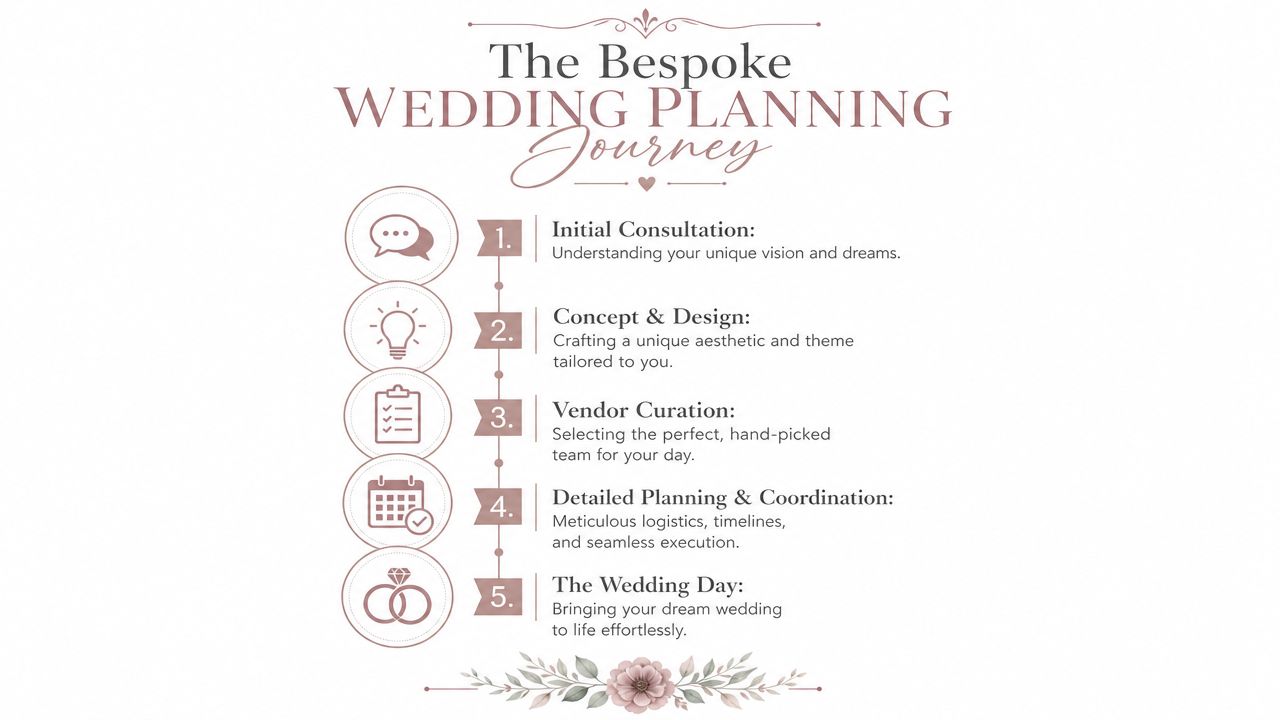
The planning process usually feels much less intimidating once couples can see the sequence clearly. Good bespoke wedding planning isn't a blur of spreadsheets. It's a series of focused decisions, made in the right order.
The first conversations
The early stage is all about discovery. Not just date and budget, but tone.
A planner listens for the details couples often don't realise are important yet. Do you want the ceremony to feel intimate, even with a larger guest list? Do you care more about the meal than the dancefloor? Do you want the day to unfold formally, or with a softer, more house-party rhythm?
This is also where planners spot possible tension points early. If one of you wants an elegant seated dinner and the other wants a relaxed late-night food moment, those aren't conflicting ideas. They're planning clues.
Curating the setting and team
Once the vision is clear enough, the right venue and suppliers become easier to identify. This difference sets bespoke planning sharply apart from generic wedding administration. A planner doesn't only book available people. They build a team that suits the shape of the day.
That often includes:
- Venue fit: The rooms, terraces and guest movement need to match your guest count and style.
- Catering style: Service needs to suit the pace of the event, not just the menu.
- Photography approach: Some couples want editorial portraits, others want quiet documentary coverage.
- Floral and styling direction: Historic interiors usually need a lighter touch than blank-canvas venues.
Practical rule: The best supplier choices solve a problem before they create a look.
Designing the atmosphere
This stage is where the wedding begins to feel real. Colour palettes, table styling, ceremony details, stationery, lighting and floral scale all begin to connect.
A bespoke design plan should answer practical questions as well as aesthetic ones. Will the flowers move from ceremony to dinner? Will candles work safely in the chosen rooms? Will the place settings feel generous on long banquet tables? Beautiful design almost always relies on sensible logistics.
A short comparison helps here:
| Planning area | Early idea | Bespoke refinement |
|---|---|---|
| Ceremony | “Romantic and classic” | Seating layout, aisle width, music timing, floral focal points |
| Drinks reception | “Relaxed” | Exact location, weather backup, canapé flow, photo timing |
| Dinner | “Elegant” | Table shapes, menu format, speech timing, candle and linen choices |
Final logistics and the wedding day
Closer to the date, the planning becomes wonderfully specific. Timings are tightened. Supplier arrival windows are confirmed. Room turns, furniture placement, menu service, ceremony cues and guest transitions are all mapped.
This is the stage couples usually underestimate, because much of it is invisible when it's done well.
- A working timeline tells every supplier where they need to be and when.
- A room-by-room plan prevents last-minute confusion.
- A guest-flow strategy keeps the day feeling effortless.
- On-the-day coordination protects you from having to answer operational questions in your wedding clothes.
By the wedding morning, the aim is simple. You shouldn't be producing the event. You should be inside it.
What a Bespoke Wedding Planner Coordinates for You
A bespoke planner works a little like a conductor. The florist, caterer, photographer, venue team, musicians and stylist may all be excellent individually, but someone still has to bring them in at the right moment, in the right order, at the right volume.
Without that, even beautiful elements can clash.
Venue, food and flow
The venue isn't just a backdrop. It sets the practical rules of the whole day.
A planner looks at access times, ceremony position, drinks locations, acoustics, dining layout and how guests move from one part of the celebration to another. At historic venues, this matters even more because different rooms often have different strengths. One room may be perfect for vows. Another may be better for dinner service.
Food sits in the same category. It's part hospitality, part timing tool. A bespoke planner helps couples choose a menu that matches the room, the season and the style of service. A three-course wedding breakfast creates one pace. Sharing boards, barbecues or late-night hog roast options create another.
Styling that works in real life
Styling isn't just choosing pretty things. It's making sure the visual language of the day is consistent.
That includes florals, linens, candles, stationery, signage and furniture choices. It also includes practical tools couples often leave until too late, such as a clear wedding seating chart, which can save hours of reshuffling once RSVPs settle and family dynamics become more real than theoretical.
Good styling should still make sense when guests are finding their seats, waiters are serving dinner and the photographer is moving quickly between moments.
Supplier management and coordination
One of the most valuable parts of bespoke wedding planning is supplier management. Not because suppliers need controlling, but because they need context.
A photographer needs to know where the light falls late in the day. The caterer needs the speech timing. The florist needs installation access. The band needs power, load-in details and a sound check window. If you're looking at what this looks like in practice, detailed wedding day coordination gives a useful picture of the kind of behind-the-scenes structure that keeps the day calm.
A planner usually coordinates four overlapping tracks:
- Creative direction: Keeping the overall look cohesive.
- Operational timing: Confirming who arrives, sets up and finishes when.
- Communication: Making sure suppliers work from the same plan.
- Problem prevention: Spotting conflicts before the wedding day.
That's the core value. You're not paying someone to send emails. You're asking someone to hold the whole event in their head so you don't have to.
Understanding Bespoke Wedding Costs and Pricing
Money is where many couples feel the word “bespoke” becoming slippery. They can sense that customisation costs more, but not always why, or where the difference is evident.
Clarity helps. So does separating the baseline wedding cost from the upgrades that make the day more personal.
The baseline budget
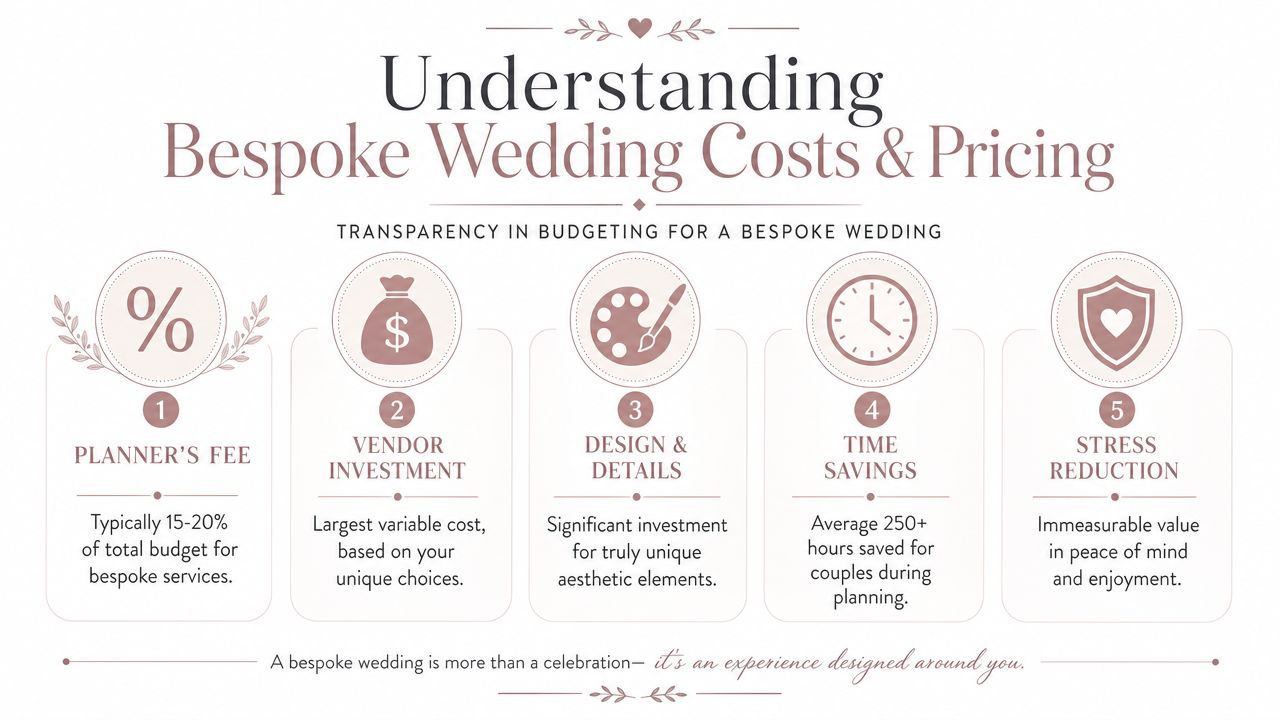
In the UK, the average cost of a bespoke wedding was £18,400 in 2023, with venue hire averaging £8,400, which is nearly 46% of the total budget. The same source notes that venue and catering together consistently account for over 40% of wedding expenditure, according to wedding cost and engagement statistics.
That matters because couples often start by focusing on décor upgrades, when the biggest financial decisions usually sit elsewhere. Venue choice, catering format, guest count and day of the week tend to shape the budget first. Everything else layers on top.
Where bespoke choices change the total
The phrase “bespoke upgrade” can cover wildly different things, which is why itemised pricing matters so much.
A custom menu may increase cost because of ingredients, staffing or service complexity. A midnight finish can affect staffing hours, transport planning and bar service. Large floral installations don't just involve flowers. They also involve build time, mechanics, delivery and removal.
A useful way to think about it is this:
| Cost area | Base spend | Bespoke factor |
|---|---|---|
| Venue hire | Secures the setting | Exclusive use, room access, timing extensions |
| Catering | Covers food and service | Custom menus, service style, late-night food |
| Styling | Creates the visual mood | Installations, candlelight, statement florals |
| Logistics | Keeps the day smooth | Extra coordination, setup windows, room changes |
The biggest surprise costs usually come from complexity, not from beauty.
Why transparency matters
Couples don't mind paying for something meaningful. They mind not understanding what they're paying for.
That's why transparent pricing is so valuable, especially at historic venues where split spaces, exclusive use and setup access can all affect the final figure. If you're comparing approaches, a guide to wedding planner costs helps frame what belongs in the planning fee and what sits outside it.
There's also a practical reason to keep things itemised. When you can see the cost of each choice, you can decide what matters most. Some couples would rather invest in food and photography. Others will happily scale back tablescape details to keep a longer drinks reception or a more dramatic ceremony setting.
How to budget without losing the magic
A bespoke wedding doesn't have to mean saying yes to every idea. It means spending deliberately.
If you want a sensible starting point, broader wedding budget saving tips can help you protect the parts guests will notice, while trimming the details that don't serve your priorities.
Try this order of decision-making:
- Protect the experience: Venue, food, drinks and coordination shape the day most.
- Choose your signature moments: Ceremony setting, tablescape, evening atmosphere.
- Price custom elements separately: This stops “bespoke” becoming one blurred line item.
- Leave room for practicalities: Historic venues often reward careful logistical planning.
When the numbers are clear, bespoke stops feeling extravagant and starts feeling intentional.
Your Fairy-Tale Wedding at Battle Abbey
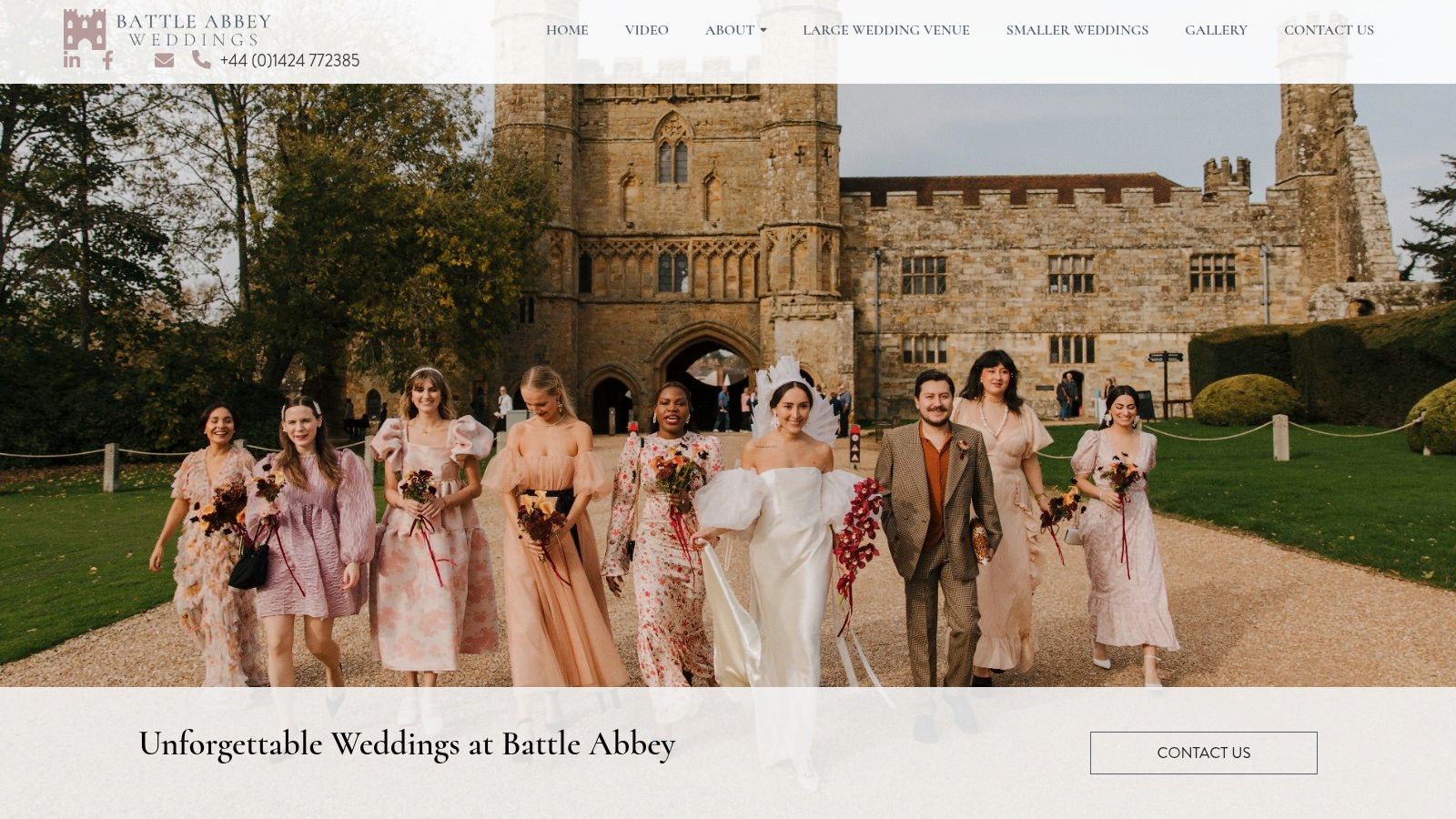
Historic venues ask a little more of a wedding day, but they also give more back. They offer atmosphere you can't manufacture. Stonework that holds light differently. Rooms with scale and texture. Outdoor spaces that already feel ceremonial before a single chair is set down.
That's why they suit bespoke weddings so well. The venue already has a story. The planning work lies in fitting your own into it gracefully.
Choosing the right level of exclusivity
At Battle Abbey, the shape of the day changes depending on guest count and how much of the site you need. For bespoke events, intimate celebrations are often capped at 60 guests to preserve service ratios, while full-site options for 75 to 250 guests require dedicated coordination, as noted in this guidance on wedding planning guest benchmarks.
That distinction matters.
A smaller wedding often works best when couples focus their spend on atmosphere, food and comfort rather than paying for more site capacity than they need. A larger celebration benefits from full-site coordination because multiple spaces, supplier timing and guest movement all become more complex.
How split-space weddings work well
The logistics of historic venues are often where couples hesitate. They worry that if the ceremony is in one place and the reception in another, the day will feel fragmented.
Done well, the opposite happens. The movement creates momentum.
At Battle Abbey, ceremonies take place in the Abbot's Hall, while wedding breakfasts can be held in the Duke's Library or the Dining Room/Bar. Reception drinks and canapés unfold on the Top Terrace or Six Penny Lawn, with the ruins and grounds doing a great deal of atmospheric work before the evening celebration even begins.
A strong planner thinks through details such as:
- How guests leave the ceremony space
- Where drinks are waiting
- When photographs happen without leaving guests stranded
- How the dining room reveal feels
- Whether evening guests enter through the same route or a separate one
Historic venues reward choreography. The best weddings there feel fluid because someone has already solved the transitions.
To get a feel for the setting itself, this look at what makes Battle Abbey the perfect historic wedding venue shows why the architecture and grounds lend themselves so naturally to a romantic wedding day.
The practical romance of the place
There's romance in the obvious details, of course. The ruins. The terraces. The sense of occasion that comes with a place of real age.
But there's also romance in practical generosity. Ceremonies and receptions can continue until midnight. In-house catering uses fresh, locally sourced East Sussex ingredients. Menus can move from a traditional three-course wedding breakfast to more relaxed evening options. Setup access the day before, subject to availability, makes styling and supplier coordination calmer.
A short film gives a better sense of the atmosphere in motion:
That combination is why historic exclusive-use weddings can feel so memorable. You get the beauty couples dream about, but also the structure needed to support a real event with real guests, changing spaces and a long list of moving parts.
Bespoke Wedding Stories Inspiration for Your Day
A couple once arrived with the same venue in mind and two completely different hopes for it. She wanted candlelight, black-tie elegance, and a dinner that felt like an old family celebration. He wanted guests outdoors as long as possible, generous food, and a party that built gradually rather than starting at full volume. What they needed was not a template. They needed the day shaped around how they wanted people to feel, and around what the venue could realistically support without wasted spend.
That is where bespoke planning becomes much clearer. It is not a prettier label for expensive styling. It is the work of deciding what matters, what can be simplified, and where the budget changes the guest experience at a historic venue.
The intimate autumn gathering
There are fifty-five guests, a close circle of family and friends, and the light outside has that soft amber tone autumn does so well.
The ceremony takes place in the Abbot's Hall, with flowers kept loose and seasonal rather than oversized. The room does not need much. Old stone, warm music, and well-placed candlelight already do half the work. After the vows, guests step out for drinks while the couple take portraits nearby, which keeps photography feeling part of the day rather than a long disappearance.
Dinner in the Duke's Library is where the planning shows. With a smaller guest list, the couple chose handwritten place cards, one long table, and a menu built around comfort and seasonality. They spent more on food and wine than on floral volume, because that was the part their guests would remember at close range. Speeches were spaced between courses so the room kept its warmth and no one felt they were waiting for the evening to begin.
This is often the point couples miss when they first hear the word bespoke. A smaller wedding is not automatically cheaper in every category. It can mean more room in the budget for better ingredients, upgraded table details, or a slower, more generous style of hosting.
The grand midsummer celebration
Another wedding at the same venue brought together one hundred and eighty guests, several generations of family, and friends travelling from abroad. The brief was not intimacy. It was momentum, clarity, and a sense of occasion from the first arrival to the last dance.
Guests gathered for the ceremony, then moved onto the terrace for drinks and canapés while photographs were taken in short, planned pockets. That timing mattered. At a historic venue with different spaces, guest movement needs careful handling or the romance can quickly give way to confusion, queues, and staff trying to redirect people on the spot. Good bespoke planning solves that discreetly, before the day begins.
Inside, dinner had a different rhythm from the autumn celebration. Longer tables, fuller florals, a more formal speech plan, and clearer zoned areas for older relatives, children, and evening arrivals. Later, the mood changed again. Extra guests joined, music lifted, and late-night food gave the celebration a more relaxed, sociable finish.
The bigger bill in a wedding like this rarely comes from one dramatic choice alone. It often comes from numbers, staffing, furniture, delivery access, setup time, and the extra coordination needed to make a large event feel calm instead of crowded.
Two weddings can share the same historic setting and ask completely different things of it.
That is why real bespoke planning starts with priorities, not trends. One couple may spend on a remarkable dinner and candlelit atmosphere. Another may put their budget into guest flow, extended entertainment, transport, and evening hospitality. Both can have a fairy-tale wedding. The difference is that the spending is intentional, the logistics are thought through, and the day feels unmistakably like theirs.
Common Questions and Your Next Steps
Even after the big decisions are made, a few practical questions usually remain. That's especially true with exclusive-use historic venues, because couples often want reassurance that multiple spaces will feel smooth rather than complicated. That concern is understandable in a market where 61% of UK couples want exclusive-use venues, as shown in this UK wedding venue report.
What's the difference between a wedding planner and a venue coordinator
A venue coordinator usually manages what the venue itself provides. A wedding planner oversees the wider event, including external suppliers, design decisions, timeline building and guest-flow strategy. On a bespoke wedding, those roles should complement each other.
How far in advance should we book
As early as you can comfortably make good decisions. Historic venues with exclusive-use appeal often get strong interest because couples want privacy, atmosphere and flexibility. If you already know the season or style you want, it's wise to enquire early.
How do split-space weddings avoid feeling disjointed
Through timing and clear direction. Guests need to know where they're going next, and each move should lead naturally into the following part of the day. Drinks ready on arrival, visible staff guidance and a well-timed photography plan all help.
Is bespoke planning only for very large budgets
No. Bespoke means customized, not necessarily lavish. A smaller guest list with focused priorities can feel far more bespoke than a larger wedding filled with expensive but disconnected choices.
If you're at the stage where you want real answers rather than more scrolling, the next step is simple. Ask for the details that make the day easier to picture: availability, hire options, what's included, and how the spaces work in practice.
If you're ready to explore a historic, exclusive-use celebration in East Sussex, Battle Abbey Weddings is a lovely place to start. You can browse the venue, request a brochure, check availability or arrange a private viewing and begin turning your ideas into a wedding day that feels beautifully your own.