You're probably in one of two moods right now. You're either planning a day out in Wiltshire and wondering whether Bradford on Avon Tithe Barn is worth the stop, or you're venue hunting and have reached the stage where hotels and blank conference suites feel a bit lifeless. In both cases, this barn tends to stop people in their tracks.
Step inside and the first thing you notice is the scale. The space doesn't behave like a cosy village hall or a prettified ruin. It feels purposeful, roomy, and old in the most convincing way. That's why it appeals to two very different groups at once. History lovers see a rare survivor from medieval England. Couples see drama, atmosphere, and a setting that doesn't need much dressing to feel memorable.
What often gets missed is that those two identities are connected. The same features that make the barn important historically also shape what it's like to visit and what it's like to hire for a wedding. If you enjoy exploring historical places in England, this is one of those sites where the story on the wall and the practical reality on the ground really do meet.
An Introduction to England's Finest Medieval Barn
Bradford on Avon Tithe Barn has presence before you know any dates at all. You walk towards a long stone structure, the roofline rises above you, and the building feels far larger than one might expect from the word “barn”. It doesn't read as rustic decoration. It reads as medieval infrastructure on a grand scale.
That matters because many visitors arrive with the wrong mental picture. They expect a quaint farm outbuilding. What they find is a monumental working structure from a world in which grain storage, rents, tithes, and estate management shaped daily life. The building's appeal comes from that honesty. Nothing about it feels invented for tourists.
For couples, that same honesty is often the draw. The barn gives you age, texture, and atmosphere without needing fake beams, faux candles, or a “rustic” theme. It already has character. The question isn't whether it's beautiful. The question is whether you're happy planning around a protected historic building rather than a modern all-in-one venue.
The barn rewards people who like places with a strong sense of purpose. It's beautiful because it was built to do a job, not because someone set out to make it picturesque.
The Story of a Medieval Giant
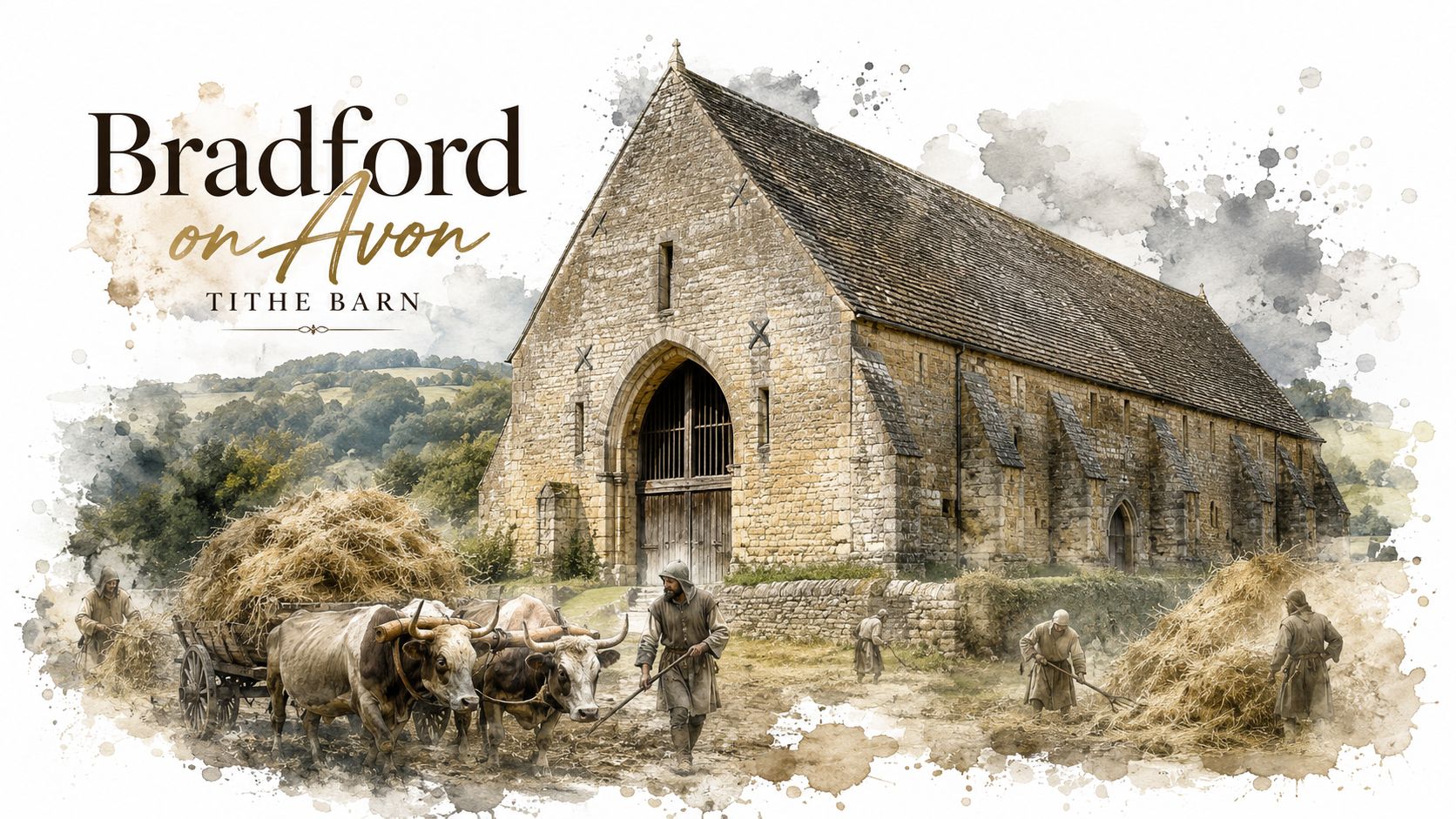
Bradford on Avon Tithe Barn belongs to the mid-14th century and is most commonly dated to around 1340. It measures about 168 by 33 feet (51 by 10 metres), and it was built to serve Barton Grange, a manor farm belonging to Shaftesbury Abbey in Dorset, which English Heritage describes as the richest nunnery in medieval England, according to English Heritage's history of Bradford on Avon Tithe Barn.
Why a barn this large existed
People sometimes assume a medieval building of this size must have been religious in the sense of worship, like a chapel or priory hall. It wasn't. Its importance is agricultural and economic. This was a specialist storage building connected to monastic landholding and the collection of produce.
That distinction helps the whole place make sense. The abbey's wealth didn't come from pretty architecture alone. It depended on estates, rents, and the careful handling of food production. A huge barn in Wiltshire tells you something direct about how organised that system was.
The abbey behind it
Shaftesbury Abbey was no minor institution tucked away on the edge of the kingdom. If English Heritage calls it the richest nunnery in medieval England, that gives you the right context for the barn's ambition. A structure on this scale reflects resources, planning, and confidence.
You can almost read the barn as a ledger in stone and timber. A modest estate gets a modest storehouse. A powerful monastic landowner creates something much larger because it needs a building that can handle serious agricultural throughput.
What happened after the monasteries
The barn didn't freeze in time when the medieval world changed. After the Dissolution of the Monasteries in 1539, ownership passed into private hands, and the building remained part of a working farm for centuries, as noted by English Heritage in the same history page. That long agricultural afterlife is one reason the place feels unusually grounded.
Historical clue: Buildings survive differently when people keep using them. A barn that continues to serve practical farming needs often retains a stronger sense of its original character than a building turned too quickly into ornament.
For visitors, that continuity is part of the charm. For wedding couples, it's also a quiet warning. You're not hiring a purpose-built events shell dressed in medieval style. You're working with a structure shaped by centuries of use, and that affects everything from layout choices to supplier access.
Understanding the Barn's Architectural Marvels
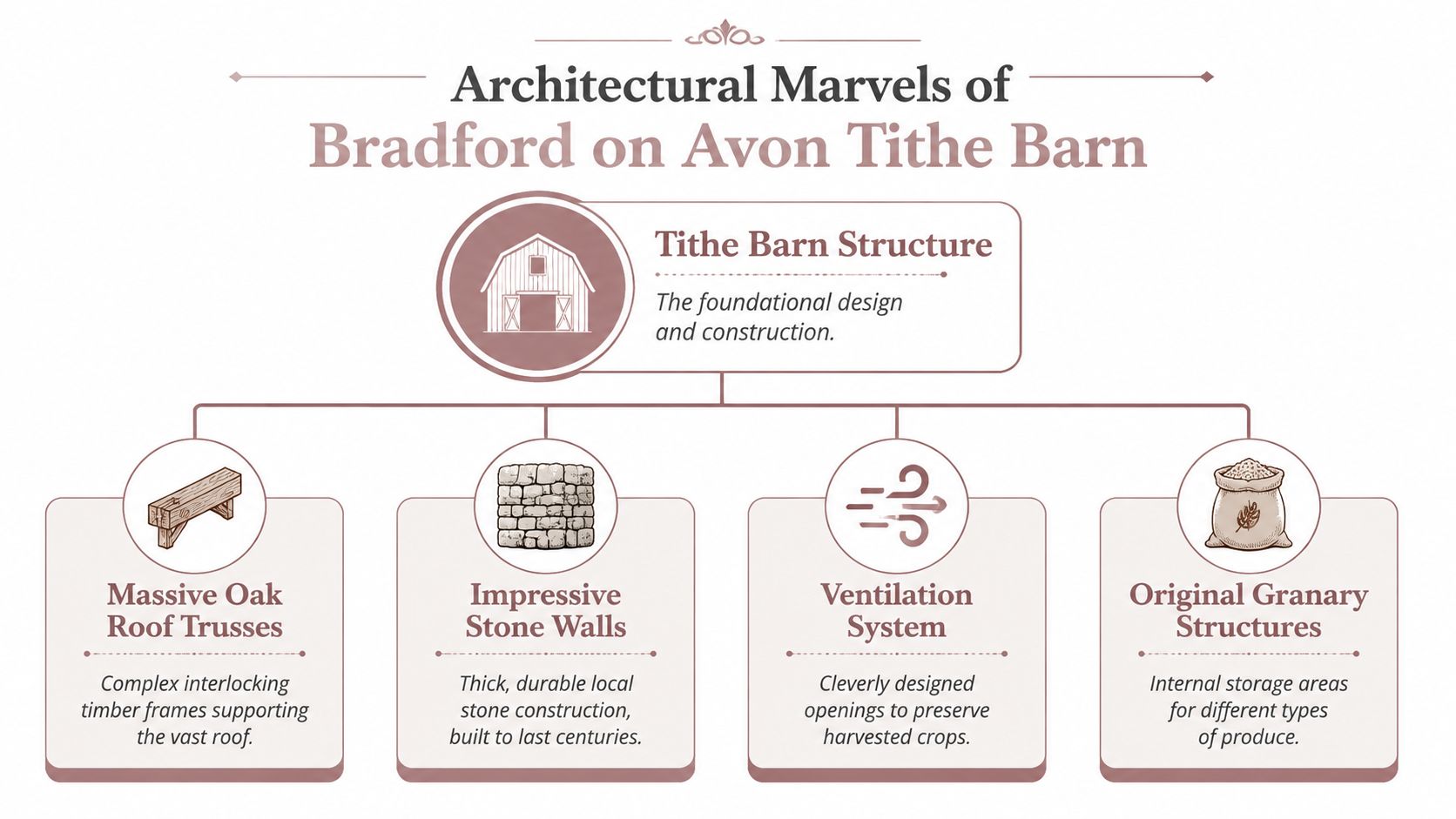
Step inside and the first surprise is not decoration but order. The barn feels grand because every part of it is doing a job. Medieval builders were solving a storage problem on a very large scale. They needed a weatherproof shell for valuable crops, enough height for volume and airflow, and a structure that could stand year after year in a wet English climate.
That practical purpose explains why the building has such presence. It was designed for work, yet the result is striking enough to feel ceremonial.
Read the building like a working machine
A medieval barn can seem simple at first glance. In reality, it works like a well-made piece of farm equipment, scaled up into architecture.
The long stone walls provide enclosure and weight. Buttresses strengthen those stretches of masonry so the walls can cope with the outward pressure and the sheer length of the building. Above, the roof structure spans a wide interior without chopping it into small rooms. That open floor area mattered for moving, sorting, and storing produce. Today, it is also the feature that makes the barn so attractive for gatherings.
If you have ever walked into a modern events venue that needed drapes, partitions, and lighting rigs to create atmosphere, this is the opposite experience. The barn already has shape, rhythm, and drama because its structure creates them naturally.
Why the roof matters so much
The roof is where many visitors stop, look up, and finally grasp the ambition of the place. Timber trusses carry the load across the interior and create that repeating pattern overhead which gives the barn its calm, almost processional feel.
For historians, those timbers are more than beautiful carpentry. Historic England records dendrochronological work on the barn, using tree-ring patterns to help date the wood and distinguish early fabric from later repairs in its tree-ring analysis report. For a general visitor, the takeaway is simple. Some of what you are admiring is not just old in a vague sense. It can be tied much more closely to the building's medieval life.
That difference matters in conservation. It matters in event planning too, because a building with important surviving fabric places real limits on how suppliers can attach, hang, light, or heat equipment.
The architecture creates both beauty and constraints
This is the point many heritage articles skip. The same features that make the barn memorable also shape what can happen inside it.
The height and stone surfaces create atmosphere, but they also affect acoustics. Speeches, live music, and recorded sound need careful setup or words can blur. The scale looks magnificent in photographs, yet a couple planning a wedding needs to think about how to stop a smaller guest list from feeling visually lost. Lighting can be magical, but it has to work with a large historic volume rather than flatten it into a generic party space.
A useful comparison comes from other heritage-day planning across southern England. Couples trying to combine architecture, travel timing, and guest experience often face similar practical questions on routes such as this London to Stonehenge day trip guide. The principle is the same here. A beautiful historic setting rewards planning that respects the building's character instead of treating it like a blank commercial hall.
What to notice when you visit, or before you book
Visitors often admire the barn as one impressive whole. Try breaking it into parts instead.
Look at the spacing of the structural bays. Notice how the buttresses set up a steady exterior rhythm, then compare that with the repeated timber pattern inside. Stand near one end and study how the length draws your eye forward. That sense of procession is one reason the barn suits ceremonies and long-table layouts so well.
For couples, these are not abstract architectural details. They affect where guests naturally gather, where a ceremony focal point will feel strongest, and how easily floristry, dining tables, or a dance floor can sit within the building without competing with it. The architecture gives you a ready-made backdrop, but it also asks for restraint. In a barn like this, the smartest styling choices usually frame the structure rather than trying to hide it.
A Practical Guide for Your Visit
A heritage visit goes smoothly when you treat it a bit differently from a modern visitor attraction. Bradford on Avon Tithe Barn is rewarding, but it isn't the kind of place where you should assume every convenience will sort itself out on arrival.
English Heritage notes a wheelchair-accessible ramp at the northwest door, but it also notes limited paid parking on site and says the barn may close for local events, which means checking ahead with the Preservation Trust is sensible, especially if accessibility or travel timing matters, according to the English Heritage visitor information for the barn.
What to plan before you go
The biggest mistake visitors make is treating the barn like a stand-alone attraction with simple in-and-out logistics. It sits within a living town setting, and that changes how you should prepare.
- Check opening arrangements: Event use can affect casual visiting.
- Confirm parking expectations: Limited paid parking means you shouldn't rely on an easy space right beside the building.
- Think about mobility early: Ramp access helps, but the wider visit may still need planning.
- Allow time around the visit: Heritage sites in town locations work better when you're not rushing.
If you're travelling from farther afield, it can help to fold the barn into a broader Wiltshire day rather than making it your only stop. People often combine heritage visits in this part of the country with longer scenic routes, much like those planning a trip from London to Stonehenge and beyond.
A useful way to think about accessibility
Accessible entrance points and easy overall logistics aren't always the same thing. That's especially true at older sites managed with conservation priorities in mind.
A good rule is to ask two separate questions before you travel:
| Question | Why it matters |
|---|---|
| Can I enter the barn comfortably? | The ramp addresses this at the northwest door. |
| Can I manage the whole visit comfortably? | Parking, timing, nearby surfaces, and event closures can affect that. |
That's not a criticism of the site. It's just the reality of historic places. The more specific your needs, the more worth there is in checking details before the day itself.
Best expectations for a first visit
Go for atmosphere rather than a packed programme. This isn't a museum crammed with displays. It's a place where scale, fabric, and context do the work. If you like architecture, medieval economy, or subtly dramatic interiors, you'll likely enjoy it most by slowing down and letting the building speak for itself.
Hosting Weddings and Events at the Tithe Barn
A couple arrives for their first viewing and falls silent for a moment. The height of the roof, the long run of timber, and the weight of the stone do the first job that any wedding venue must do. They create feeling. Then the practical questions begin. Where do guests enter? How will the room be lit after dark? What can suppliers bring in, and what must stay outside? Bradford on Avon Tithe Barn is at its best when you appreciate both sides of it at once. It is a magnificent medieval building and a working event space with heritage rules.
The barn's real appeal is that the architecture carries much of the atmosphere for you. In a hotel ballroom, couples often spend money trying to add character. Here, character is already built into the room. The timber roof works like a vaulted canopy over the day, and the long interior naturally draws the eye forward, which helps ceremonies, feasting tables, and photographs feel more dramatic without excessive styling.
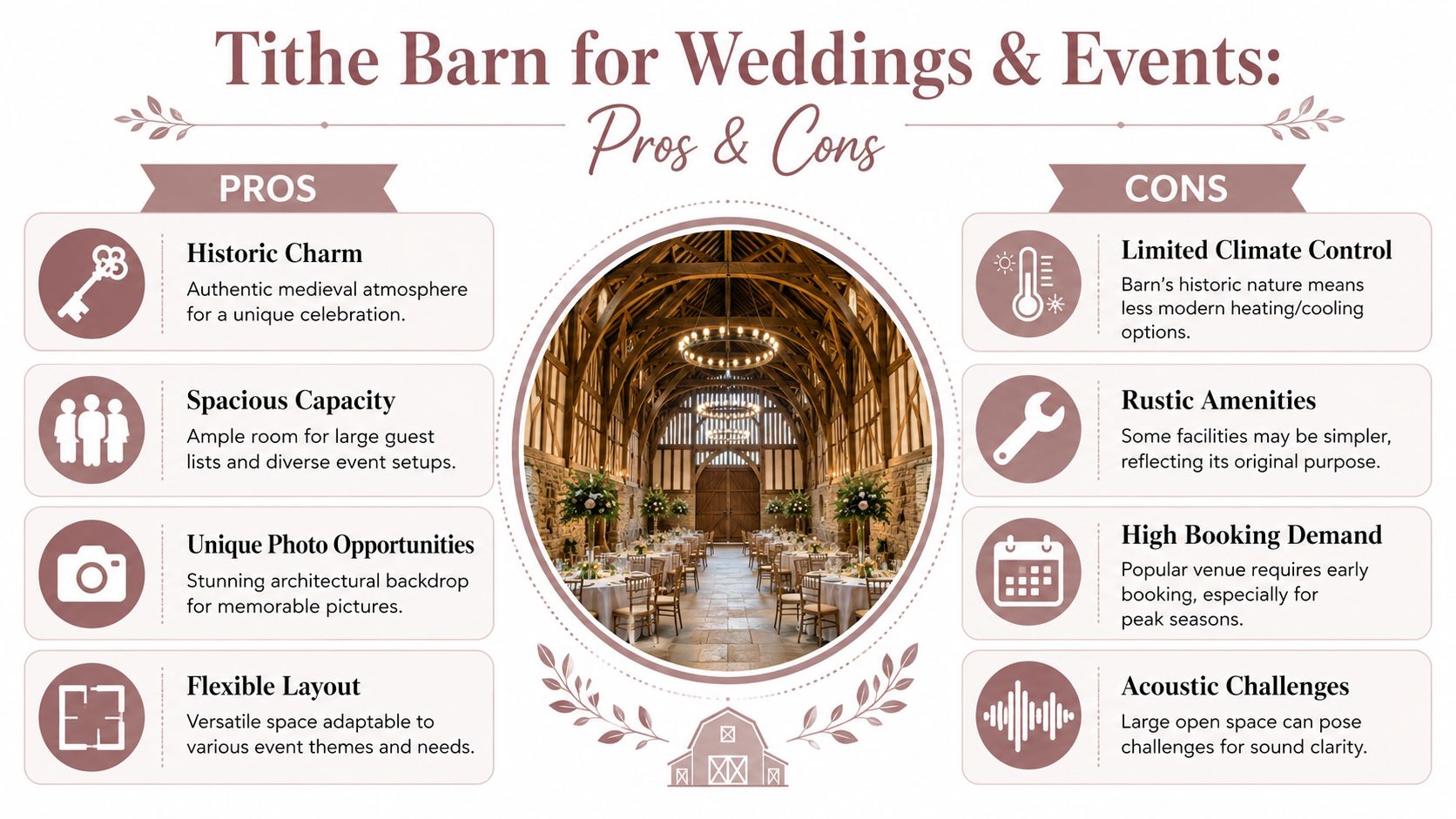
That visual strength brings a clear budgeting lesson. Couples often get better results here by editing rather than adding. A heritage barn can look overwhelmed if every surface is treated as empty space. The more sensible approach is to let the building lead and use decor to support it. If you want ideas that fit that mindset, these budget-friendly wedding decor tips are useful, especially the advice on using the architecture as part of the design.
What does the space do especially well?
- Creates a memorable ceremony setting. The scale gives entrances and vows a sense of occasion.
- Photographs beautifully. Old stone, weathered timber, and natural texture do not need much enhancement.
- Allows flexible layouts. Long tables, banquet-style dining, or a more open reception plan can all make sense, depending on the event.
- Rewards restrained styling. Flowers, candles where permitted, and careful lighting often achieve more than large decorative installations.
That said, historic romance can hide practical friction.
A medieval barn is not a blank room in the modern venue sense. It is closer to borrowing a treasured old house from a careful custodian. You can celebrate in it, but you must respect how it is built and what it can safely accommodate. Couples sometimes discover this late, after they have fallen in love with a Pinterest idea that depends on fixing items to walls, suspending heavy decor, or flooding the room with production equipment.
The common pressure points are usually these:
- Conservation limits. Do not assume you can pin, hang, tape, or attach decor wherever you like.
- Comfort across the day. Large historic interiors can feel cooler, airier, or more changeable than newer venues.
- Load-in and load-out timing. Suppliers may need a tighter, more carefully managed setup plan than they would at a purpose-built event site.
- Acoustics. Music and speeches need thought in a long, high space, particularly if you want words to carry clearly.
This is why experienced couples ask operational questions early, not after paying a deposit. A good starting point is a checklist of questions to ask a wedding venue before booking, then adapt those questions to a protected historic building. The answers matter more here because heritage venues can look simple in photographs while being more demanding in practice.
In planning terms, the barn suits couples who like shaping a day rather than selecting a package. If you enjoy choosing suppliers, making design decisions, and accepting a few restrictions in exchange for authenticity, it can be a rewarding venue. If you want one in-house team to handle catering, styling, timings, and room turnarounds with minimal involvement from you, another heritage model may fit better. Battle Abbey Weddings is one example of that more managed approach, where ceremony and reception planning are handled with stronger in-house support.
A simple test helps. Ask whether you want the building itself to be one of the main hosts of the day. At Bradford on Avon Tithe Barn, it will be. That is the gift of the place, and also the planning challenge. Couples who understand both usually get the best from it.
The Booking Process and Planning Logistics
The most sensible way to approach booking is to assume nothing and ask clear questions early. Historic venues often look simple online because the photographs do the talking. Real planning starts when you get into timings, access, supplier rules, and what's included.
Because the barn may close for events and visitors are directed to check with the Preservation Trust in advance, your first step should be a direct enquiry rather than reliance on assumptions from third-party listings. That's especially important if you're comparing it with hotels, estates, or purpose-built venues that publish more standardised hire details.
A practical booking sequence
I'd approach it in this order:
- Check availability for your preferred timeframe and ask what kind of event use is permitted.
- Ask what's included in the hire. Tables, chairs, power arrangements, access times, staffing, and cleaning can change the true shape of your budget.
- Clarify supplier policy before you book specialist caterers, florists, musicians, or production teams.
- Request setup and breakdown details in writing so your planner and suppliers can schedule properly.
- Confirm restrictions on candles, hanging installations, sound equipment, and floor protection.
Couples who haven't planned a heritage event before often benefit from reading a broader strategic event guide for professionals. Not because a wedding should feel corporate, but because the discipline of event planning helps when a venue has unusual operational constraints.
Questions worth asking the trust
The strongest enquiries are specific. Instead of “How does it work?”, ask targeted questions such as:
- What access times are available on the day itself?
- Can suppliers visit in advance for site checks?
- What decoration methods are permitted inside the barn?
- Are there noise or finish-time rules that affect music and speeches?
- How are deliveries and collection handled around the site?
- What happens if public visiting or local activity overlaps with setup timing?
A good planning framework is to use a venue-question checklist and tailor it to heritage use. This guide to questions to ask a wedding venue is a useful starting point for building that list.
Get practical answers before you fall in love with a mood board. Heritage venues reward careful organisers and frustrate vague ones.
What to pin down before paying a deposit
Before any commitment, make sure you understand who is responsible for each operational area. That includes setup supervision, supplier liaison, end-of-night clearance, and any conservation-related instructions. The less ambiguity you leave at booking stage, the calmer the planning period tends to be.
Frequently Asked Questions
Is Bradford on Avon Tithe Barn good for photography
Yes, especially if you like texture, depth, and natural character. The strongest images usually make use of the long interior lines, the stone walls, and the contrast between the large volume of the barn and the people within it. For weddings, the building works best when the photographer treats it as architecture first and backdrop second.
Is it easy for older guests or visitors with mobility needs
It can be, but it needs forethought. As noted earlier, there's an accessible ramp at the northwest door, but parking and overall logistics may need advance checking. If you're organising a wedding, don't limit accessibility planning to the entrance alone. Think through arrival, waiting time, seating comfort, and departure.
Should couples choose it if they want a simple planning process
Only if “simple” means visually simple, not logistically simple. The barn can reduce the need for heavy decor because the building is already striking, but heritage venues usually ask more of you in planning and coordination.
Are there places for guests to stay nearby
Yes, Bradford on Avon is the sort of town where people usually pair a venue visit or event with nearby accommodation options in town or the surrounding area. The best approach is to build a small guest guide with a mix of local choices rather than assuming everyone will stay in one place.
What if we love history but want more support from the venue team
That's a sensible thought, not a compromise. Some couples love historic buildings but realise they'd rather have more in-house structure, especially for catering, guest flow, and setup management. In that case, look at heritage venues with a stronger hosted-events model rather than a more independent barn hire.

Bradford on Avon Tithe Barn stays in people's minds because it doesn't feel staged. It feels earned. That's why it works so well both as a place to visit and, for the right couple, as a place to celebrate.
If you're comparing heritage venues and want a setting with historic atmosphere plus a more structured wedding format, Battle Abbey Weddings is worth a look. It offers a licensed historic venue in East Sussex for ceremonies and receptions, which can be useful for couples who love old buildings but want more built-in event support.